
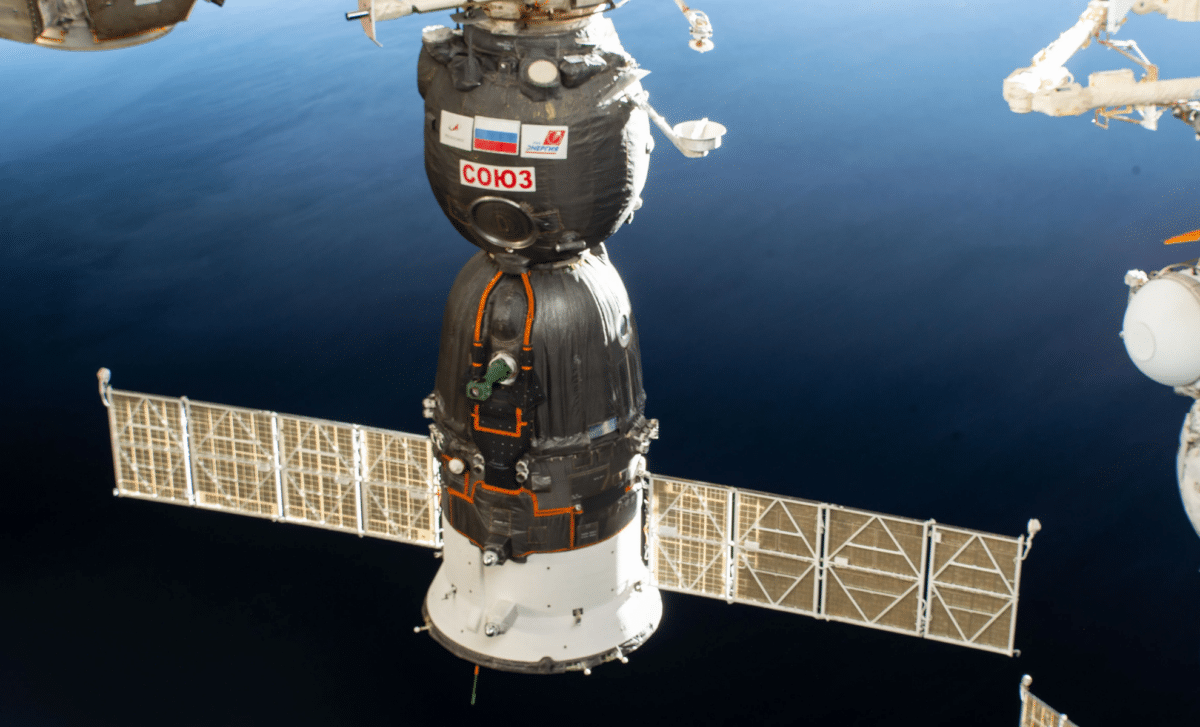
NASA astronaut Chris Williams and his fellow crew members are gearing up to depart the International Space Station after an extensive 241-day mission orbiting Earth, reports NASA. They will return aboard the Soyuz MS-28 capsule, completing over eight months of scientific research and station operations in low Earth orbit.
Joining Williams on this journey back to Earth are Roscosmos cosmonauts Sergey Kud-Sverchkov and Sergei Mikaev. Their spacecraft is planned to detach from the station’s Rassvet module at 3:02 a.m. EDT on Sunday, July 26, initiating a parachute-assisted descent to a landing site in Kazakhstan.
Soyuz MS-28 Embarks on Return Trip from Orbit to Kazakhstan
The Soyuz MS-28 capsule will transport all three astronauts away from the International Space Station, reentering Earth's atmosphere for a controlled descent toward its designated landing area southeast of Dzhezkazgan, Kazakhstan, according to NASA.

The capsule is expected to touchdown at 6:26 a.m. EDT, corresponding to 3:26 p.m. local time. The landing sequence involves a precise series of maneuvers, including separation from orbit, atmospheric reentry, and parachute deployment, ensuring the crew’s safe return after months in weightlessness.
NASA’s live broadcast will cover every step of the final mission stages, from farewell rituals and hatch closure to undocking, deorbit maneuvers, and touchdown. Viewers worldwide can follow the event across NASA’s official channels.
After spending 241 days aboard the @Space_Station, @Astro_ChrisW is returning to Earth on July 26. Here's where to watch as Williams concludes his first-ever space mission: https://t.co/Xv2TTppIzL pic.twitter.com/wrqDaF8GTo
— NASA (@NASA) July 22, 2026
Covering Over 102 Million Miles and 3,856 Earth Orbits
Throughout their mission, Chris Williams, Sergey Kud-Sverchkov, and Sergei Mikaev orbited Earth 3,856 times, amassing over 102 million miles traveled before their homecoming. This mission marked the inaugural spaceflight for Williams and Mikaev, while Kud-Sverchkov participated in his second orbital expedition.
This extensive mission highlights the challenges of long-term spaceflight, demanding astronauts adapt to microgravity conditions while managing station maintenance and scientific experiments. Each mission on the International Space Station generates critical data essential for future crewed space exploration, improving spacecraft technology, human health protocols, and operational strategies.
Upon landing, recovery teams will assist the crew, who will then be airlifted via helicopter to Karaganda, Kazakhstan, the center for post-landing operations. Williams will return to NASA’s Johnson Space Center in Houston, whereas Kud-Sverchkov and Mikaev will head back to their training hub in Star City, Russia.
International Space Station: A Cornerstone in Space Exploration Research
The crew’s return coincides with the ongoing role of the International Space Station as a premier orbital laboratory driving scientific discovery. Since the advent of continuous human presence onboard more than twenty years ago, astronauts and cosmonauts have carried out experiments impossible to perform under Earth’s gravitational conditions.
This research fuels breakthroughs in biology, materials science, technology innovation, and astronaut health. Findings derived from space station experiments also support NASA’s ambitions for lunar missions through the Artemis program and eventual Mars expeditions.
The ISS remains vital for testing hardware and procedures essential for extended missions beyond low Earth orbit, with each crew’s experience enriching humanity’s grasp of sustaining life and operations in deep space.
NASA’s Live Broadcast to Highlight Final Moments Before Return
NASA’s coverage will kick off with pivotal mission milestones leading up to the crew’s departure. On Saturday, July 25, the Expedition 74/75 change of command ceremony will be broadcast beginning at 9:40 a.m. EDT, during which Kud-Sverchkov will hand over control of the station to NASA astronaut Jessica Meir.
Later that night, live reporting will cover crew farewells and hatch closure beginning at 11:10 p.m., with hatch sealing scheduled for 11:30 p.m. Early Sunday morning, undocking coverage starts at 2:30 a.m., with the spacecraft undocking by 3:02 a.m.
Broadcast of the deorbit phase will begin at 5:15 a.m., featuring the deorbit burn at 5:32 a.m., culminating with the expected landing at 6:26 a.m.
The conclusion of this mission adds another significant milestone in human presence in orbit and furthers the international collaboration toward the next frontier in space travel.
- Categories:
- Nasa




0 comments
Sign in to Comment