
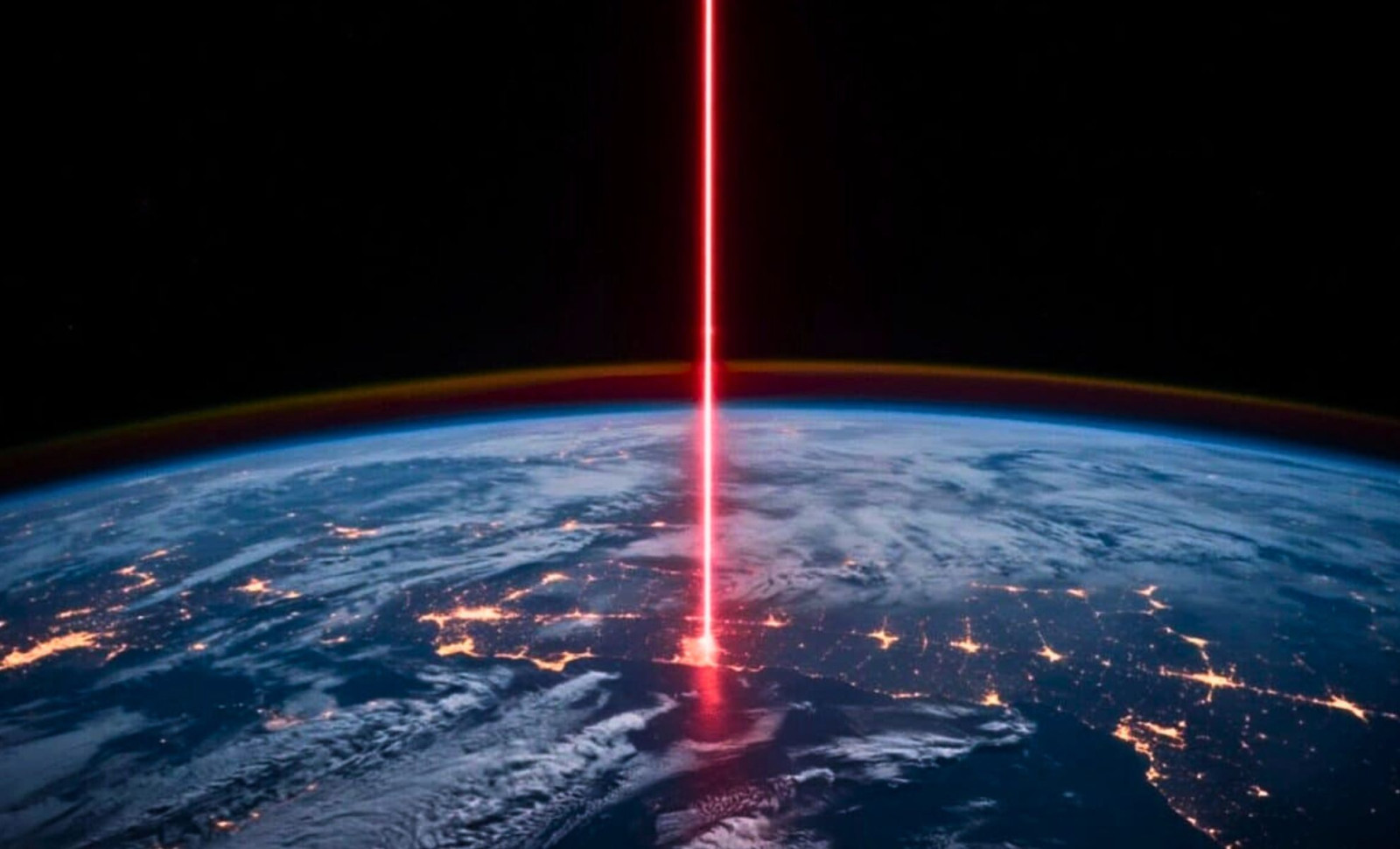
Data collected by the MeerKAT radio telescope revealed a narrow, persistently strong signal that defied expectations related to cosmic distance. This distinct line appeared within a commonly studied radio frequency range, yet the signal originated so far away that it should have dispersed into the cosmic background. Remarkably, it stayed concentrated and measurable, suggesting an external factor was amplifying the emission.
The source, listed under the designation HATLAS J142935.3–002836, was previously recognized as a warped and stretched galaxy system, the kind typically shaped by gravitational effects. A feature in Live Science dubbed it a “mega-laser,” but the real puzzle was why this emission line remained so distinct across such a vast distance.
Upon calculating its distance, researchers found the system corresponds to a redshift of z = 1.027, translating to more than 8 billion light-years away in terms of light-travel time. This means the radio waves began their journey when the universe was significantly younger than today. Thus, the MeerKAT radio telescope captured a signal emitted long before Earth even formed.

The Signature of an 18-Centimeter Signal
The defining characteristic was the wavelength, approximately 18 centimeters. This radio wavelength is famously associated with the presence of the hydroxyl molecule (OH), a simple molecule made of oxygen and hydrogen, often found in extensive gas clouds. Under specific environmental conditions, hydroxyl molecules can act as natural amplifiers, boosting radiation emitted at this precise frequency.
This radio amplification works similarly to lasers but at longer wavelengths and is termed a maser (microwave amplification by stimulated emission of radiation). When powerful enough to be detected in distant galaxies, these are called hydroxyl megamasers. The team asserts that this signal’s intensity is so great that it qualifies as a newly proposed category labeled a gigamaser.
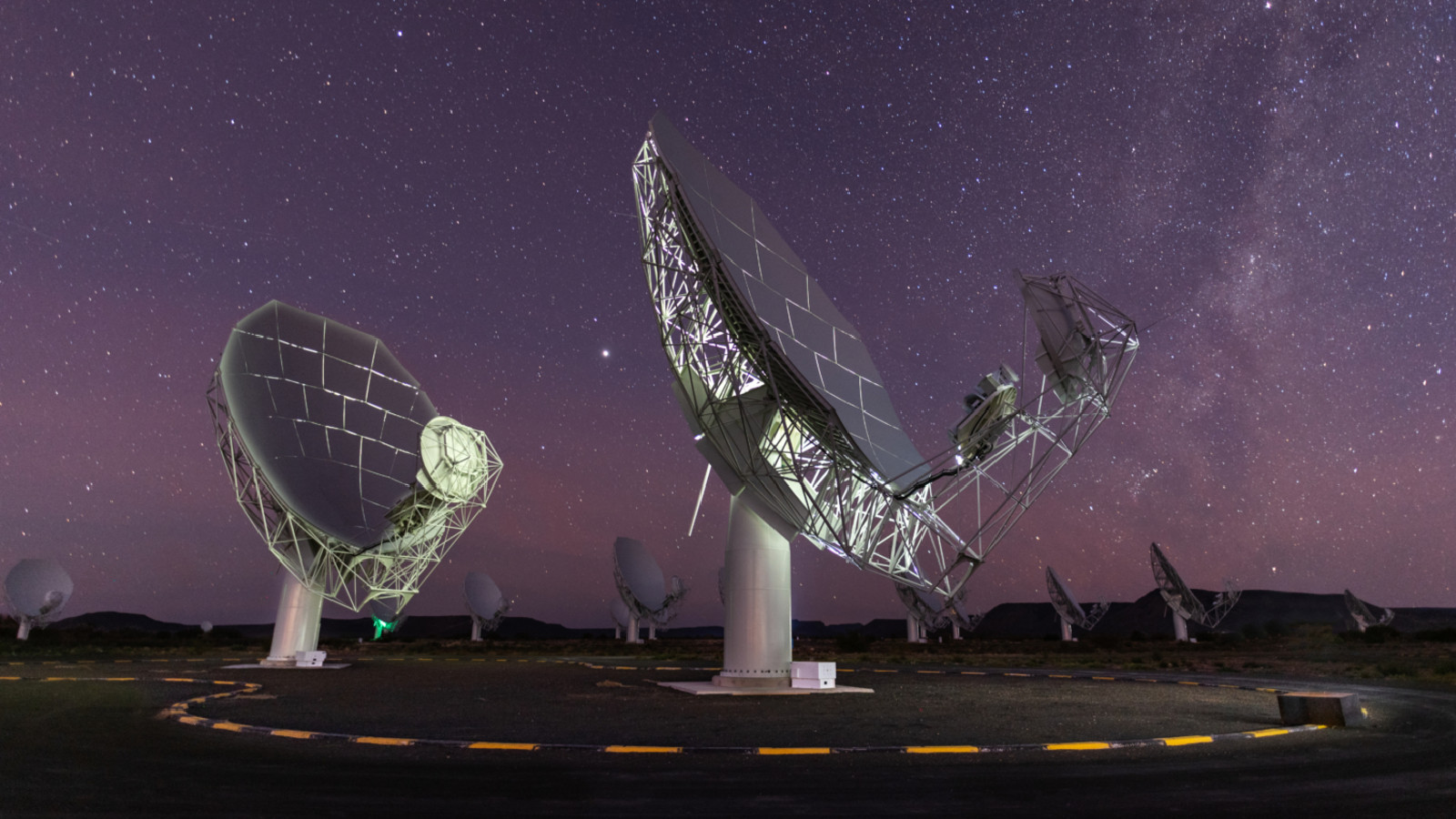
The research, shared on arXiv, outlines emissions detected at the hydroxyl lines near 1667 MHz and 1665 MHz, frequencies traditionally used to identify such signals. What distinguished this observation was not just these lines’ presence but their intense strength at such an immense distance, setting it apart from prior hydroxyl surveys.
Galaxy Collision Fuels the Intense Signal
This galaxy system is identified as undergoing a violent merger. This classification is significant because hydroxyl megamasers tend to be brightest where galaxies collide, leading to dense turbulent gas clouds. Such collisions compress gas, generate turbulence, and form dust-rich regions where molecules accumulate. These conditions “pump” hydroxyl molecules into energetic states that amplify radio frequencies.
“This system is truly extraordinary,” stated Dr. Thato Manamela from the University of Pretoria. “What we’re observing is essentially the radio counterpart of a laser emitted halfway across the cosmos.” Though this description is dramatic, the underlying mechanism is straightforward: galaxy mergers create dense energetic environments enabling hydroxyl molecules to amplify specific radio wavelengths.
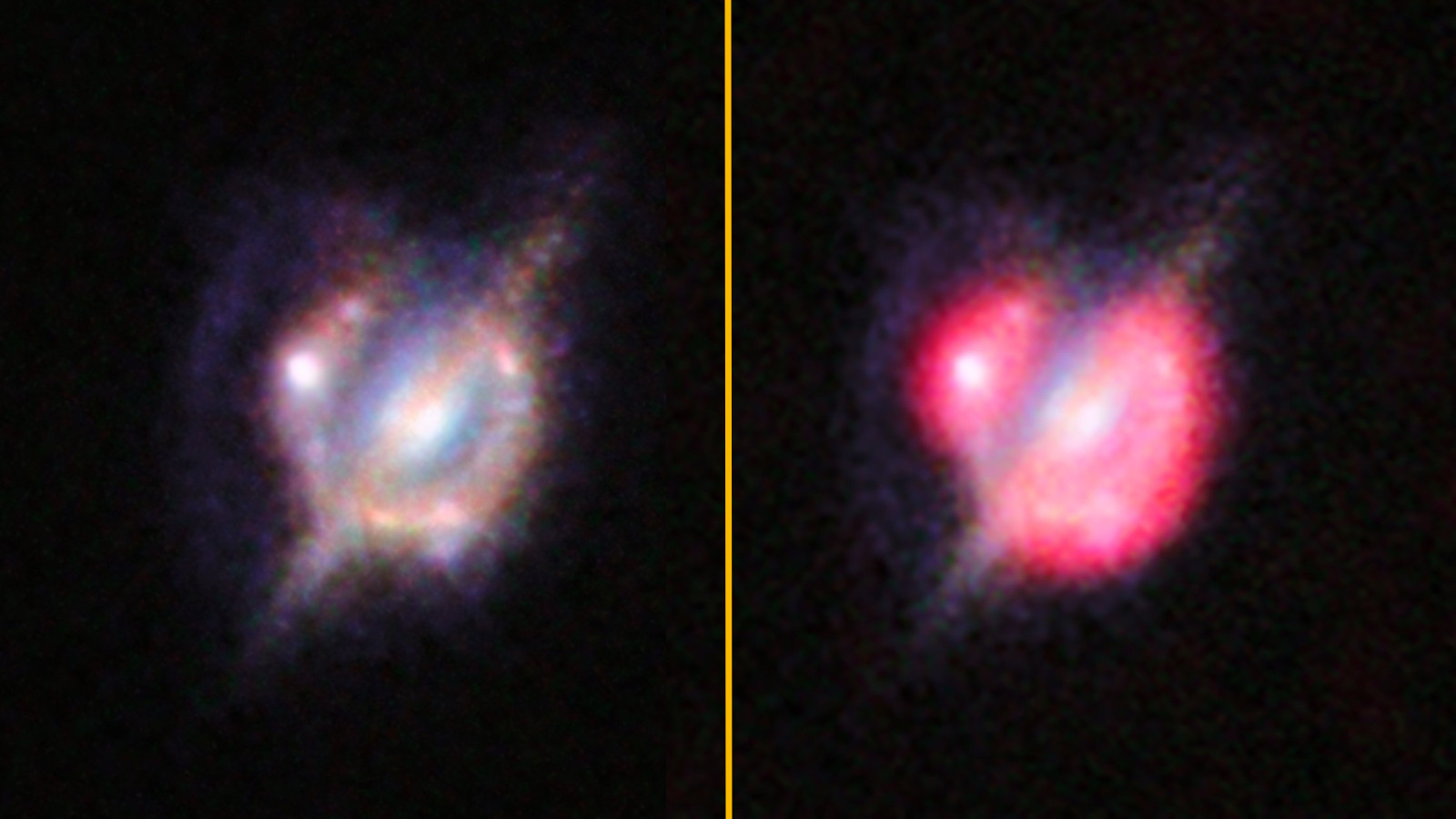
Researchers at the South African Radio Astronomy Observatory also note signs of intense star-forming activity in the galaxy merger. Previous investigations suggest a rapid star formation rate consistent with a merger rapidly transforming gas into new stars. This intense starburst provides a further explanation for the hydroxyl signal’s high brightness, even before any magnification effects are accounted for.
Gravity from a Foreground Galaxy Amplifies the Signal
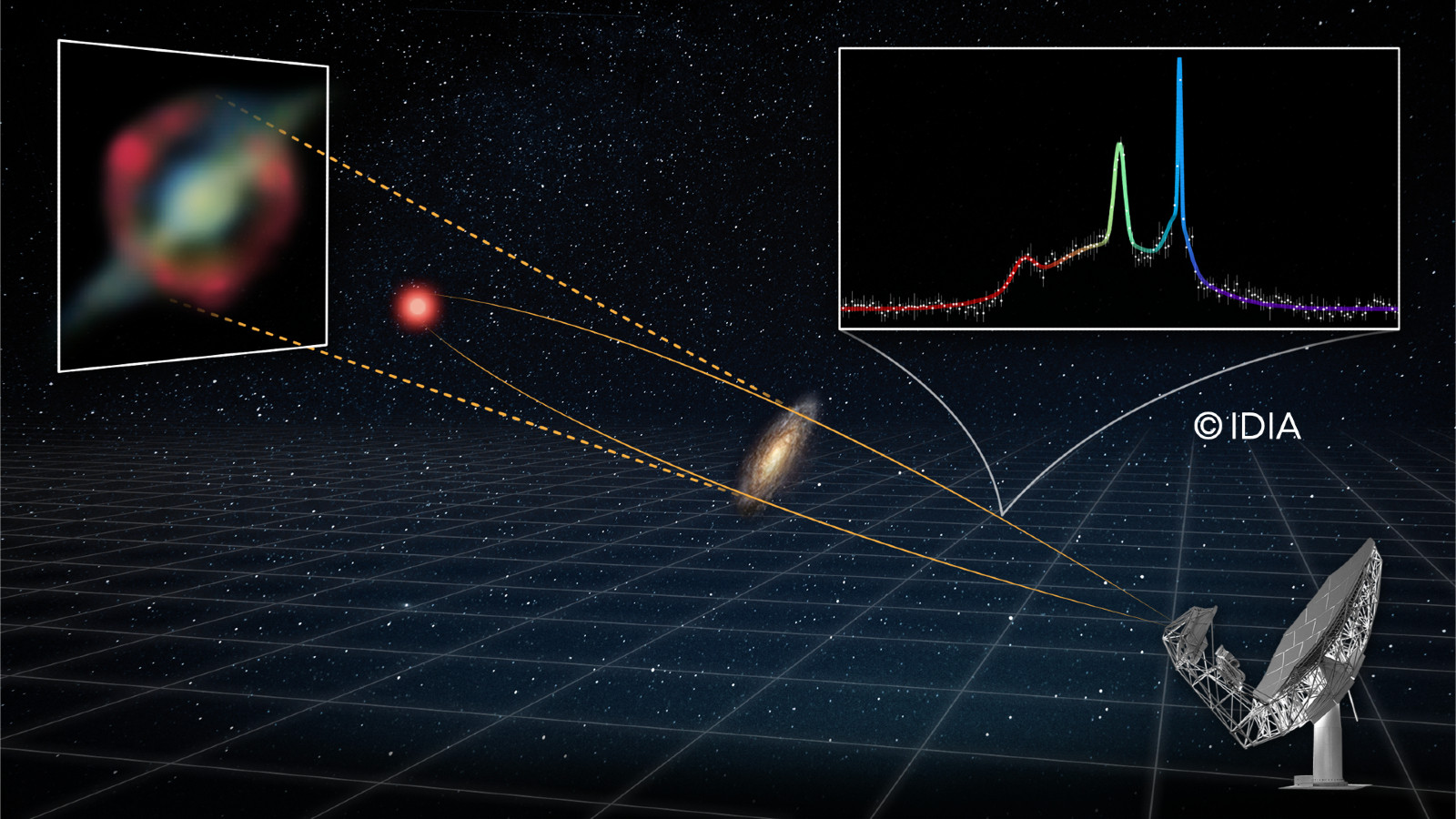
Distance does not fully account for the signal’s impressive brightness. Between Earth and the merging galaxies lies an unrelated foreground galaxy that aligns almost perfectly with the distant system. Its gravitational field distorts space-time and acts as a lens, amplifying the background radio emission reaching Earth.
This phenomenon, known as strong gravitational lensing, does not produce new radiation but acts like a cosmic magnifier that redirects more photons our way. This explains the observed distortions in images and the unusually strong radio intensity. Universe Today has described the intervening galaxy as a “cosmic telescope,” a fitting analogy for gravitational lensing.
Because gravitational lensing boosts apparent brightness, the researchers clarify that the term “brightest” refers to the observed luminosity, not the intrinsic emission without lensing. The gigamaser designation is based on this apparent power, combining the extreme conditions in the distant galaxy with a fortunate cosmic alignment in the foreground.
MeerKAT’s Findings and Implications for Future Research
Interestingly, confirming this discovery required only a few hours of observation using the array of dishes comprising the MeerKAT radio telescope. The brevity of the observing session highlights the detection as a demonstration of this instrument's capabilities, rather than a singular anomaly. It suggests that broad surveys using such telescopes could uncover additional remote hydroxyl-emitting systems, provided they observe at the right frequencies.
Moreover, the same observation also revealed a separate absorption signature from neutral hydrogen (H I), a common indicator of diffuse gas clouds. This finding implies the galaxy merger hosts multiple gas layers beyond the hydroxyl-emitting molecules. Together, these observations contribute to a richer understanding of gas-rich galaxy collisions during this epoch of the universe.
- Categories:
- Science












0 comments
Sign in to Comment