
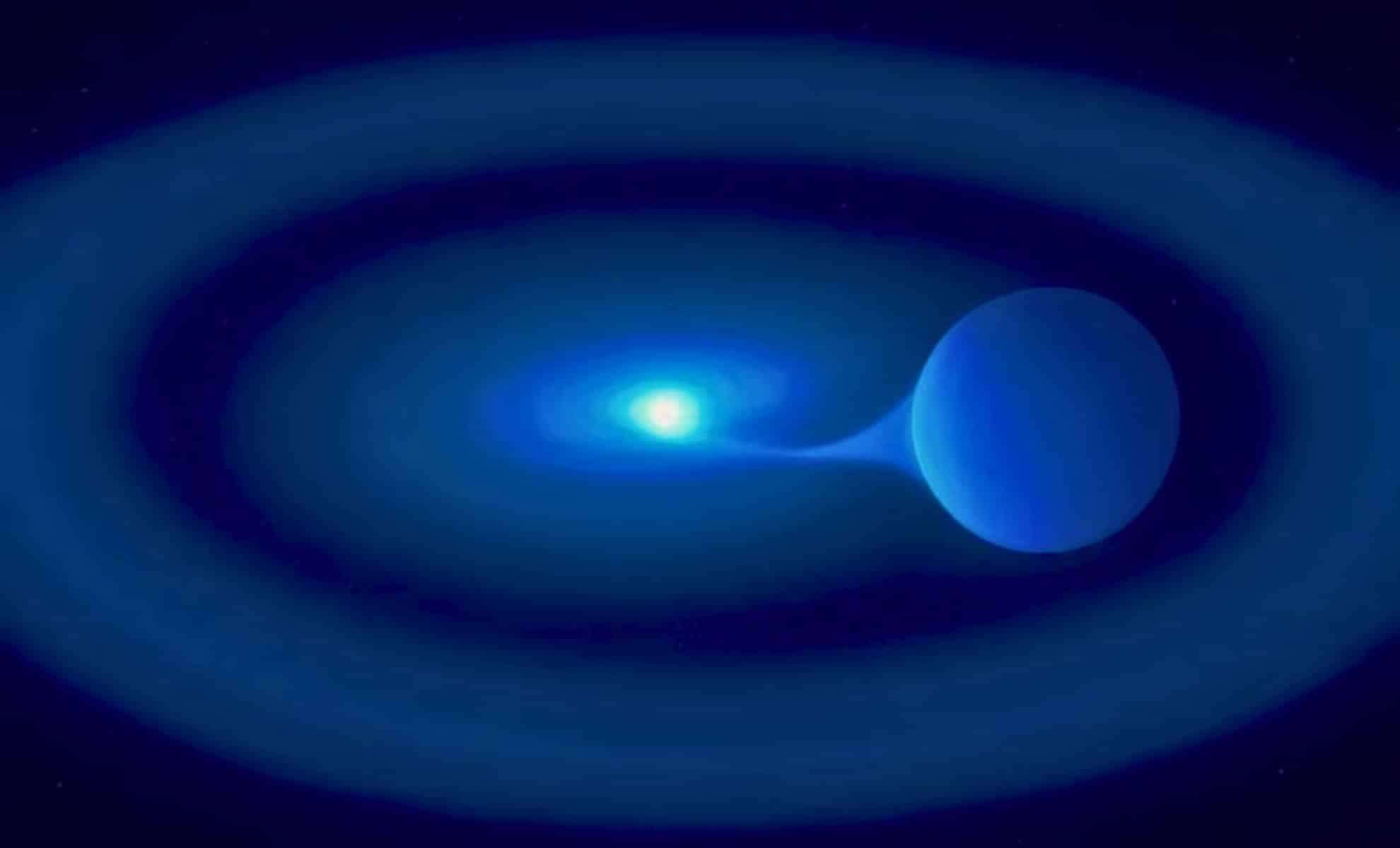
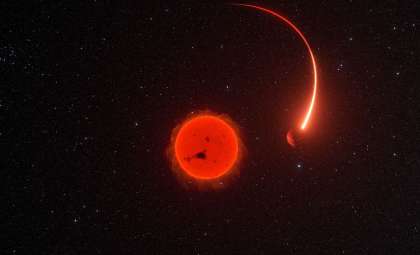
A white dwarf star entwined with a close companion is currently experiencing one of the most intense episodes of stellar cannibalism ever documented. A recent paper in the Monthly Notices of the Royal Astronomical Society reveals that the binary system V Sagittae, situated approximately 10,000 light-years away, is accreting material so rapidly that it may soon trigger a luminous nova eruption visible from Earth without telescopic aid.
A Peculiar Stellar Duo Radiating Puzzlingly Bright Light
Since its initial identification in 1902, the star system V Sagittae has stood out for its unusual brightness compared to similar systems. Thanks to observations from the European Southern Observatory’s Very Large Telescope in Chile, scientists have gained fresh insights. At its core lies a densely packed white dwarf that is siphoning hydrogen-rich gas at a prodigious pace from its companion star.
Unlike typical white dwarfs which gradually fade, this stellar remnant has transformed into a nuclear-powered lighthouse. The accreted gas heats to temperatures sufficient to initiate thermonuclear fusion, rendering the white dwarf extraordinarily bright. Professor Phil Charles from Hampshire University remarked, “The intense luminosity arises because the white dwarf is forcefully extracting material from its partner,” describing the phenomenon as “an intense cosmic blaze.”

A Surrounding Halo Indicates Turbulence Ahead
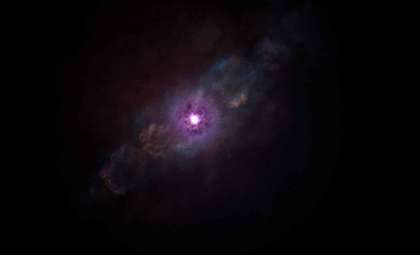
The research team identified an additional phenomenon: a luminous gas envelope encircling the stellar pair, forming a circumbinary halo created from material the white dwarf is unable to assimilate. Lead author Dr. Pasi Hakala from the University of Turku explained, “The white dwarf cannot ingest the entire mass flowing from its heated companion, resulting in this brilliant gaseous ring.”
This halo is not merely an aesthetic feature but a warning. The mass transfer is so powerful that the system’s orbital dynamics are increasingly erratic. Astronomers characterize V Sagittae’s behavior as “chaotic,” signaling it is approaching a critical transition. This unstable, glowing halo serves as a vivid clue that the system may soon experience a dramatic upheaval.
A Nova and Possibly Even a More Cataclysmic Event Imminent
Should the intense feeding continue, V Sagittae is expected to erupt in a nova explosion. This brief yet brilliant outburst is produced when accumulated hydrogen ignites explosively on the white dwarf’s surface. Though the star survives, its luminosity could surge enough to become visible unaided from Earth.
On longer timescales, astronomers monitor the potential for a far grander finale. If the white dwarf’s mass continues to increase or the two stars ultimately coalesce, the system might trigger a Type Ia supernova—a catastrophic blast bright enough to outshine the daytime sky. While this outcome may be hundreds of years distant, the current pace of material transfer and the circumstellar ring suggest it is a scenario worthy of serious consideration.
This Rapidly Evolving System Offers a Rare Glimpse Into Stellar Death
Unlike most binary systems that evolve over thousands of years, changes in V Sagittae unfold swiftly enough to observe within a human lifespan. Dr. Pablo Rodriguez-Gil from the Instituto de Astrofísica de Canarias emphasized, “The pace of this doomed duo’s erratic behavior is a frantic signal of a near and violent finale.”
Beyond explaining V Sagittae’s exceptional brightness, this research provides a unique window into how binary stars behave under extreme mass exchange conditions. It presents an unprecedented chance to witness the birth of a potential nova and gain insight into the processes driving some white dwarfs to cross the threshold leading to full-scale supernova explosions.
- Categories:
- News



0 comments
Sign in to Comment