

Researchers have identified four white dwarfs that had remained undetected within close binary star systems, demonstrating that our immediate cosmic vicinity is not as thoroughly charted as previously assumed. Detailed in a study published in MNRAS, this breakthrough adds four elusive stellar remnants to the local star catalogue and hints at the possibility that many more such stars lurk unnoticed around common neighbors.
Uncovering Concealed Stellar Partners
Although astronomers have meticulously mapped the stars nearest to the Sun over many years, uncovering what was considered a near-complete inventory of nearby stars in the Milky Way, these four white dwarfs avoided detection by orbiting brighter red dwarfs. The overwhelming brightness of their companions masked the faint light emitted by the compact remnants, causing these systems to appear as single-star entities when observed from Earth.
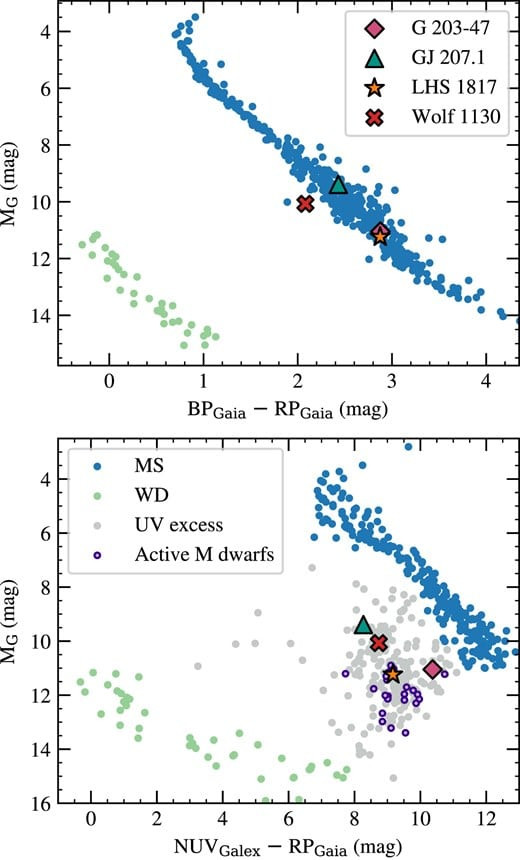
The key to this discovery came through analyzing ultraviolet data collected by the Hubble Space Telescope, which makes these elusive white dwarfs more distinguishable. Yet, distinguishing them from red dwarf flares, which produce similar ultraviolet patterns, was challenging. The team developed advanced calibration techniques to confidently verify the invisible companions. Documented in MNRAS, the study showcases how observations outside visible light reveal hidden objects overlooked by conventional methods, proving the nearby cosmos still holds surprises.

Lead author Dr. Mairi O’Brien, a research fellow at the University of Warwick, commented,
“Nearby isolated white dwarfs are usually easy to find, but we couldn’t see these four stars directly in visible wavelengths because their red dwarf companions were drowning out their light. It’s a reminder that even in our own cosmic neighborhood, we can still find surprises if we look in the right way, at the right wavelengths.”
A Close Binary That Defies Expectations
Of the newly uncovered systems, G 203-47 stands out due to its location and unique characteristics. Situated about 25 light-years away, it hosts the ninth-closest white dwarf to Earth. This finding resolves a decades-old puzzle that began when unexplained radial velocity variations suggested a large unseen companion. While the white dwarf’s presence is now confirmed, the system’s orbital and spin dynamics remain unusual.
The red dwarf orbits its white dwarf companion every 14.9 days but rotates sluggishly with a period exceeding 100 days. In typical binaries, tidal forces synchronize these cycles, analogous to how the Moon’s rotation aligns with its orbit around Earth. G 203-47’s uncommon slow spin hints at a distinct developmental history compared to similar pairs, which may offer key insights into stellar mass transfer, energy dissipation, and evolutionary processes over billions of years.

Co-author Dr. David Wilson, of the University of Colorado Boulder, explained,
“What’s fascinating is that G 203-47 shouldn’t be rotating this slowly if it formed the same way as similar systems. This suggests that these binaries have had very different evolutionary histories. Some underwent violent, prolonged interactions early on that locked them tidally. Others, like G 203-47, experienced gentler, briefer encounters that left them in this unusual state.”
Filling Gaps in the Local White Dwarf Inventory
This discovery extends beyond adding four stars; it plays a crucial role in refining models of stellar aging, binary dynamics, and galactic star formation history. Previously, theoretical calculations estimated roughly four to five white dwarf–red dwarf binaries should exist within 20 parsecs (~65 light-years) from Earth.
The newly detected binaries align well with these predictions, reinforcing the theoretical frameworks while revealing how incomplete our current observations of nearby stars remain. Since only a small portion of local red dwarfs have been scrutinized for hidden white dwarf companions, many more undiscovered systems may be present. Given red dwarfs are the galaxy's most numerous class of stars, expanding these searches promises to enhance our understanding of nearby space and refine stellar population estimates in the Milky Way.
Professor Pier-Emmanuel Tremblay from the Astronomy and Astrophysics Group at the University of Warwick noted,
“Only about 30% of red dwarfs within 20 parsecs have been systematically surveyed for hidden white dwarf companions. We think there could be as many as nine or 10 additional binary systems in our local stellar environment that we haven’t found yet. If we put more targeted effort into observing red dwarfs, perhaps we will find more surprises like this.”
- Categories:
- Astronomy













0 comments
Sign in to Comment