
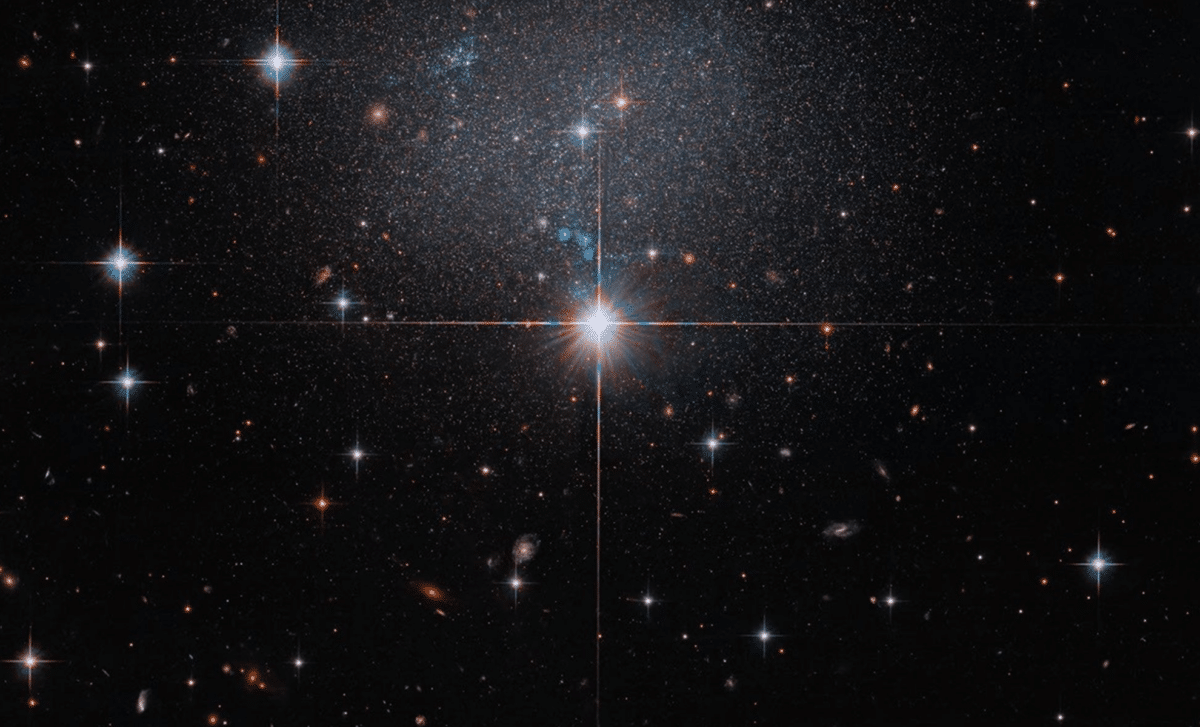
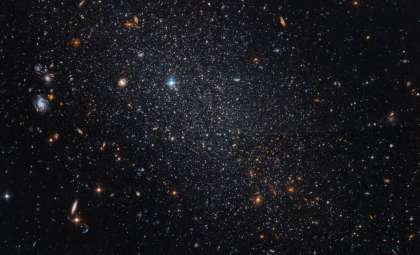
The Hubble Space Telescope has detected the subtle light emitted by ESO 490-017, a faint dwarf irregular galaxy located more than 23 million light-years distant. This observation provides researchers with valuable insights into the dynamics of galaxy motion throughout the cosmos.
Captured in a remarkable image by Hubble, this finding reveals the galaxy’s delicate star formation while highlighting the unseen gravitational forces influencing cosmic flows. NASA has underscored the importance of this discovery in enhancing our comprehension of the local galactic environment and the larger cosmic structure.
Discovering the Faint Charm of ESO 490-017
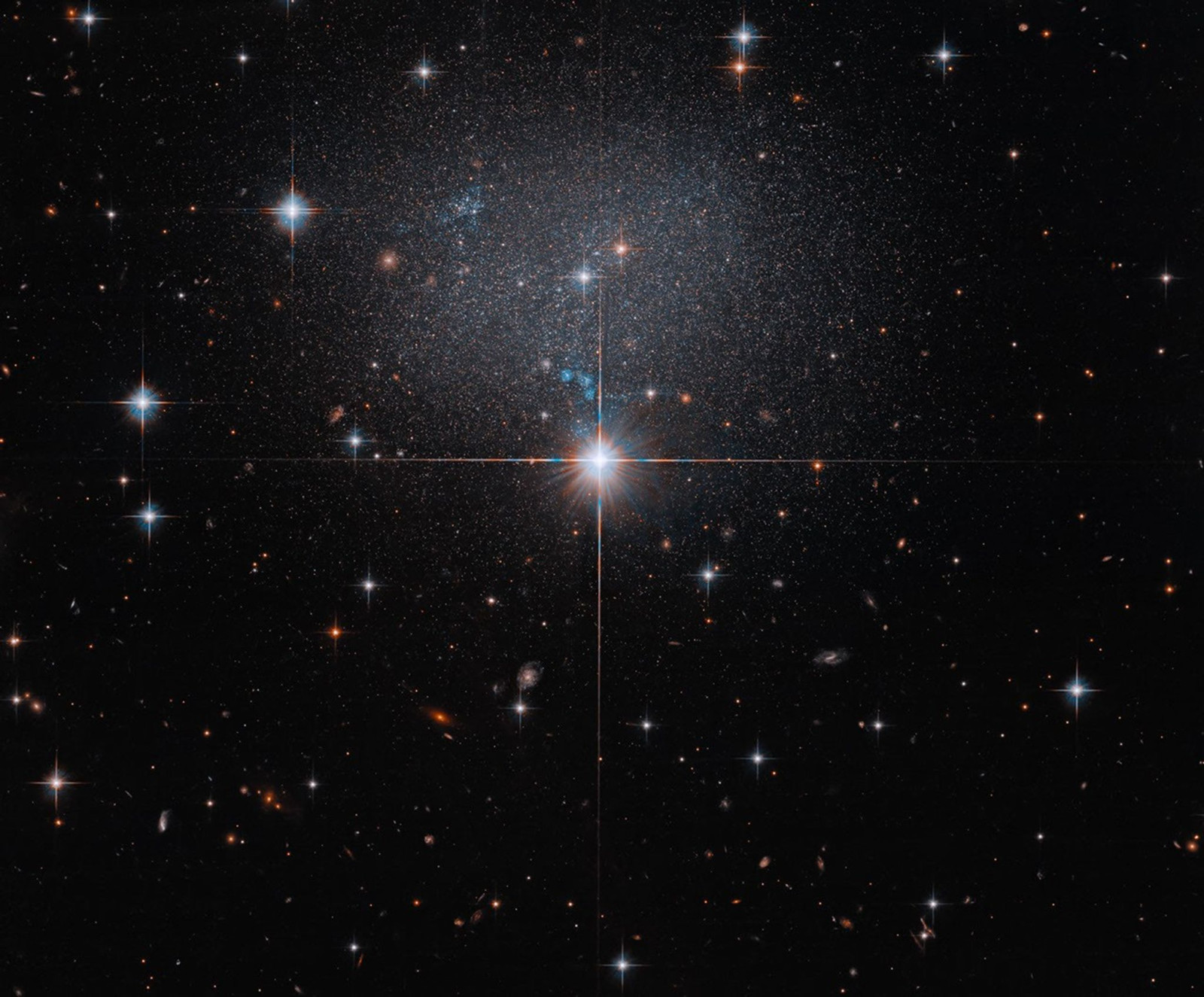
ESO 490-017 is categorized as a low-surface-brightness galaxy, making it extremely difficult to spot amid the starry backdrop. With an approximate diameter of 12,000 light-years, it resides in the constellation Canis Major, nestled among bright foreground stars that outshine it.

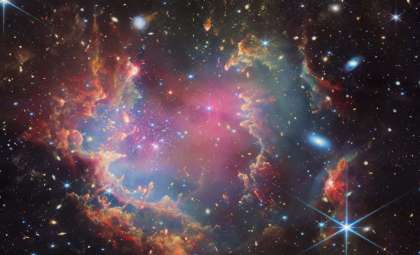
Thanks to Hubble’s exceptional resolution, astronomers can clearly distinguish this elusive cluster of stars from the brighter stars located in the foreground. The image not only captures this galaxy but also displays numerous distant galaxies in shades of red, orange, and beige, many showing subtle spiral patterns, painting a detailed picture of this cosmic region.
Such detections are particularly important given that dwarf irregular galaxies are often missed due to their faint and diffuse nature.
Tracking the Movement of Galaxies
This discovery stems from a Hubble initiative focused on observing how galaxies and galaxy clusters move through space. Matter in the universe is unevenly spread, creating gravitational currents that guide the large-scale motions of galaxies, a phenomenon known as cosmic flow.
By studying galaxies such as ESO 490-017, scientists can map these invisible gravitational streams, unveiling the impact of both visible and dark matter over incredible distances. Data like this are key to improving models of how cosmic structures evolve and how galaxies interact over billions of years.
Using Stellar Beacons to Gauge Distances
Hubble’s distance measurements to nearby galaxies depend on the approach of utilizing low-mass red giant stars as reliable standard candles. Measuring the brightness of these stars enables astronomers to precisely calculate the distance to galaxies such as ESO 490-017, helping create an accurate map of our local universe. This technique is especially advantageous for studying dwarf galaxies, whose faint stars would otherwise be challenging to analyze.
Pinpointing these distances not only clarifies galaxy locations but also aids in comparing movements and distributions on a grand scale, offering valuable insights into the universe’s past and future development.
Preserving Stellar Records for Future Study
Beyond distance calculations, this Hubble observation enriches a comprehensive archive of stellar populations in nearby galaxies. By documenting the various star types within ESO 490-017, astronomers deepen their understanding of star formation and lifecycle in small galaxies. These archives serve as critical resources for ongoing research and for recognizing patterns across different galactic settings.
NASA’s Hubble mission persists in expanding this stellar database, providing professionals and enthusiasts alike with greater insight into the varied and complex nature of the universe’s smallest galaxies.
- Categories:
- Nasa






0 comments
Sign in to Comment