
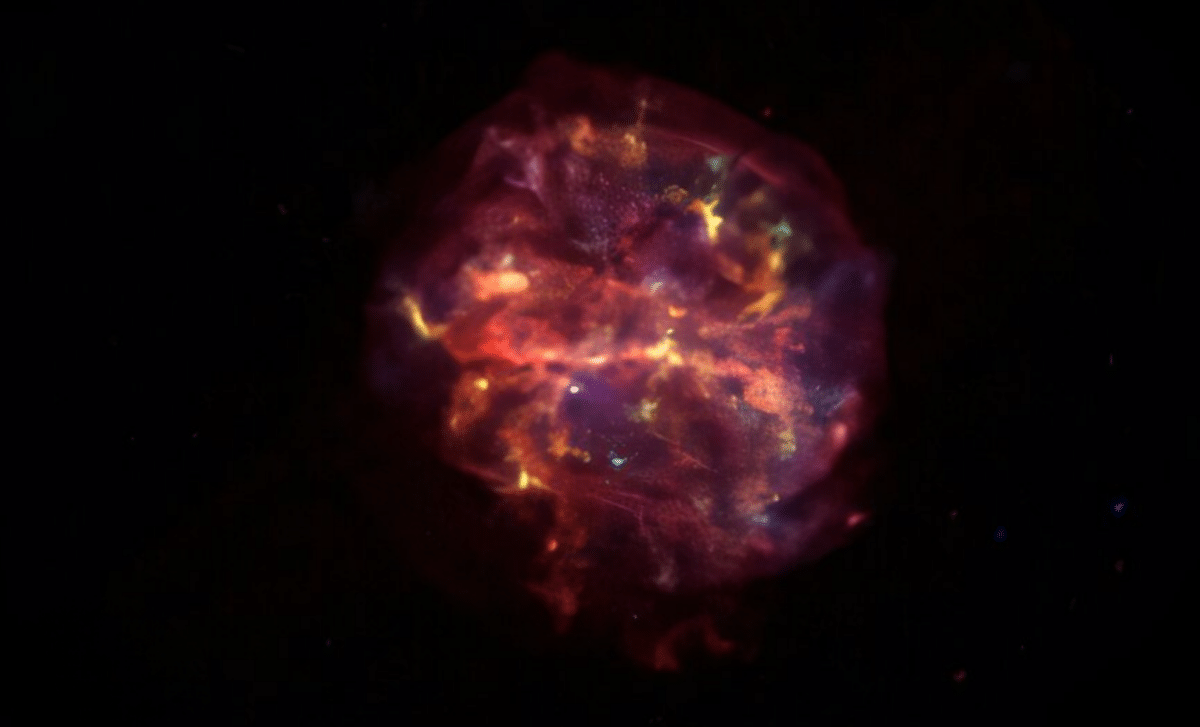
Over ten years of data collected by NASA’s Chandra X-ray Observatory has revealed a surprising pattern within the young supernova remnant G292.0+1.8. This analysis demonstrates that the stellar debris is expanding unevenly, challenging conventional assumptions about supernova evolution. These results, shared in a preprint on arXiv, deliver the first weighted average X-ray expansion rate measurement for this remnant.
Ten Years of X-Ray Monitoring Illuminate the Remnant’s Expansion
Situated roughly 15,000 light-years away, G292.0+1.8 ranks among the rare Milky Way remnants enriched with oxygen. Originating from a core-collapse supernova, it features both expanding debris and a fast-spinning neutron star. Although studied extensively, discerning its precise motion necessitated a decade of repeated observations. Utilizing deep imaging from Chandra’s Advanced CCD Imaging Spectrometer (ACIS), a team led by Maria Aslanidou at the University of Amsterdam compared datasets over about ten years to track changes across the remnant.
Their findings yielded the inaugural weighted mean expansion rate in X-rays, calculated at nearly 0.016% per year. This corresponds to an estimated expansion age between 2,500 and 4,200 years, consistent with previous optical estimates and the pulsar’s spin-down age. As stated by the authors,

“This study examines the expansion rate of the Galactic SNR G292.0+1.8 using deep X-ray observations in order to better understand its dynamical evolution and the structure of the ejecta,” the researchers wrote in the paper.
This research offers unprecedented insight into how the remnant continues to evolve long after the initial explosion.
Irregular Expansion Highlights Complex Shock Wave Interactions
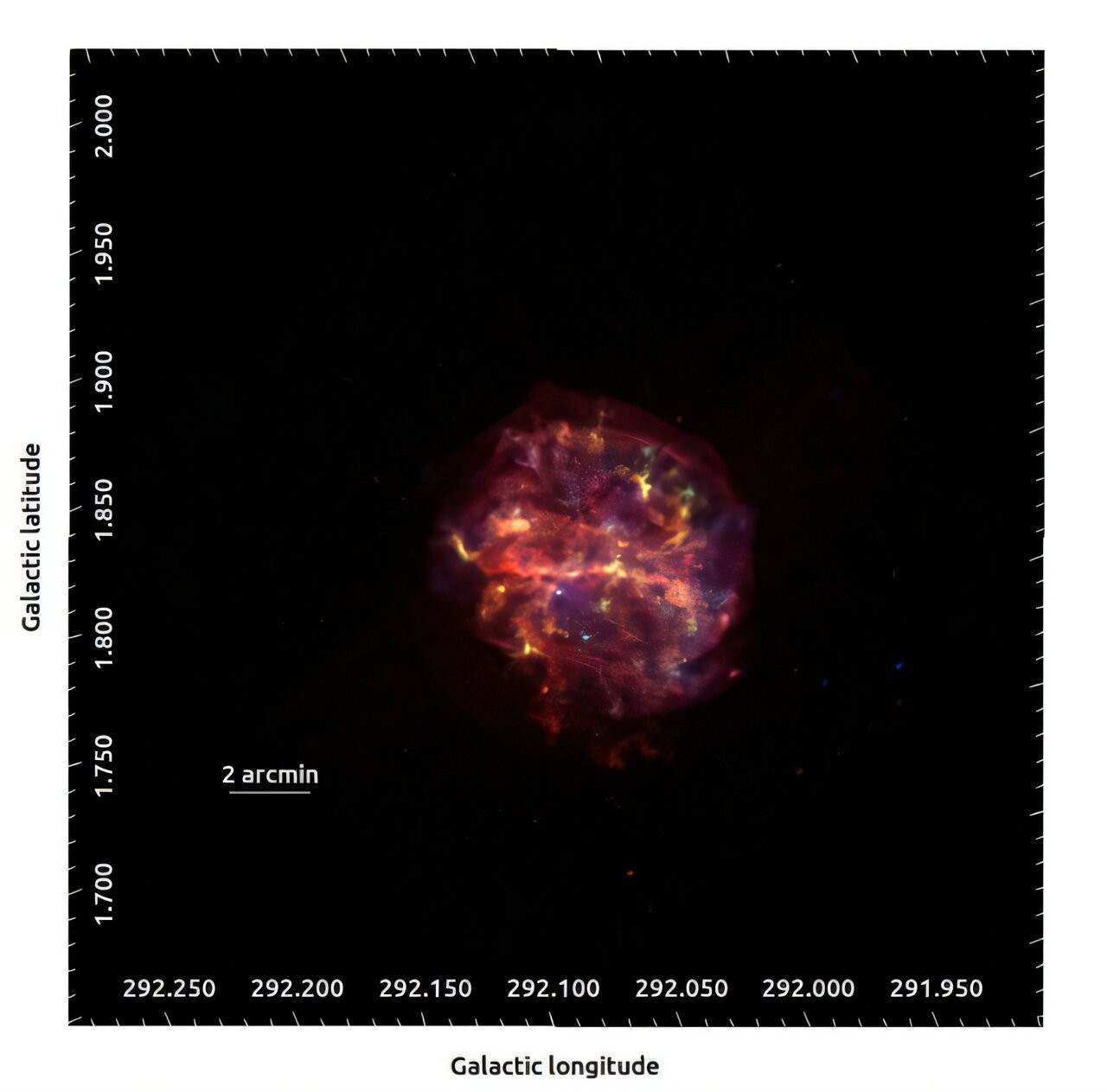
The most notable discovery isn’t the average expansion speed itself, but rather the significant variations detected throughout the remnant. Rather than growing uniformly, the eastern section of G292.0+1.8 expands faster than other areas. This irregularity implies that the debris interacts with the surrounding environment in far more intricate ways than a simple symmetrical outflow. According to the paper made available on arXiv, one explanation involves the interplay between the pulsar wind nebula and the remnant’s reverse shock.
The collision of these components may produce a reflected shock wave pushing ejecta unevenly in different regions. This mechanism naturally causes some parts to move ahead faster, creating a fractured, rather than smooth, shell. These detailed long-term X-ray observations are crucial, as minor motions become noticeable only after consistent, precise measurements. By charting these variations, researchers can reconstruct the physical conditions after the supernova and improve models explaining how debris interacts with internal shock waves and the interstellar medium.
Findings Defy Simple Expectations of Supernova Momentum Conservation
The latest data also uncovered a perplexing inconsistency. Basic supernova theory suggests that the fastest moving ejecta should travel opposite to the direction in which the neutron star was propelled. However, observations of G292.0+1.8 show that some high-velocity sections are aligned with the neutron star’s trajectory rather than opposing it. As detailed by the team, “In some sectors, the largest expansion is observed broadly in the same direction as the neutron-star kick, rather than opposite to it as a simple momentum argument might suggest.”
This reveals a genuine astrophysical conundrum rather than a mere observational error. It indicates that post-explosion interactions—such as reflected shocks, variations in environmental density, or intricate ejecta dynamics—significantly influence the remnant’s progression over millennia. Instead of providing a straightforward snapshot of the initial explosion, the debris narrates a complex history marked by ongoing interactions.
- Categories:
- Astronomy



0 comments
Sign in to Comment