

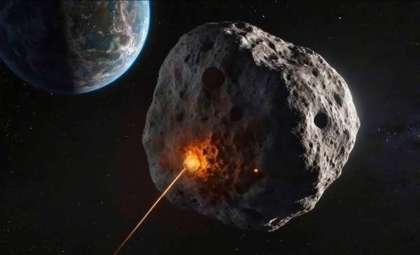
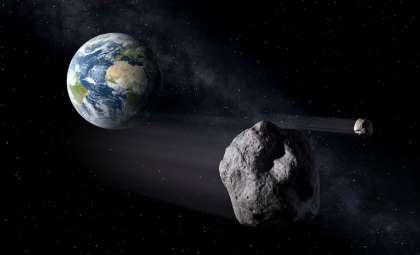
An asteroid roughly the size of a bus is rapidly approaching Earth's neighborhood, drawing keen observation from scientists. Although it poses no threat, its close passage highlights a week filled with notable celestial activity, prompting heightened vigilance regarding near-Earth objects (NEOs). Additionally, a significantly larger asteroid is set to fly past our planet within the same timeframe.
How Near Will 2025 VP1 Pass by Earth?
Labeled 2025 VP1, this space rock is estimated to be about 37 feet wide and is predicted to come within 361,000 miles of Earth. This distance is closer than the Moon’s orbit. While an impact is not anticipated, the encounter offers an opportunity for researchers to study the characteristics and trajectories of smaller near-Earth objects in close proximity.
Information from NASA’s Jet Propulsion Laboratory (JPL) indicates that VP1 is among multiple asteroids expected to pass nearby this week. Another comparable object, called 2025 VC4, will fly by at about 1.24 million miles. While neither asteroid poses immediate danger, their observations contribute essential data toward NASA’s comprehensive planetary defense efforts. These benign encounters help improve orbital calculations and forecasting abilities over time.

Orpheus: The Week’s Significant Asteroid
In addition to the smaller near-Earth objects, a much larger asteroid—3361 Orpheus—will also pass by Earth. Discovered in 1982, Orpheus spans nearly 1,400 feet, comparable in size to the Empire State Building. Traveling at approximately 20,000 miles per hour, it will maintain a safe distance but is designated a potentially hazardous asteroid (PHA) due to its dimensions and trajectory.
PHAs are categorized based on their size and the proximity of their orbits to Earth's path, typically those larger than 460 feet that come within 4.6 million miles. Orpheus meets these criteria, warranting continuous monitoring by NASA. Although there’s no imminent threat, scientists keep a close watch to detect any orbital changes influenced by gravitational factors.
Why Monitoring These Asteroids Matters
Even though none of the asteroids posing this week are dangerous, their orbital paths provide insight into the continual evolution of our solar system. Many asteroids are remnants from the early formation of planets, typically originating from the belt between Mars and Jupiter. When these objects cross Earth’s path, they are classified as near-Earth objects.
NASA differentiates between routine NEOs and PHAs. While the majority of NEOs maintain safe distances, PHAs require enhanced monitoring due to their size and potential long-term orbital shifts. Per JPL, the “potentially hazardous” label is not an indication of imminent collision, but a notice for ongoing observation over extended periods to track any alterations in trajectory caused by gravitational forces.
The Critical Role of Continuous Space Surveillance
Close asteroid flybys emphasize the value of initiatives such as NASA’s Center for Near Earth Object Studies (CNEOS), which compiles observational data from telescopes worldwide. This continuous surveillance enables accurate modeling of asteroid orbits and early detection of newly discovered objects.
In addition to early warning, such monitoring underpins long-term planetary defense programs. Projects like DART (Double Asteroid Redirection Test) aim to deflect potentially dangerous asteroids. The current asteroid encounters serve as practical exercises for advancing these mitigation technologies.
Current Status: No Immediate Danger but Ongoing Vigilance Needed
While several asteroids have passed near Earth over recent days, the vastness of space makes these distances relatively safe. Nevertheless, each close approach highlights Earth's exposure to cosmic hazards and the importance of sustaining effective early-warning systems.
Presently, NASA confirms no objects pose a collision risk in the near future. However, due to the numerous undetected smaller asteroids like 2025 VP1, ongoing detection and tracking efforts remain crucial.
- Categories:
- Space










0 comments
Sign in to Comment