
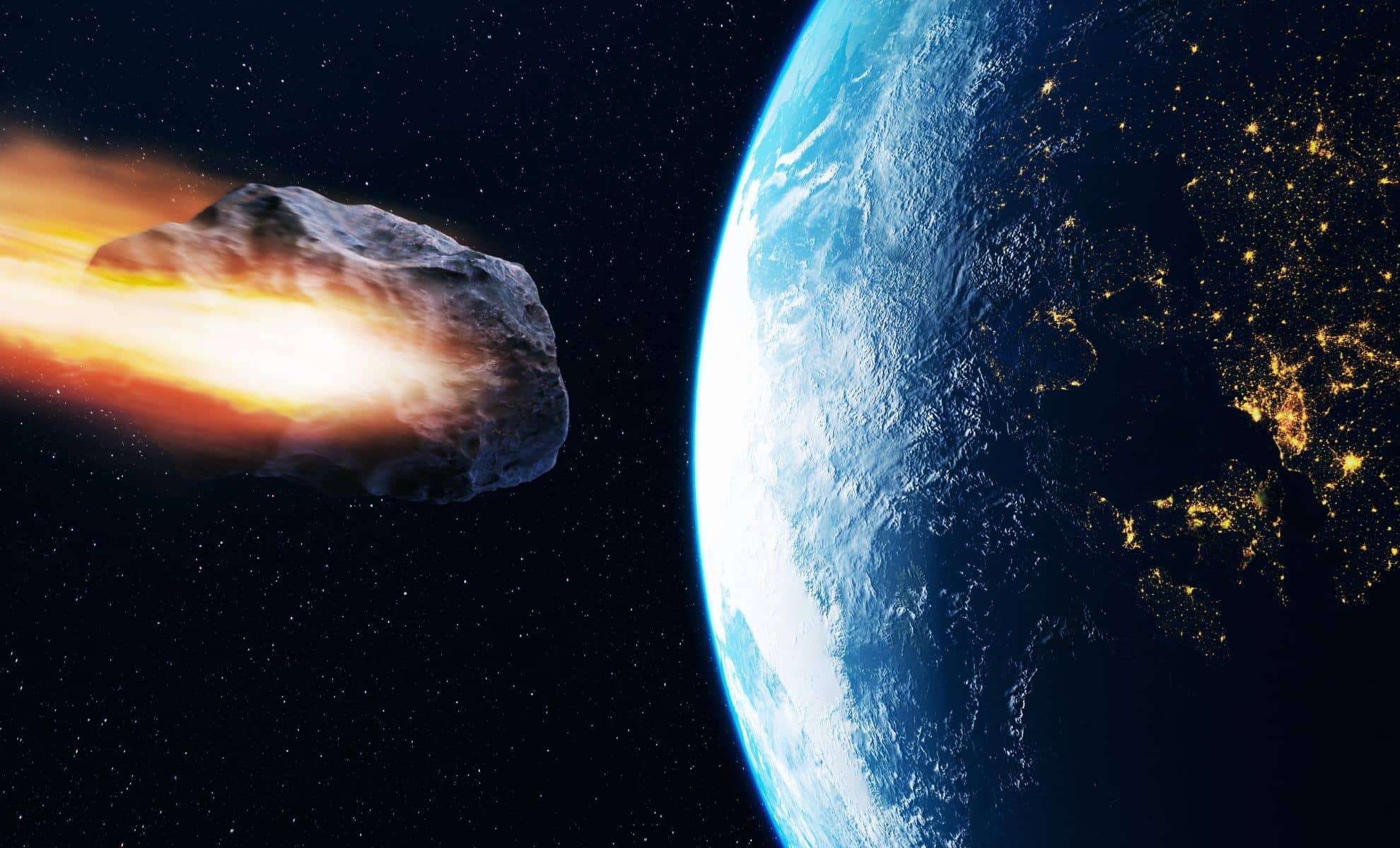
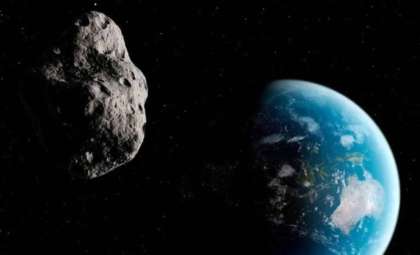
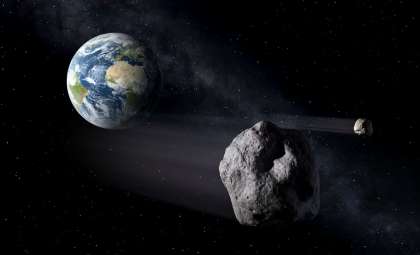
An asteroid approximately the size of a football field, named 2006 WB, is expected to pass near Earth tomorrow, traveling at a distance of about 554,000 miles (891,576.58 km). While this distance is roughly double that between the Earth and the Moon, it is considered close on astronomical scales.
According to NASA’s Jet Propulsion Laboratory (JPL), 2006 WB measures around 310 feet (94.49 meters) in diameter, though estimates range from 240 to 525 feet (0.16 kilometers). To put this in perspective, the Statue of Liberty rises to 305 feet (92.96 meters), and a standard football field is 360 feet (0.11 kilometers) long.
Rapid Approach at Significant Distance
Despite the seemingly large distance of 554,000 miles, the passage of 2006 WB is significant due to its status as a near-Earth object (NEO). The asteroid is moving at an impressive velocity of nearly 4.2 kilometers per second (approximately 9,400 mph or 15,127.82 km/h), far outpacing the speed of a typical rifle bullet, which travels around 2,700 mph (4,345.23 km/h).

By comparison, the closest planet to Earth, Venus, approaches only as near as about 24 million miles. Although the asteroid’s trajectory is secure, its close approach reminds us of the necessity for continuous monitoring of objects intersecting Earth’s orbital path.
Defining Near-Earth Objects
2006 WB falls within the category of NEOs — a group of asteroids and comets that come within 30 million miles of our planet. Organizations like NASA’s Center for Near-Earth Object Studies (CNEOS) monitor these bodies to identify any possible threats. A finer classification, potentially hazardous asteroids (PHAs), must come closer than 4.6 million miles and exceed 460 feet (0.14 kilometers) in size to be deemed a significant risk.
While 2006 WB qualifies as a NEO, it is not considered a PHA due to its relatively small size and safe passing distance.
Additional Near-Earth Asteroid Flybys Coming Up
Alongside 2006 WB, other asteroids will make close passes in the near future. Today, two smaller space rocks — 2024 WF2 and 2024 WJ3, each about the size of a bus — will fly by at distances of 1,780,000 miles (2,864,632.32 km) and 2,780,000 miles (4,473,976.32 km) respectively. On Tuesday, another bus-sized asteroid called 2024 WD3 will approach within 1,080,000 miles (1,738,091.52 km). Additionally, a plane-sized asteroid, 2009 WB105, will pass safely at 3,600,000 miles (5,793,638.4 km).
The steady stream of asteroid encounters underscores the active, ever-changing dynamics of the solar system. “Asteroids are whizzing by all the time—mostly unreported!” noted Jay Tate, director of the United Kingdom’s Spaceguard Centre observatory.
Earth’s Preparedness for Potential Impacts
Although the chance of a large asteroid colliding with Earth is very slight, such an impact could have severe consequences. “An object around 460 feet (0.14 kilometers) wide hitting Earth could obliterate a city and cause devastating regional damage, while even larger survivors over 1 kilometer might trigger global catastrophes or mass extinctions,” explained Svetla Ben-Itzhak, assistant professor at Johns Hopkins University.
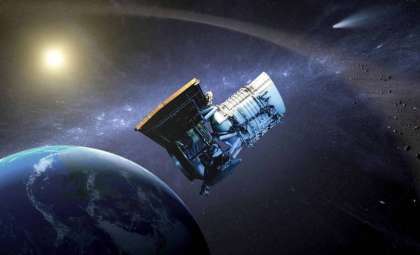
So far, astronomers have catalogued more than 34,000 NEOs and continue active surveillance of around 2,300 PHAs. Constant vigilance by groups like CNEOS is vital for early detection and planetary defense against cosmic dangers.





0 comments
Sign in to Comment