
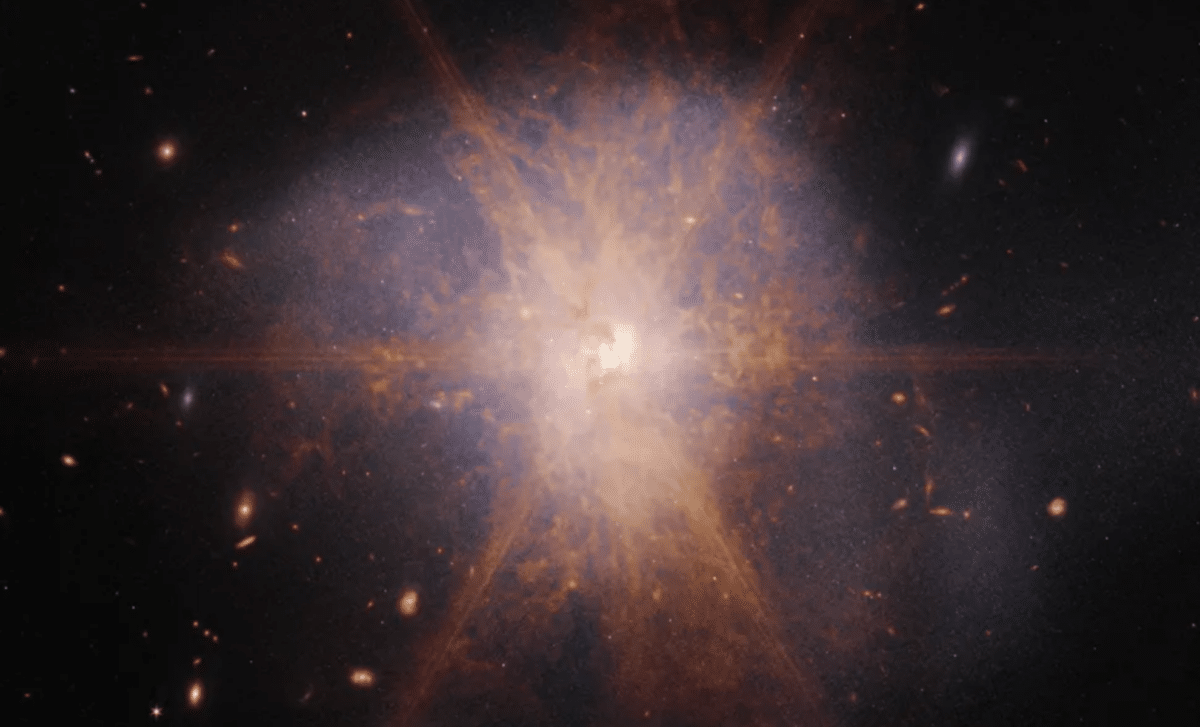
A recent investigation featured in The Astrophysical Journal Letters showcases an unprecedented glimpse into the forces molding the merging galaxy pair known as Arp 220. Employing the cutting-edge instruments of the Atacama Large Millimeter/submillimeter Array (ALMA), scientists have charted the magnetic field configurations within Arp 220, producing the most intricate view of this cosmic blend to date. Their research spotlights a “magnetic express lane” facilitating galactic winds hurtling at an astonishing velocity of 1.1 million miles per hour.
How Magnetic Fields Influence Galaxy Collisions
Situated roughly 250 million light-years away, the interacting galaxies of Arp 220 have captivated researchers due to prolific starburst activity and intense energetic phenomena. The newly published study in The Astrophysical Journal Letters dives deeper into the role magnetic fields play in directing the behavior of the galaxy’s outflows and winds.
“We used ALMA to map the orientation and strength of magnetic fields in the twin galaxies,” said Enrique Lopez-Rodriguez, the team leader from the University of South Carolina.
Add Cosmo Herald as a Preferred Source

The magnetic blueprint unveiled by the team illustrates not only how these fields modulate the galactic winds but also how they steer them along coherent pathways, influencing the expulsion of gas, dust, and heavy elements into the surrounding space.
This advance enriches our comprehension of the forces driving the accelerated transformation of galaxies across the universe. Once considered secondary actors, magnetic fields emerge as vital influencers in structuring cosmic environments, reframing prevailing ideas about merging galaxies and the dispersal of star-forming material into the cosmos.
Mapping the Magnetic Express Lane
The standout discovery of the research is the identification of a so-called “magnetic express lane.” This magnetized corridor arises from intense winds emitted by the dual nuclei of Arp 220. “This revealed previously unseen details about Arp 220’s dust-enshrouded cores and molecular outflows,” noted Josep Miquel Girart, the observational lead and an investigator at the Institut de Ciències de l’Espai. These magnetic pathways serve to channel matter and cosmic rays outward, far beyond the confines of the galaxy’s dense centers.
Finding this magnetic conduit represents a major leap in understanding galactic evolution under extreme circumstances. The fields not only govern the direction of outflows but also regulate the rate at which matter escapes, shedding light on processes that mold galaxy growth and star formation dynamics.
Dynamic Winds and Starbirth Within Arp 220
The intense star formation triggered by the collision of two spiral galaxies at Arp 220’s core drives powerful outflows laden with gas, dust, metals, and cosmic rays, pushing material at speeds reaching 1,500 times Earth's sound velocity. The research indicates that magnetic fields play a crucial role in sculpting these rapid outflows, traditionally attributed to stellar activity and black hole forces.
These swift gas streams influence the galaxy’s evolving structure and mass accumulation. Their alignment with magnetic field lines ensures material follows defined routes, critically shaping the transformation of this merging system. This insight challenges the prior notion of magnetic fields’ passivity, affirming their active contribution to material flow control.
Magnetism’s Influence on Galaxy Lifecycles
A striking result of the analysis is the realization that magnetic field strengths in Arp 220 exceed those in the Milky Way by hundreds to thousands of times. Such potent magnetic forces strongly affect gas movement and cooling, thereby controlling the timing and occurrence of star formation.
The team also discovered that these amplified magnetic fields are instrumental in governing how matter escapes the galaxy. This offers a fresh viewpoint on galactic life cycles, demonstrating how magnetic dynamics influence galaxy evolution and interactions with the wider intergalactic environment. These insights have broad implications for predicting the longevity and star-forming potential of galaxies across cosmic time.
- Categories:
- Astronomy


0 comments
Sign in to Comment