
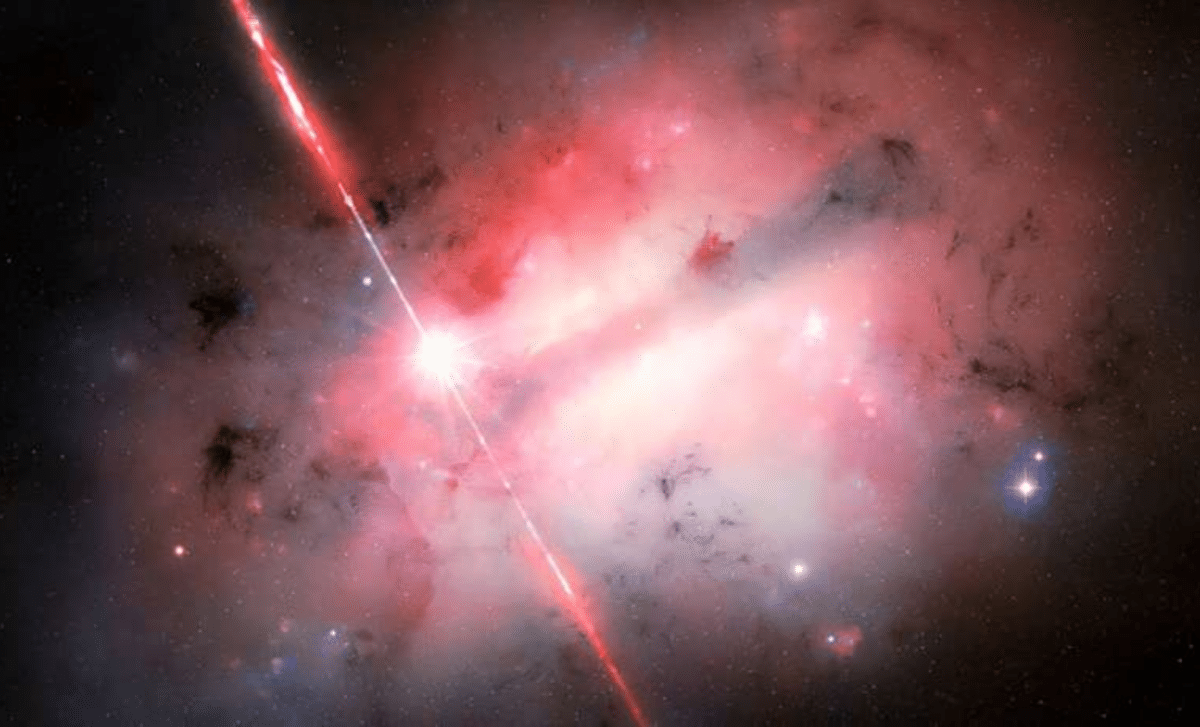
Researchers at Rutgers University have made significant strides in examining one of the cosmos’s most baffling events—a mysterious explosion labeled GRB 250702B. This phenomenon has left the scientific community puzzled due to its extraordinary intensity and duration, which conflict with conventional understandings of similar bursts. The investigative team, composed of astrophysicists from Rutgers and collaborating institutions, is utilizing advanced orbital observatories to dissect the complexities of this rare cosmic occurrence.
Unraveling an Astrophysical Enigma
Gamma-ray bursts (GRBs) are typically extremely energetic but short-lived flashes detectable across the universe. However, GRB 250702B stands out by persisting for hours and displaying unforeseen X-ray emissions days before its main flare-up. This unexpected behavior has prompted astronomers to reconsider the mechanisms powering such intense cosmic displays.
“This object shows extreme properties that are difficult to explain,” said Huei Sears, a postdoctoral researcher at the Rutgers Department of Physics and Astronomy, who is leading the study.
Add Cosmo Herald as a Preferred Source

While gamma-ray bursts have been studied extensively, GRB 250702B challenges prevailing patterns with its prolonged energy output and timing. The current research is concentrated on uncovering why this event defies norms, hinting at novel astrophysical processes yet to be fully understood.
Collaborative Effort in Studying GRB 250702B
Decoding the nature of GRB 250702B required the integration of data from multiple observatories and space missions, each offering unique observations to piece together the event’s nature.
“Usually, these bursts are over in less than a minute, but GRB 250702B lasted for hours and even showed signs of X-ray activity a day prior,” explained Eliza Neights, an astronomer at NASA’s Goddard Space Flight Center, underscoring the unusual nature of this event.
The team's discoveries are prompting revisions to traditional gamma-ray burst models and hold potential consequences for theories about star life cycles and black hole formation.
Investigations into GRB 250702B are challenging long-held theories about gamma-ray bursts while opening windows into extreme cosmic environments. Insights gained from this event offer novel perspectives on interactions between stars and black holes, possibly redefining future astrophysical interpretations.
Tidal Disruption Events: A New Perspective on Star Death
GRBs often arise from massive stars collapsing or neutron star mergers, but the unusual traits of GRB 250702B have led scientists to explore alternative scenarios, including tidal disruption events where a black hole’s gravity tears a star apart. “We have only seen a few tidal disruption events of this type, so we don’t know for sure how they’re supposed to evolve,” said Sears, suggesting that GRB 250702B could shed light on these rare cosmic catastrophes.
Because tidal disruption events are seldom observed, studying them may unlock new understanding of black hole-star interactions. Unlike conventional GRBs, GRB 250702B defies existing classifications, inviting scientists to revisit established knowledge about stellar deaths and black hole dynamics.
In-Depth Observations of a Singular Cosmic Event
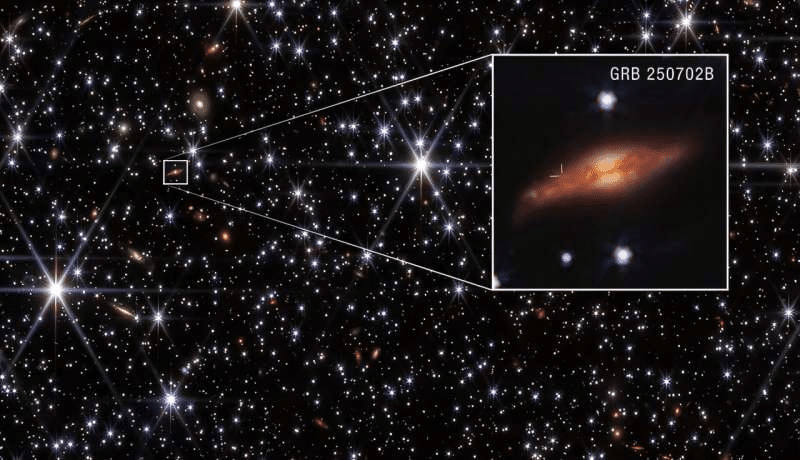
One remarkable aspect of GRB 250702B is the extraordinary level of detail captured by astronomers. “In such vibrant and unprecedented detail, we see just one very large galaxy with a dust lane,” said Sears. These observations revealed a galaxy morphology more complex than anticipated, challenging assumptions about the relationships between galaxies and dramatic cosmic events within them.
As teams analyze extensive datasets from space and terrestrial telescopes, a more comprehensive view of the explosion’s source emerges. However, the complex galactic setting means some effects of the burst might be faint or elusive. “The galaxy has such a complex structure that it’s not 100% clear if there’s anything left to see of the explosion, but if there is, it’s really faint,” Sears noted, indicating that the event’s full impact might be subtle.
Shaping the Future Directions of Astrophysical Studies
Though many questions remain about GRB 250702B, its detailed examination is already influencing the trajectory of astrophysics research. “This gives us a unique chance to study the extremes of how stars and black holes evolve,” Sears emphasized, highlighting the potential for revolutionary findings. This explosion may represent a phenomenon never before documented, hinting at uncharted realms of cosmic activity.
While some interpretations about GRB 250702B are still tentative, its rarity ensures each new insight adds depth to our understanding of the universe’s mechanics. “This is certainly an outburst unlike any other we have seen in the past 50 years,” said Neights, reflecting on its extraordinary significance. Continued exploration promises to uncover unprecedented cosmic phenomena, ushering in a new era of discovery.
- Categories:
- News







0 comments
Sign in to Comment