
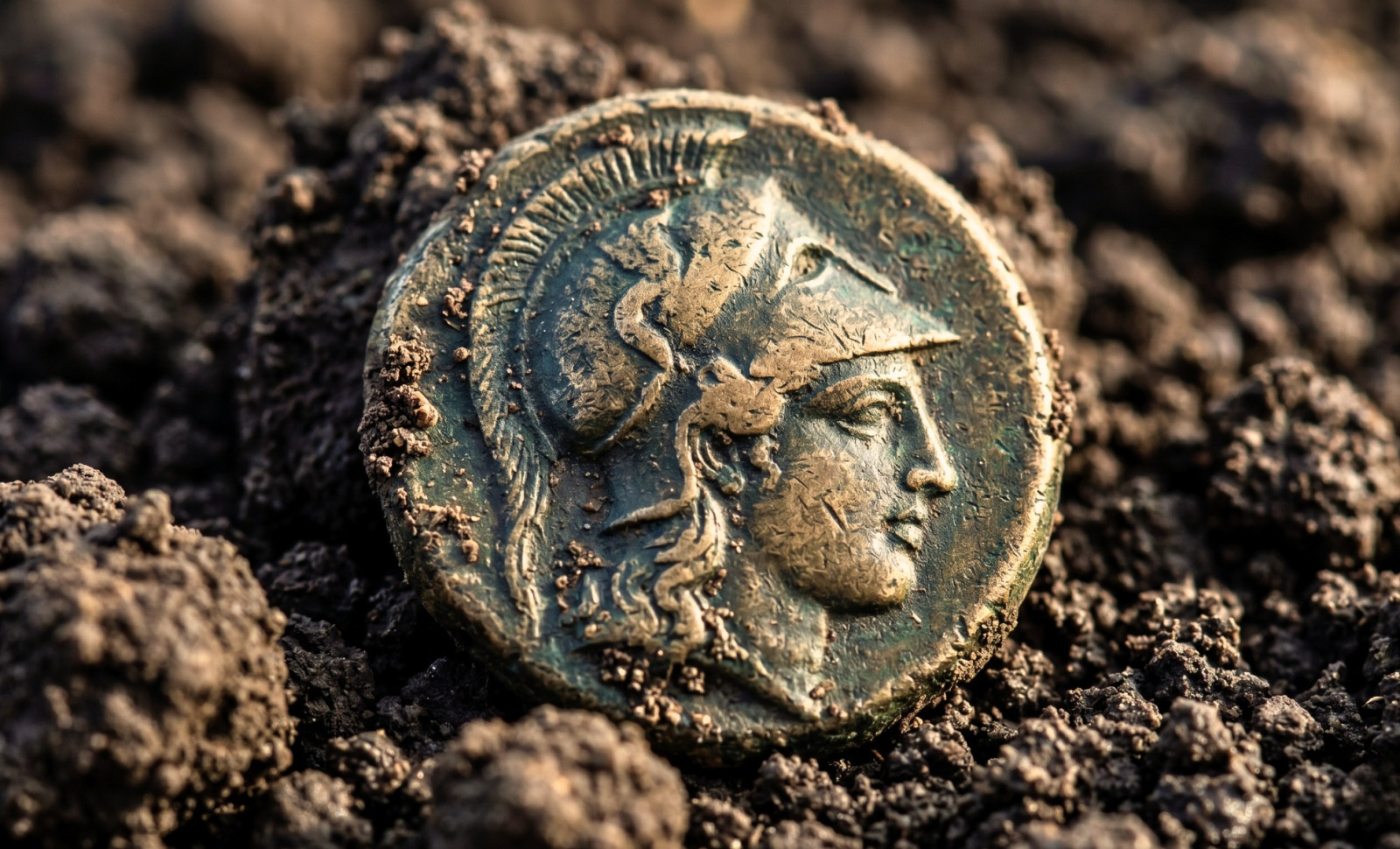
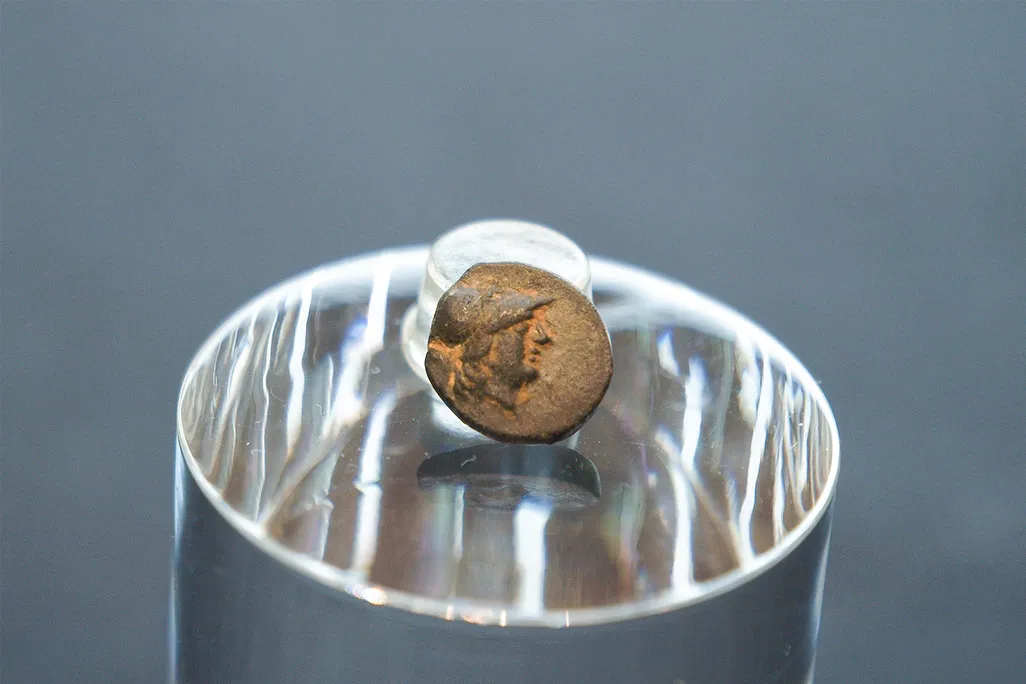
A young boy aged 13 stumbled upon a tiny bronze coin while walking through farmland on Berlin’s outskirts, a coin now confirmed as the capital’s earliest find from ancient Greece. Minted in Troy during the third century B.C., it offers researchers a rare tangible connection between the Mediterranean and northern Europe during the Iron Age and is displayed at a Berlin archaeology center.
This coin is remarkably small, just 12 millimeters wide and weighing about 7 grams—smaller than a U.S. dime. Archaeologist Jens Henker from the Berlin Heritage Authority, who headed the analysis, commented that the coin’s diminutive size likely helped it avoid being melted down by the local Germanic populations who lived there at the time.
During a school trip to Petri Berlin, an interactive archaeology lab situated on medieval school grounds, the boy revealed the artifact to specialists. The coin then passed through various experts until a professional at Münzkabinett Berlin, one of the largest numismatic collections globally, authenticated it.

Athena’s Image Twice Adorns a Coin Smaller Than a Dime
Experts dated the coin to the Hellenistic era, specifically between 281 and 261 B.C. Its design leaves no doubt about its origin. The front depicts Athena wearing a Corinthian helmet, symbolizing both war and wisdom in a style known throughout Greece. The back shows Athena again, with a kalathos headpiece, wielding a spear in her right hand and holding a spindle in the left.
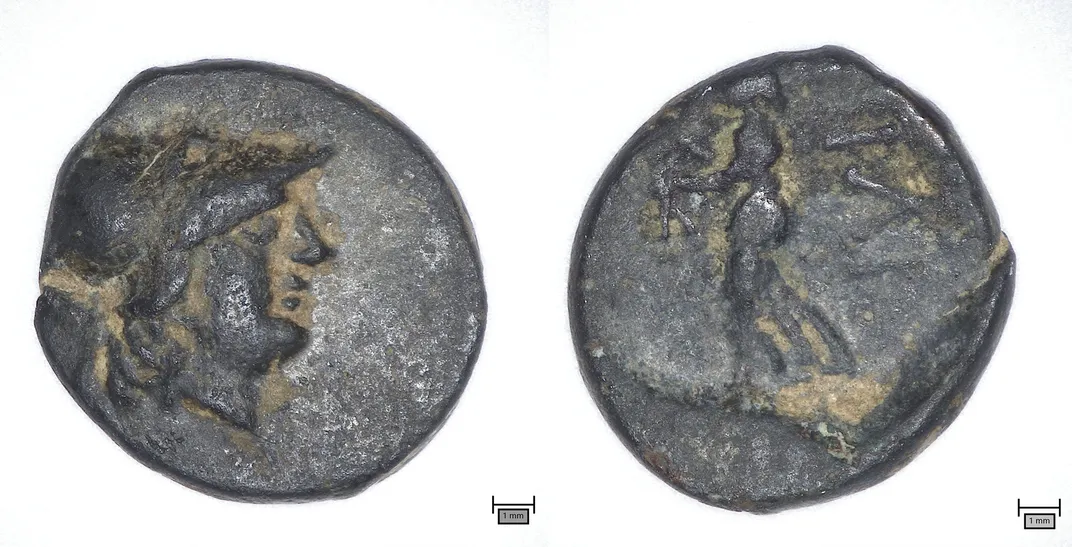
Struck in Troy, located in modern-day western Turkey and immortalized by Homer’s Iliad, the city had been renamed Ilion by the third century B.C. and was a modest but symbolically important settlement within succeeding Hellenistic realms. Its composition in bronze identifies the coin as everyday currency rather than a treasure of gold or silver.
A Site Yielding Artifacts for Numerous Decades
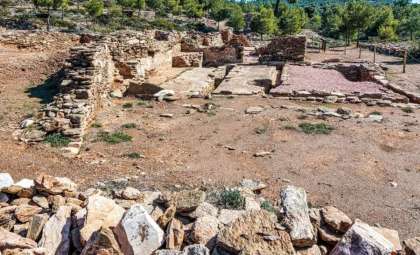
After tracing the coin’s origin, Henker examined how it found its way to Spandau in western Berlin. The boy pinpointed the exact location. Checking Berlin’s archaeological records revealed the area was well-studied.
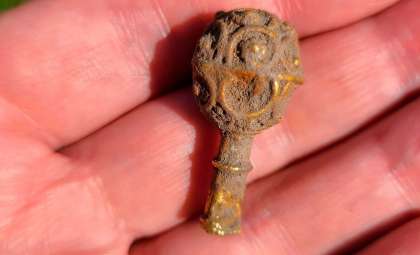
Since the 1950s, Berlin’s Museum for Pre- and Early History has conducted many surveys there. Excavations uncovered pottery shards, a bronze button, Slavic knife sheath parts, and burnt bone fragments. These items suggest the site functioned as a cemetery, likely first utilized during the early Iron Age (circa 800–450 B.C.) and revisited over many centuries.
Henker highlights that metal artifacts seldom endure on ancient settlements because they were commonly recycled. Graves, however, sometimes contain metal objects as symbolic gifts. “Metal was sometimes placed in graves as a kind of grave gift,” he explained to Deutsche Welle. “This seems like a memento, likely meant to recall a memory or life event.”
Tracing a Journey Without Written Records
The exact route of the Trojan coin to northern Europe remains uncertain. Trade is the most plausible explanation. Greek artifacts have emerged in other German regions, and amber from the Baltic has been found in Greek tombs fashioned into jewelry. The Amber Road was one of the rare known trade routes connecting the Mediterranean with northern Europe.
Historical writings on contact between these areas are scarce but exist. Around 320 B.C.E., Pytheas, a Greek navigator from Massalia (modern Marseille), voyaged northward toward the British Isles and possibly the Arctic Ocean, documenting phenomena like the northern lights and frozen seas. His accounts were largely doubted by contemporaries. “People said, ‘He is fabricating stories; this can’t be real,’” Henker told Smithsonian magazine.
Recreated versions of Pytheas’s lost writings indicate that the Greeks recognized the flow of resources like tin, amber, and gold from Europe’s Atlantic coast. Nonetheless, a cultural gap remained. “The Greeks never wrote about the people in what is now Germany; they regarded us as barbarians,” Henker explained to Deutsche Welle. “Meanwhile, the locals left no written records, so these finds are crucial in revealing any connections.”
Henker also suggests a speculative possibility: Germanic tribes might have served in Greek armies, similar to their later participation in Roman forces. “During the Iron Age, population declines occur with unknown causes,” he said. “People disappear without clear evidence; perhaps some joined the Greeks militarily.” He emphasizes this as an idea, not an established theory, needing further research.
The Significance of a Young Discoverer's Attention to Detail
The coin debuted publicly at Petri Berlin on April 15, 2026, showcased in the museum’s newest finds exhibit. It stands as the first artifact of ancient Greek origin discovered within Berlin’s boundaries presented for public viewing. For archaeologists, it provides tangible evidence of cross-cultural interactions between ancient Greece and northern Europe during the Iron Age—interactions previously underappreciated.
Investigations at the Spandau location hint at more buried treasures. The Museum for Pre- and Early History has noted the site's archaeological promise repeatedly. Though what remains below the surface remains a mystery, even this urban fringe farmland has revealed an artifact reshaping views on cultural exchanges before the Roman era.
The identity of the boy who uncovered the coin remains anonymous in official reports. His decision to hand over the find rather than keep it has brought Berlin its archaeological first. Spanning over two millennia, the coin’s journey from a Hellenistic mint through an Iron Age grave to a museum display is an ongoing story awaiting fuller understanding.
- Categories:
- News



0 comments
Sign in to Comment