

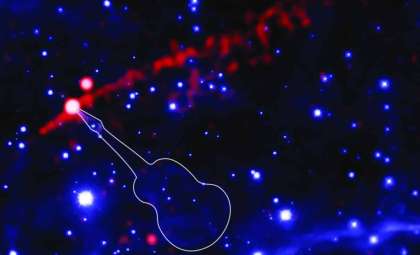
NASA’s Chandra X-ray Observatory has delivered a breathtaking glimpse of the nebula MSH 15-52, often called the “Hand of God.” Situated roughly 17,000 light-years away in the Circinus constellation, this cosmic marvel has long intrigued researchers. Fresh analysis, merging X-ray observations from Chandra with radio telescope data, uncovers fresh details about the pulsar residing at its center and its complex interaction with the remnants of a supernova. Featured in The Astrophysical Journal, these findings deepen our understanding of this enigmatic nebula’s dynamic processes.
The Pulsar Powering the Celestial Hand
At the core of the Hand of God nebula is a pulsar, an intensely magnetized neutron star spinning at incredible speeds. This remains of a colossal star that exploded in a supernova, leaving behind a dense core measuring about 12 miles in diameter. Its magnetic field is an astonishing 30 million times stronger than the most powerful magnets on Earth. Rotating roughly seven times each second, it spews out high-energy particles in the form of pulsar winds that sculpt the surrounding cloud.
As this neutron star spins, it emits streams of energetic particles that collide with leftover supernova debris, somewhat akin to a rapidly revolving lighthouse beacon sweeping light across the dark. However, unlike earthly beacons, this pulsar’s radiation generates extreme shock waves and powerful magnetic fields that influence the structure of the nebula. New Chandra data reveal that the pulsar wind produces highly energetic particles escaping from a shock wave phenomenon similar to a sonic boom seen in supersonic jets. These particles move along magnetic field lines, crafting the finger-shaped formations that give the nebula its unique appearance.


Unexpected Differences in Light Across Wavelengths
A significant discovery in the latest research, combining X-ray and radio observations, reveals that certain nebula features don’t match as expected when viewed in different light spectra. These mismatches hint that the interplay between the pulsar’s wind and the supernova residue is more intricate than previously thought. By studying the nebula across various wavelengths, including X-ray and radio, scientists have detailed the complex behavior of the pulsar wind interacting with the exploded star’s remains.
For instance, some X-ray features such as the pulsar’s jet and the distinctive finger-like extensions are absent in radio images. Chandra Observatory points out that this absence indicates that these structures arise from particles possessing much higher energy. Meanwhile, the radio data expose delicate filamentary structures that likely formed as the pulsar wind collided with the supernova leftovers. These filaments trace out the nebula’s magnetic field directions, providing essential clues on the forces shaping the structure.
Decoding the Nebula’s Magnetic Architecture
One of the most intriguing aspects of the MSH 15-52 nebula is how magnetic fields carve its architecture. As the pulsar wind expands, it becomes confined by magnetic field lines, creating the elaborate features that stretch across the nebula’s expanse. These magnetic field lines govern not just particle movement at ultra-high energies but also the overall form of the nebula. The slender filaments detected in radio wavelengths follow these magnetic pathways, revealing critical information on cosmic magnetic field dynamics.
Investigating the magnetic fields within this nebula provides a glimpse into the fundamental cosmic forces at work. Understanding these magnetic structures enhances knowledge about the physics behind pulsars, supernova remnants, and pulsar-driven winds. By integrating the latest X-ray and radio data, astronomers aim to better comprehend how these fields evolve and interact with other universal phenomena, potentially leading to breakthroughs about magnetic field generation and their part in accelerating high-energy particles.
Advancing Our Grasp on Cosmic Ray Origins
One key objective in studying MSH 15-52 is to unravel how cosmic rays—high-energy particles journeying through space and sometimes reaching Earth—are generated. Thought to originate from catastrophic cosmic events like supernovae and pulsar winds, the exact details of cosmic ray production are still uncertain. The pulsar embedded within MSH 15-52 serves as an excellent natural laboratory to investigate these processes because its fierce winds may be a major cosmic ray source.
By exploring the interactions between the pulsar wind and its surrounding debris, researchers hope to uncover how these energetic particles form and gain acceleration to incredible velocities. According to the Chandra X-ray Observatory, “Highly energetic particles are leaking out from a shock wave… near the pulsar and moving along magnetic field lines to create the fingers.” Such particles could eventually develop into cosmic rays that travel to Earth, linking us directly to the violent cosmic phenomena that produce them. Insights into these processes could significantly deepen our understanding of cosmic rays and their influence on the universe.
- Categories:
- News




0 comments
Sign in to Comment