
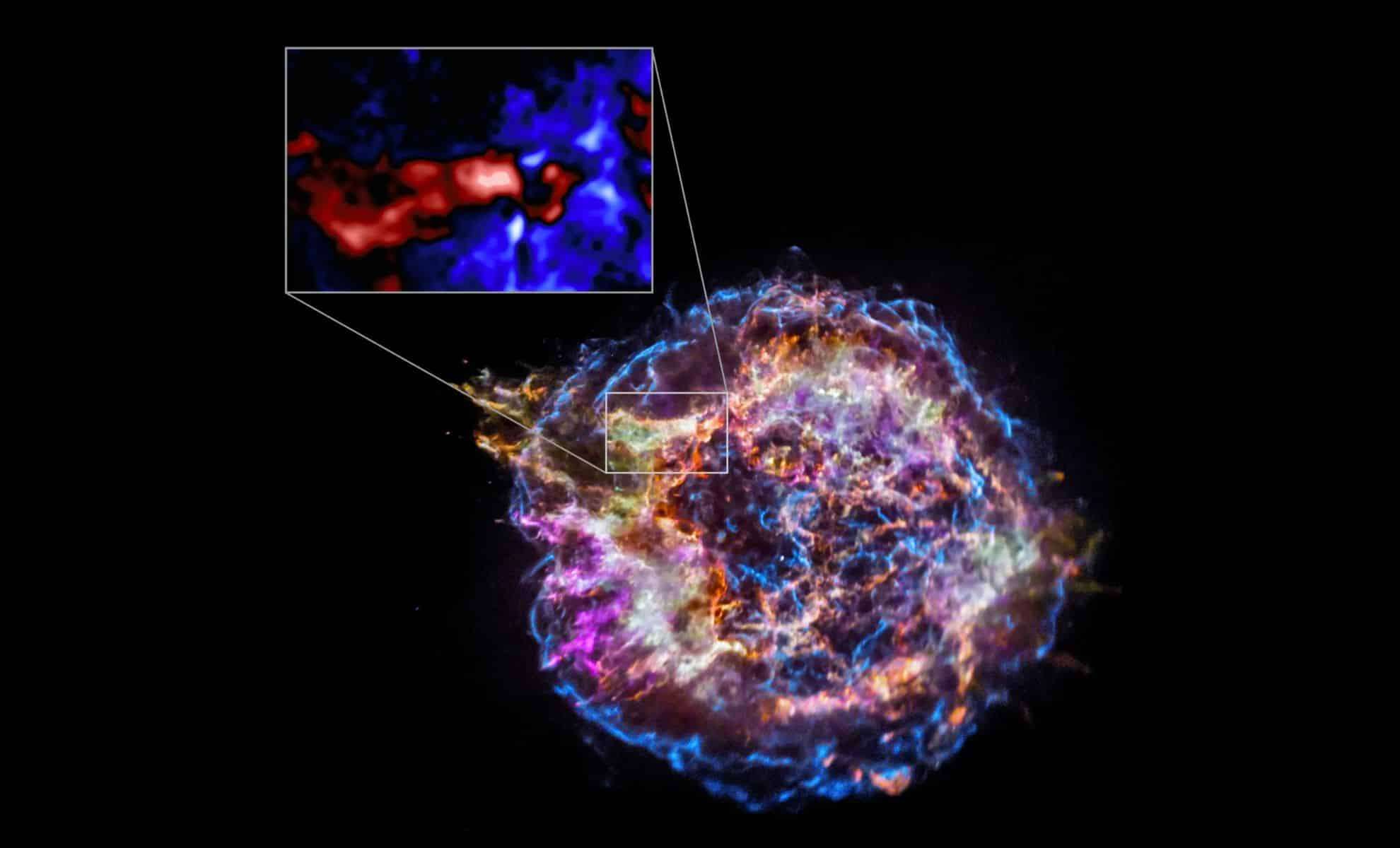
NASA’s Chandra X-ray Observatory has provided groundbreaking evidence about the chaotic final moments inside the star that eventually exploded to form Cassiopeia A, a well-known supernova remnant. A recent paper posted on the arXiv preprint archive details how the star underwent a dramatic reshuffling of its elemental layers only hours before it collapsed, challenging previous ideas about the death of massive stars. This finding enriches our understanding of supernova mechanisms and highlights that the star’s violent internal turmoil likely played a crucial role in determining the nature of its explosive end.
The Tumultuous Story Behind a Supernova
Cassiopeia A, commonly called Cas A, is situated roughly 11,000 light-years from Earth within the constellation Cassiopeia. This brilliant, ring-like nebula visible today was once a huge star approaching the end of its life journey. Like many massive stars, it developed a multi-layered structure resembling an onion, with lighter elements such as hydrogen and helium surrounding deeper shells composed of carbon, oxygen, silicon, and neon. At its core, iron built up—a critical factor that ultimately triggered its collapse. When the iron core grew beyond about 1.4 times the mass of the Sun, gravitational forces overwhelmed it, causing an inward collapse that sparked the powerful supernova explosion.
Previously, scientists assumed that the collapse unfolded in a relatively simple fashion, but fresh observations from Chandra’s detailed X-ray imaging have revealed that the star’s inner layers were highly unstable right before its demise. The innermost zones rich in silicon and neon underwent turbulent collisions and mixing during the star’s last hours, traces of which remain visible in the present-day supernova remnant.

Insights From Chandra: Inner Chaos Detected
By integrating years of X-ray observations with sophisticated simulations, the Chandra research team explored the tumultuous final stages of Cas A. Their findings show that silicon-rich material was thrust outward into regions abundant in neon, while neon-rich substances simultaneously moved inward. This implies a complete breakdown of the star’s internal stratification, effectively jumbling its elemental composition just before the cataclysmic collapse.
“Every detailed look at Chandra’s data on Cas A uncovers something remarkable,” said Toshiki Sato of Meiji University in Japan, who spearheaded the study. “Combining precise X-ray measurements with powerful models has revealed extraordinary things about the star’s last moments.”
The implications are substantial. Confirming theoretical predictions, this late-stage instability indicates that the explosive death of massive stars involves chaotic processes deep within, rather than a smooth, orderly collapse. Cas A’s supernova was triggered by this internal upheaval, upending earlier assumptions about how these explosions unfold.
Silicon Versus Neon: The Star’s Final Clash
One of the most fascinating aspects uncovered is the violent interaction between the silicon and neon layers inside Cas A. “Our work demonstrates that, moments before collapse, a silicon-rich inner layer surged outward and disrupted a neighboring neon-rich zone,” explained Kai Matsunaga from Kyoto University. “This event shattered the boundary separating these elemental layers.”
This chaos produced distinctive patterns still evident in the current nebula. Some regions remain silicon-rich but neon-poor, right next to areas with the reverse makeup. This uneven mixture implies that while the layers violently intermixed, they did not fully homogenize, preserving important clues about Cas A’s late-stage behavior.
These findings emphasize how unstable massive stars become just before they explode. Cas A’s final hours were marked by an internal storm that created an irregular, uneven supernova remnant, with turbulence playing a key role in shaping the blast.
Uneven Explosion and Neutron Star Motion
The internal turmoil inside Cas A also helps explain the supernova remnant’s unusual shape. Rather than a smooth spherical explosion, the debris field shows off-center voids and irregular arcs. The turbulence disrupting silicon and neon likely caused this asymmetry by unevenly distributing shockwaves across the star’s collapsing interior.
Another fascinating outcome is the high velocity of Cas A’s neutron star, the compact object left behind. The uneven flows during the collapse may have imparted a gravitational "kick" that propelled the neutron star through space at remarkable speeds. This links Cas A’s strange remnant geometry directly to the chaos inside its last moments.
Further, the data hint that the star’s turbulent internal motions amplified the supernova explosion itself. Stirring the inner layers and pushing energy outward likely helped drive the core’s violent rebound, fueling the blast wave that now illuminates Cas A’s spectacular remains.
How Massive Stars Meet Their End
The study’s most profound insight lies in revealing how late-stage internal instabilities affect a star’s final fate. “This rearrangement inside the star may have been the critical factor that triggered its explosion,” said Hiroyuki Uchida of Kyoto University. “The star’s last internal activity might determine if it dies in a bright supernova or not.”
This suggests that not all massive stars produce brilliant supernovae; some may collapse quietly into black holes. Others, like Cas A’s progenitor, experience chaotic internal disruptions that set the stage for a dramatic explosion. By blending observational data with modeling, astronomers are now better equipped to forecast which massive stars will erupt and which will fade without fanfare.
- Categories:
- News


0 comments
Sign in to Comment