
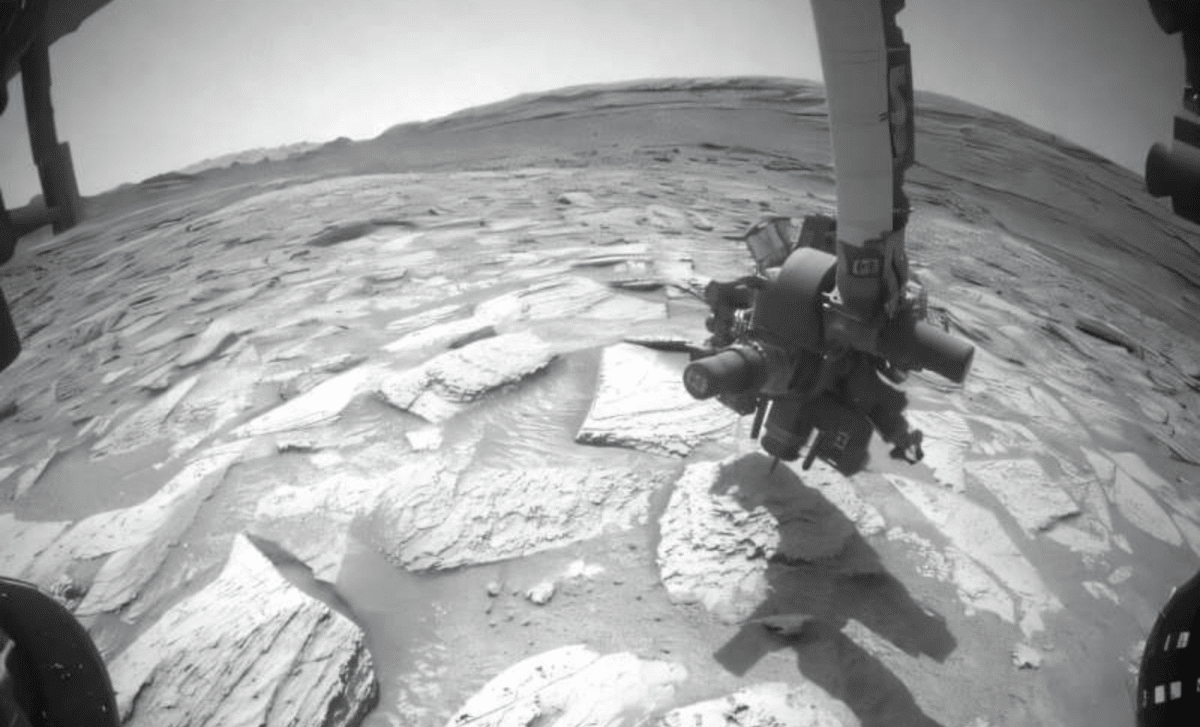
NASA’s Curiosity Rover has demonstrated extraordinary ingenuity and determination by overcoming a rare drilling complication on Mars. When the rover drilled into a rock dubbed Atacama, the entire rock unexpectedly adhered to the drill bit. After multiple attempts, NASA engineers successfully detached the rock, shedding new light on the complex interactions between Curiosity's tools and Martian rock formations. This achievement not only highlights the rover’s ingenuity but also advances our understanding of Mars’ geological landscape.
An Unusual Encounter: The Intriguing Atacama Rock
On April 25, 2026, Curiosity came across a distinctive rock on Mars that presented challenges it had never faced before. Named Atacama, the rock was about 1.5 feet across, half a foot thick, and weighed close to 28.6 pounds (13 kilograms). It rested on the Martian surface within Gale Crater, a region famed for its rich ancient history and clues about Mars’ past environment.
While Curiosity had previously drilled into many rocks, this time, after extracting a sample, the rock astonishingly remained stuck to the drill bit when the robotic arm retracted. This rare occurrence perplexed NASA’s engineering team, as they had never observed a rock adhering so firmly during drilling operations.

Ingenious Strategies to Resolve a Stubborn Hitch
When the rock remained stuck, the NASA team brainstormed approaches to free it. Their initial tactic involved vibrating the drill at various speeds to dislodge the rock, but this failed to produce any results.
On April 29, 2026, they adjusted Curiosity’s robotic arm to a different position and tried vibrating the drill again. Images from the rover’s navigation and hazard cameras revealed sand trickling off the rock, yet Atacama still clung to the bit firmly.
The challenge grew more complex as the rock seemed to secure itself even tighter. Undeterred, NASA engineers devised a series of iterative maneuvers, combining rotations and vibrations of the drill bit to dislodge the stubborn rock. Their perseverance culminated successfully on May 1, 2026, when the new technique freed the rock on its initial application.
The Breakthrough: Freeing the Rock with Precision
The winning method involved tilting the drill further, rotating it delicately, and applying controlled vibrations that finally loosened the rock. Upon detaching, the rock broke after impact with the Martian surface. Though unplanned, this outcome provided vital operational insights for Curiosity’s ongoing tasks. The successful resolution was a morale boost for the team, signaling advancement in handling unpredictable challenges on Mars.
This milestone reflects NASA’s evolving problem-solving capabilities. Despite setbacks, Curiosity’s mission team remains committed to scientific discovery, showing adaptability and securing the rover’s continuous supply of crucial geological data.
Significance for Mars Exploration and Beyond
Though seemingly minor, the Atacama event has profound repercussions for Mars expeditions. Curiosity’s ability to overcome this obstacle underlines the importance of toughness and adaptability in robotic explorers dealing with the Martian terrain. Such flexibility is vital for prolonged space missions where surprises are inevitable.
NASA’s success in managing unforeseen difficulties exemplifies a model for future planetary ventures beyond Mars. Curiosity’s achievements help pave the way for upcoming missions aimed at deeper investigation of the Red Planet’s history and search for life. Each challenge mastered brings humanity closer to deciphering Mars’ enduring mysteries.
- Categories:
- Nasa





0 comments
Sign in to Comment