
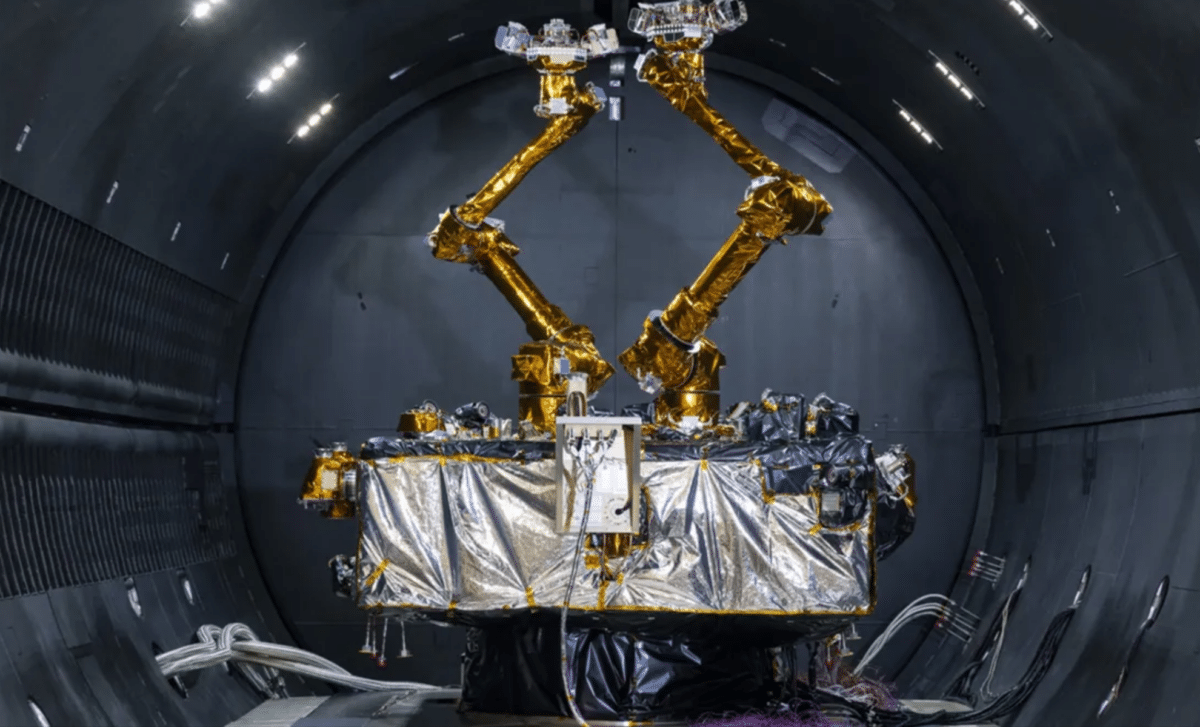
DARPA is gearing up to launch a groundbreaking orbital repair mission involving a robotic spacecraft designed to service and enhance satellites positioned approximately 22,236 miles above Earth. This initiative, titled Robotic Servicing of Geosynchronous Satellites (RSGS), has the potential to transform how public agencies and private enterprises maintain costly satellites in high Earth orbit. The agency anticipates a launch as early as this summer, signaling a major advancement in extending satellite operational lifespans rather than replacing them.
Autonomous Satellite Repair at Extreme Altitudes
Satellites operating in geostationary orbit have long faced a major constraint: a lack of viable service options once onboard fuel dwindles or technical issues develop. Positioned well beyond the International Space Station’s reach, these satellites have remained inaccessible to astronaut repairs using current technology. The RSGS project aims to upend this limitation by deploying a robotic servicing craft equipped with sophisticated manipulation tools into one of Earth’s most valuable orbital zones.
The mission’s primary function involves docking with aging or malfunctioning satellites to conduct precision maintenance in orbit. DARPA referred to the core component as a “highly dexterous robotic servicing suite.” This robotic technology is intended to carry out inspections, orbital corrections, anomaly diagnostics, repositioning maneuvers, and hardware upgrades. Such tasks require exceptional accuracy, given that geosynchronous satellites often represent investments worth hundreds of millions and support critical communications, meteorological observation, defense, and surveillance systems worldwide.

In contrast to satellites in low Earth orbit—which can often be replaced with relative ease—geostationary satellites are engineered for extended service periods. Even a single robotic servicing mission that adds several extra years of life could drastically improve the economics of the satellite market. Program engineers also anticipate that routine robotic support will reduce spacecraft complexity, enabling satellites to launch with fewer backup systems and decreased fuel reserves.
The Strategic Value of Geosynchronous Orbit
Located roughly 22,236 miles above Earth, geosynchronous orbit holds a unique tactical advantage. Satellites here orbit at the same rotational speed as Earth, appearing stationary over a fixed point on the surface. This characteristic makes GEO indispensable for telecommunications, military monitoring, weather prediction, GPS navigation, and climate tracking.
Operating at such great distances entails significant engineering challenges. Launching to GEO demands much more energy than missions targeting low Earth orbit, and every satellite deployed requires a substantial financial investment. Once deployed, these satellites are expected to operate reliably for about 15 years or more. However, even fully functional satellites can quickly become outdated as technology evolves.
DARPA has emphasized this growing concern: “Even fully functional satellites often have their operational lives cut short simply because they carry obsolete payloads — a frustrating situation for owners of assets worth hundreds of millions of dollars. With no support once in orbit, GEO satellites are equipped with redundant systems and maximum fuel capacity, which increases their complexity, weight, and expense,” DARPA noted.
The urgency of this challenge increases alongside rising orbital congestion. Defunct satellites are typically relocated to graveyard orbits once fuel is exhausted, exacerbating the problem of space debris and orbital traffic management. DARPA and collaborators aim to introduce a more sustainable model for GEO operations by deploying servicing spacecraft capable of maintaining multiple satellites during extended missions.
From Setbacks to Upcoming Launch
The RSGS program has experienced numerous hurdles since its inception. Announced in 2017 to showcase robotic servicing at geosynchronous altitude, the mission faced contractor changes, pandemic-related supply chain disruptions, and challenges integrating the servicing payload technology.
Initially managed by Maxar Technologies, which withdrew in 2019, responsibility later shifted to SpaceLogistics, a Northrop Grumman subsidiary. The team encountered significant obstacles in adapting the complex robotic payload for practical use aboard the spacecraft.
Now, after nearly ten years of development, DARPA reports the mission is nearing launch readiness. Following deployment, the spacecraft will use electric propulsion over roughly ten months to reach GEO, where it will conduct a series of tests to demonstrate in-orbit servicing capabilities under operational conditions.
Collaboration includes contributions from NASA and the U.S. Naval Research Laboratory, highlighting the strategic importance of validating robotic servicing technologies as critical tools for future national space assets. This partnership reflects an expanding understanding that maintaining satellites in orbit may prove as crucial as their initial deployment.
Advancing Toward Sustainable Satellite Networks
The vision behind RSGS extends beyond just refueling. DARPA envisions a future in which satellites evolve dynamically, receiving ongoing upgrades, repairs, inspections, and hardware replacements while remaining operational.
This shift could revolutionize the business of space operations. Instead of designing satellites to last decades without intervention, manufacturers might create systems optimized for regular in-orbit servicing, reducing launch expenses, simplifying designs, and enhancing adaptability to fast-changing technologies.
DARPA encapsulated this ambition in its mission statement.
“By transitioning from a paradigm of disposable space assets to one of sustainable, upgradable, and resilient satellites, RSGS aims to fundamentally alter space operations for both the public and private sectors,” officials wrote of the mission in a separate statement. “With launch on the horizon, the RSGS program is poised to pave the way for a more resilient and sustainable infrastructure in space.”
Global interest in orbital servicing is intensifying, with companies like Astroscale and Thales Alenia Space developing similar technologies. DARPA’s mission could become one of the first major demonstrations proving robotic satellite repair can be reliably performed at geostationary distances.
- Categories:
- Space










0 comments
Sign in to Comment