
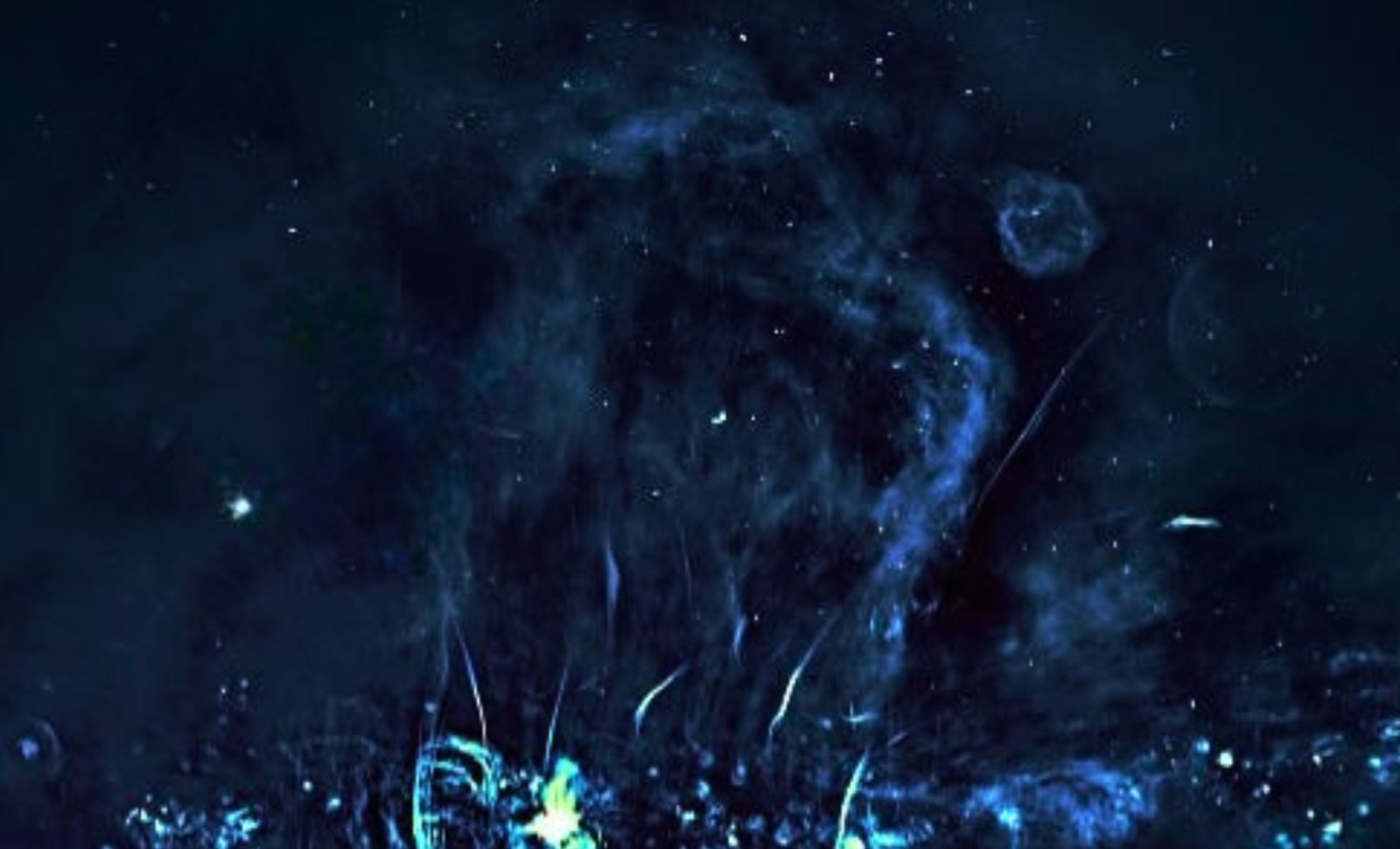
For nearly 40 years, astronomers puzzled over a striking feature captured in radio images of the Milky Way. This formation, dubbed the Galactic center lobe, was observed repeatedly as a massive arc seeming to rise from the turbulent heart of our galaxy. Scientists proposed various origins, from a supernova remnant to the effects of a powerful outburst from the supermassive black hole at the galaxy's core, but no consensus was reached.
Described by researchers as "a Rorschach test for Galactic astrophysics," the mystery has now been clarified thanks to a recent study published in Astronomy & Astrophysics. The findings reveal that this structure is not related to the galactic nucleus, but is instead a spherical bubble of ionized gas located only about 6,520 light-years away—well in front of the galactic center.
Led by astrophysicist Kathryn Kreckel from Heidelberg University, the team argues the feature’s true shape is a closed bubble likely formed and illuminated by the activity of massive stars within the Milky Way’s disk. To reflect its complex history and shape, they suggest renaming the object the “greatly confused loop.”

Why Pinpointing the Structure’s Location Was So Challenging
The difficulty in locating this phenomenon stems from the complexity of the galactic center, crowded with countless stars, dense gas clouds, and dust that clutter the line of sight from Earth. Determining distances in this area is notoriously problematic, resulting in large uncertainties even for well-known objects.
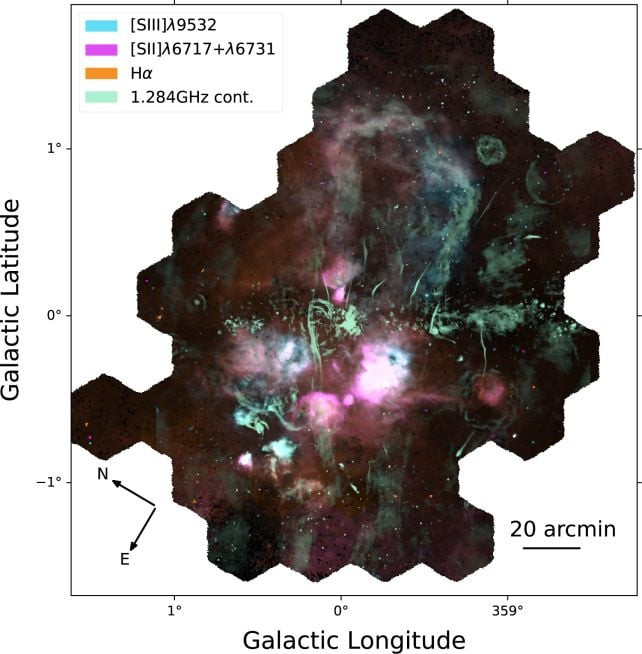
The shape of the Galactic center lobe added another layer of confusion. Its lower portion overlaps the bright emissions of the galactic plane, making it indistinguishable from surrounding sources in radio observations. As a result, only the upper arc was visible, creating the illusion of an open lobe extending from the galactic core.
In reality, the missing lower segment forms part of a closed bubble concealed behind the very environment astronomers aimed to study—prompting a “40-year struggle to separate genuine nuclear features from the foreground galactic disk,” according to the researchers.
Ionized Sulfur: The Key to Revealing the Entire Bubble
The breakthrough emerged via an unexpected tool: the SDSS-V Local Volume Mapper, which captures optical and infrared emissions of glowing gases across the Milky Way by simultaneously observing multiple emission lines.
Among these, ionized sulfur emission stood out. Its longer, red-shifted wavelength penetrates interstellar dust more efficiently than other emissions, enabling the lower hidden part of the bubble to become visible for the first time.
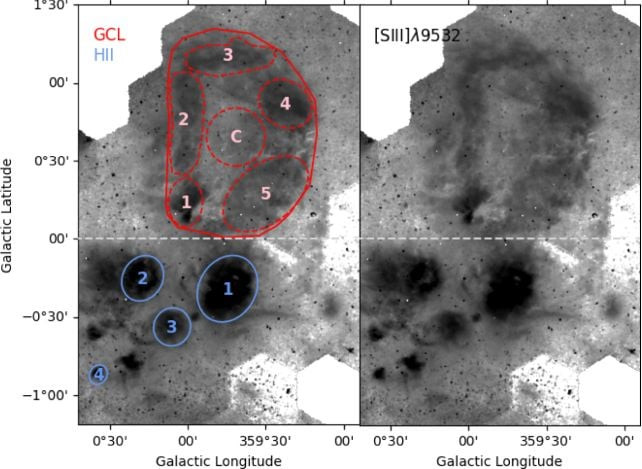
Using this data alongside 3D Milky Way dust distribution maps, the team estimated the bubble’s distance at about 6,520 light-years—significantly closer than the galactic center, which lies at roughly 26,000 light-years from our vantage point.
This updated proximity also means the structure is smaller than previously assumed, spanning approximately 115 light-years across. This size is comparable to Barnard’s Loop, a renowned shell in the Orion constellation formed by stellar winds and supernova explosions.
Star Formation, Not Black Hole Activity, Shapes the Bubble
The Galactic center lobe is actually a vast hydrogen gas cloud emitting light due to intense ultraviolet radiation. While the exact stellar sources remain unidentified, the formation mechanism likely mimics those of similar galactic features elsewhere.
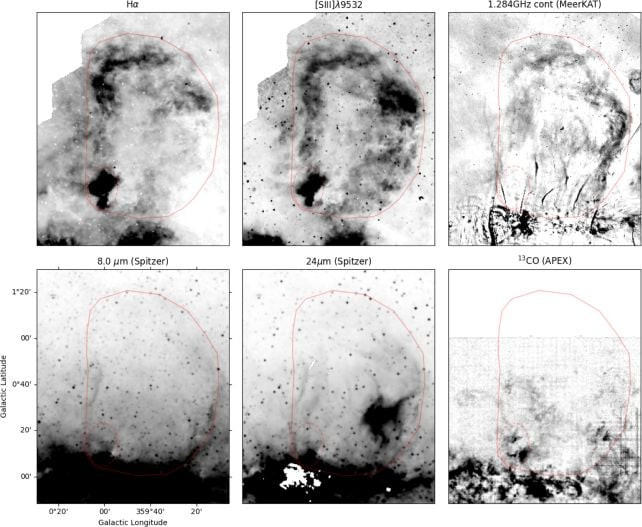
Clusters of massive stars formed in the same stellar nursery have short lifespans, ending in supernova explosions that carve cavities into the surrounding gas and dust. The expanding shock front compresses material at its edges, triggering new star formation. The young stars then bathe the gas in ultraviolet light, causing it to shine. From Earth’s perspective, this glowing shell appears as a loop or arc rather than a full sphere.
This process closely parallels that which crafted Barnard’s Loop in Orion. The similarities in scale and formation suggest the so-called Galactic center lobe is not a relic of black hole activity or ancient galactic nuclear events, but rather a familiar consequence of massive stellar life cycles within the Milky Way’s disk.
- Categories:
- Science











0 comments
Sign in to Comment