
A group of astronomers from around the world has pioneered a novel approach that could transform how we detect some of the faintest black holes across the cosmos. By employing frequency phase transfer (FPT), the team effectively compensated for atmospheric distortions, significantly boosting the performance of the Event Horizon Telescope (EHT) network. This advancement, detailed in a recent report The Astronomical Journal, unlocks the potential for longer observations, paving the way to reveal black hole features previously out of reach.
Mitigating Atmospheric Effects to Probe Deeper into Black Hole Environments
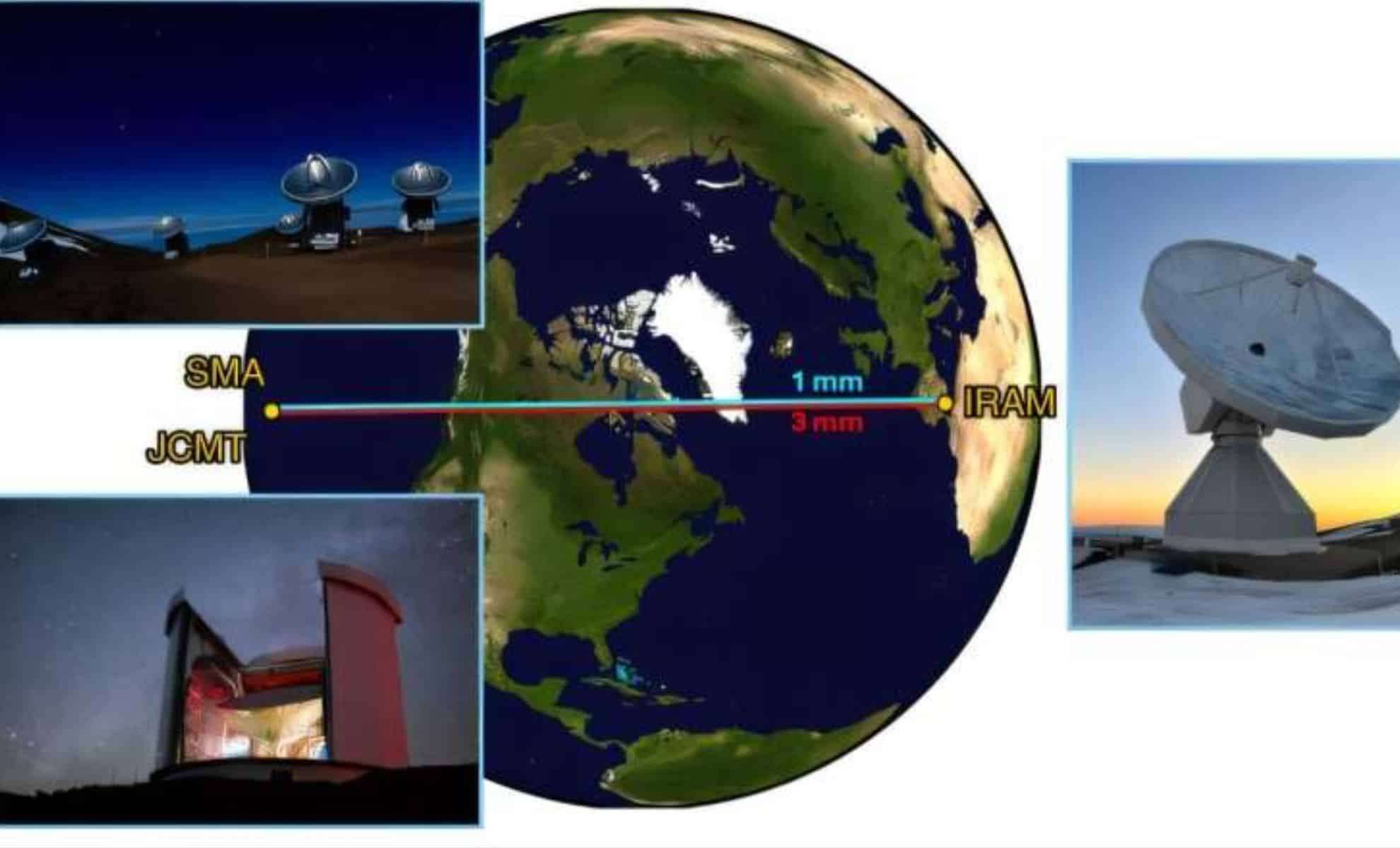
Detecting black holes at millimeter-wave frequencies from Earth is notoriously difficult due to atmospheric turbulence that distorts radio signals. The EHT—a global collaboration merging radio telescopes into an Earth-sized virtual instrument using very long baseline interferometry (VLBI)—has captured the clearest black hole images so far. Yet, atmospheric interference limits exposure duration and confines observations to the brightest black holes. The FPT method overcomes this obstacle by using atmospheric data gathered at a 3 mm wavelength to correct measurements taken at 1 mm. This correction clarifies the radio signals, allowing astronomers to extend exposure times and identify dimmer black holes than previously possible.
Demonstrating Multi-Wavelength Capability With Existing EHT Facilities
The latest trial connected three EHT sites: the IRAM 30-Meter Telescope in Spain alongside the James Clerk Maxwell Telescope (JCMT) and the Submillimeter Array (SMA) in Hawaii. Observing simultaneously at two different wavelengths, the study confirmed that atmospheric phase data from 3 mm observations could enhance the clarity of 1 mm data—an unprecedented achievement at these short wavelengths. This ability to conduct "multicolor" observations is unusual among current EHT stations, which typically operate at a single wavelength. Successfully applying FPT at 1 mm signals a vital step forward in expanding the EHT’s sensitivity and its capability for multi-frequency black hole imaging.

The Road Ahead: Expanding Black Hole Exploration and Telescope Technology
The promising results with FPT spur efforts to broaden multi-wavelength observations across the entire EHT network, establishing a foundational strategy for next-generation black hole research. Projects such as the Next-Generation EHT (ngEHT) and the Black Hole Explorer (BHEX) plan to integrate these improvements, giving scientists the tools to capture richer, more varied black hole data. Extended exposure durations and heightened sensitivity will provide deeper insights into faint black holes, changes within accretion disks, and jet dynamics with unmatched detail. This technique enhances current telescope performance and heralds new opportunities for unraveling the mysteries of the universe’s darkest phenomena.
- Categories:
- News











0 comments
Sign in to Comment