
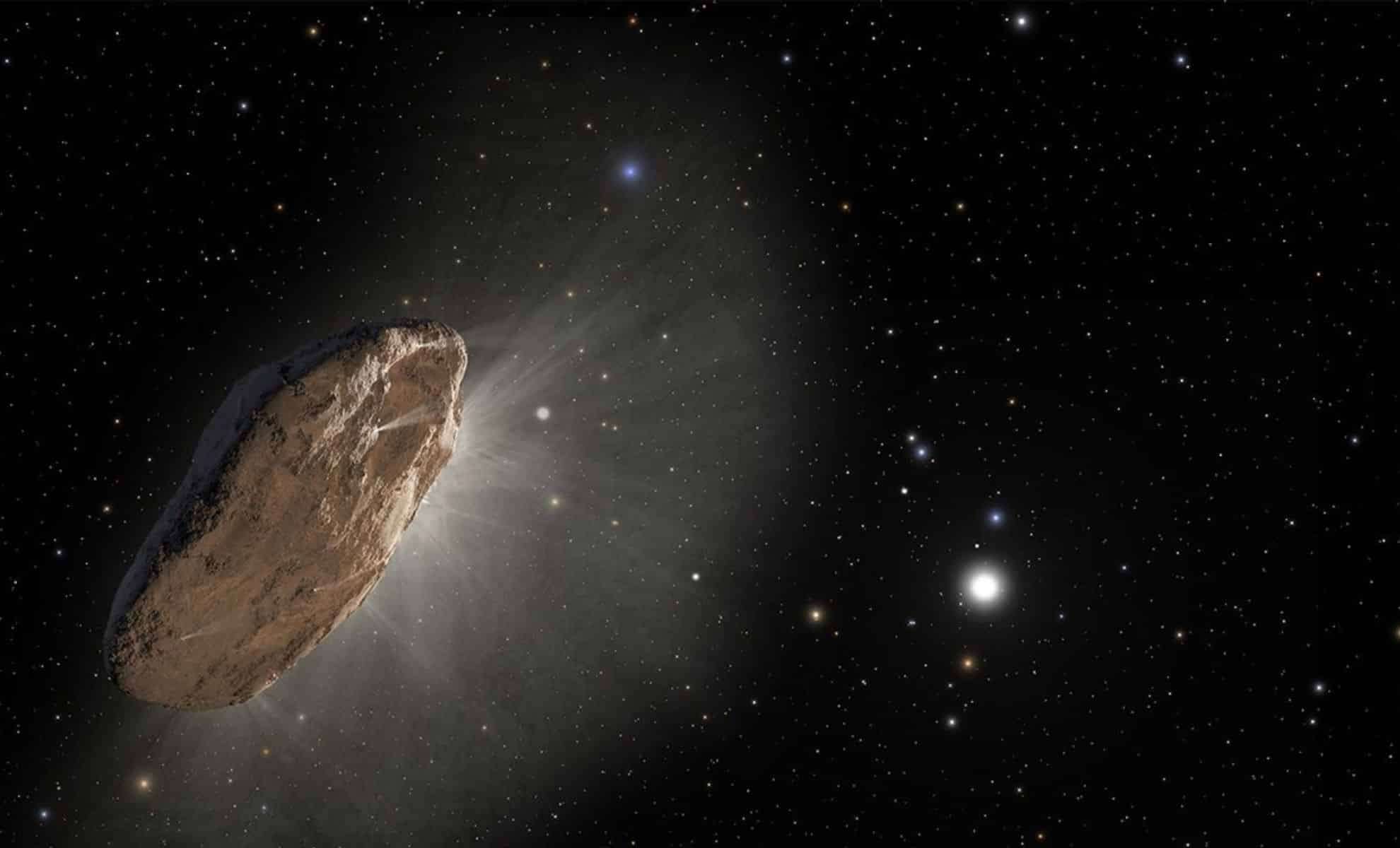
In groundbreaking studies published in 2018 and 2021 within the Journal of Geophysical Research: Planets, planetary researchers Steve Desch and Alan Jackson from Arizona State University introduced an innovative explanation for the nature of ‘Oumuamua, the first documented interstellar visitor in our solar system.
A Fragment from an Icy World Beyond Our System
Discovered in October 2017 by Hawaii’s Pan-STARRS1 telescope, 1I/’Oumuamua intrigued astronomers with its odd path, tumbling spin, and absence of a comet-like tail. Originally categorized as a comet, its properties defied typical cometary behaviors. What set ‘Oumuamua apart were its exceptionally reflective surface, its distinctive stretched or flattened shape, and most importantly, a chemical profile that lacked the usual comet emissions. Through detailed simulations and investigation, Desch and Jackson deduced that the object was nearly entirely made of nitrogen ice—a substance common on Pluto and other objects in the Kuiper Belt.
“All evidence points to this being a slab of nitrogen ice similar to that found on Pluto’s exterior,” explained Steve Desch, emphasizing the importance of this finding. This nitrogen-rich composition is extremely rare within our solar system and generally forms on the surfaces of cold, distant dwarf planets. According to Desch’s hypothesis, ‘Oumuamua originated as part of the crust of an icy exoplanet—akin to an “exo-Pluto”—which suffered a catastrophic collision that expelled fragments into space.

The Violent Past of Exo-Pluto Remnants
During the early stages of planetary system formation, chaotic events like collisions and gravitational disturbances are common. Desch suggests that exo-Pluto-like bodies are frequently damaged in such cosmic turmoil. These bodies, formed in the outer, icy regions of their star systems, were likely shattered by powerful impacts that dislodged nitrogen-rich surface pieces. Simulations by Desch and Jackson indicate that the early solar system alone could have created as many as 2,000 Pluto-sized objects, many of which were fragmented or destroyed.
Once broken off, these pieces—including nitrogen ice slabs—could be flung out of their home systems by gravitational interactions with gas giants or through orbital instabilities. “Since such objects weren’t commonly observed in our solar system before, we didn’t anticipate their presence,” Desch shared with Space.com. “Yet these fragments almost certainly exited our solar system, and ‘Oumuamua forces us to reconsider the volume of material ejected.”
Some of these fragments may have lodged in distant areas such as the Oort Cloud, while many others journey across interstellar space, potentially drifting for millions or billions of years until encountering another star system, just as ‘Oumuamua entered ours.
Why ‘Oumuamua Defies Traditional Comet Classification
‘Oumuamua's unusual orbit and its absence of gas emissions place it outside the typical comet or asteroid categories. Measuring around 330 feet (100 meters) long, it was smaller than many comets and showed no coma or tail. Additionally, its velocity was slower than expected for an interstellar comet. Desch suggests this is because it may have been expelled from a relatively young star system, lacking accelerations common in older stellar neighborhoods.
Its nitrogen ice composition also provides a key clue. On cosmic timescales, nitrogen ice is short-lived due to cosmic ray degradation. Desch estimates ‘Oumuamua’s age to be under 2 billion years and possibly as young as 500 million years. “‘Oumuamua represents a distinct category of objects,” he noted. “They are harder to detect, but far more numerous.” Unlike typical water-ice comets, nitrogen ice fragments may reflect more light initially but also sublimate faster, rendering them fleeting and difficult to observe.
Insights ‘Oumuamua Offers About Our Solar Neighborhood
‘Oumuamua may not be unique but rather the earliest identified example of a widespread class of interstellar debris. Desch believes these pieces provide a glimpse into the outer layers of icy dwarf planets that have mostly been destroyed. “I am convinced these fragments from Pluto-like surfaces contribute to the population leaving our solar system,” he stated. This understanding helps reveal more about our own Pluto, which New Horizons found to have a nitrogen ice shell that has likely diminished over the past 4.5 billion years.
Desch further proposes that some comets observed within the solar system might be fragments of Kuiper Belt objects. Examples including C/2016 R2, C/1908 R1 Morehouse, and C/1961 R1 Humason exhibit nitrogen-enriched chemistries compatible with this idea. As Desch remarked, “Additional studies of ‘Oumuamua-like bodies ... would deepen our knowledge of Pluto-like compositions.”
- Categories:
- News







0 comments
Sign in to Comment