

As warm evenings arrive, many stargazers look up hoping to identify well-known constellations. While the Big Dipper is a common favorite, the less conspicuous but equally captivating Little Dipper, or Ursa Minor, often goes unnoticed due to its fainter stars. Yet, with some tips, even residents of brightly lit cities can locate this stellar gem.
A Gentle Introduction to Locating the Little Dipper
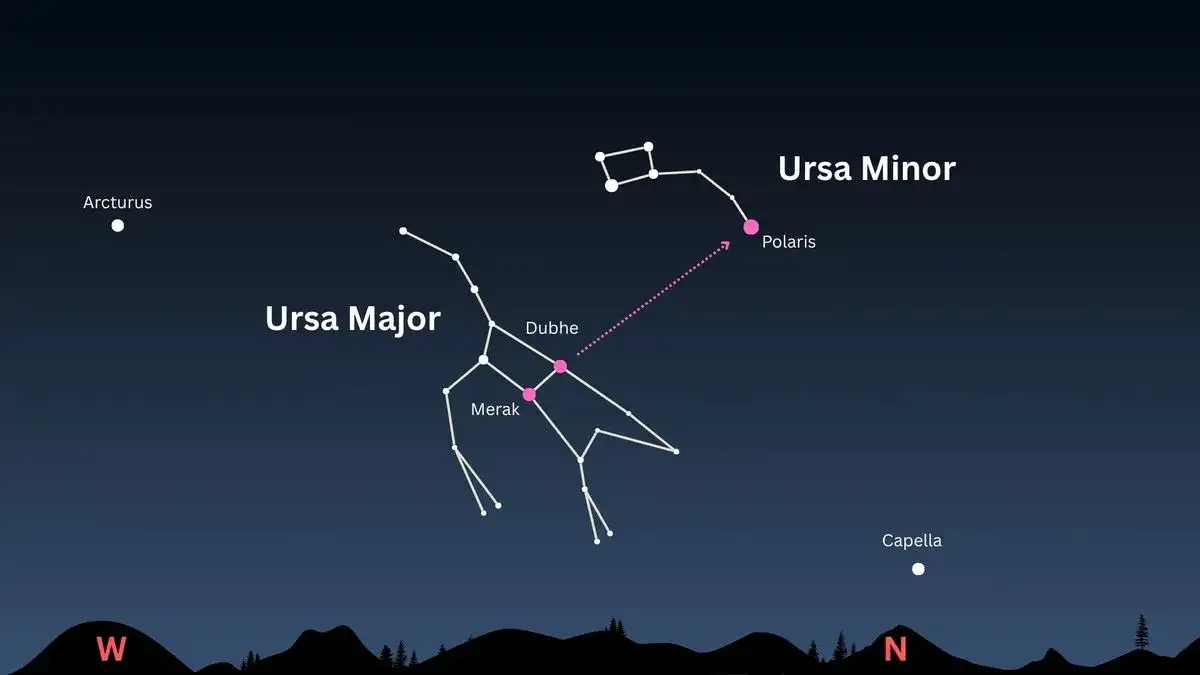
A frequent misunderstanding is confusing the Pleiades star cluster with the Little Dipper. Although the Pleiades resemble a small, slanted dipper, the true Little Dipper is Ursa Minor. It consists of seven stars, with Polaris, famously known as the North Star, located at the tip of its handle.
Since Ursa Minor’s stars are dim, they can be difficult to detect in areas affected by light pollution, making them nearly invisible to those in urban settings. However, knowing the precise spot to look can greatly improve your chances of seeing them.

Navigating from the Big Dipper to Find the Little Dipper
Space.com explains that Polaris is essential for finding the Little Dipper. Contrary to popular belief, the North Star is not one of the brightest stars but remains almost stationary in the sky, making it a reliable point of reference.
To locate Polaris, use the Big Dipper’s Pointer stars, Dubhe and Merak. Draw an imaginary line connecting these two stars and extend it roughly five times its length. This line directs you straight towards the North Star.
Your latitude affects Polaris’s position: in a city like Minneapolis, it appears about halfway between the horizon and the zenith. At the North Pole, it’s directly overhead, whereas near the equator, it sits low on the horizon. Traveling southward beyond the equator causes Polaris to vanish from view.
The Celestial Guardians of the North
Within Ursa Minor, two stars at the front of the bowl stand out as the Guardians of the Pole: Kochab and Pherkad. Positioned nearest to the celestial pole apart from Polaris, they seem to orbit the North Star in a steady march.
Historically, these stars have been invaluable for navigation. Kochab, notable for its brighter orange glow, is a second-magnitude star, while the slightly dimmer Pherkad shines at third magnitude. Explorers like Christopher Columbus relied on their consistent presence for timing and course setting on oceanic voyages.
The Fascinating Nature of Polaris
Though heralded as the North Star, Polaris is often mistaken for the brightest star, but it ranks only as the 47th brightest in the night sky. This star belongs to a triple system, with the main component being a yellow supergiant about 446 light-years away. It’s vastly larger than the Sun—about five times the mass, 46 times the diameter, and nearly 1,300 times more luminous.
Polaris’s importance stems not from its brightness, but from its guiding role. Classified as a Cepheid variable star, its luminosity pulsates slightly by approximately 0.1 magnitude over roughly four days.
The Changing Face of the North Star
Polaris will not remain the North Star indefinitely. Due to precession, a slow wobble of Earth’s axis happening over about 25,800 years, the identity of the North Star shifts. In ancient times, the star Kochab served as the North Star around 1200 B.C., marking the dawn of the Iron Age.
On March 24, 2100, Polaris will reach its closest point to the celestial pole—just 27.15 arc-minutes away, narrower than the Moon's apparent diameter. Despite moving nearer, it will never align exactly with the pole.
- Categories:
- News












0 comments
Sign in to Comment