
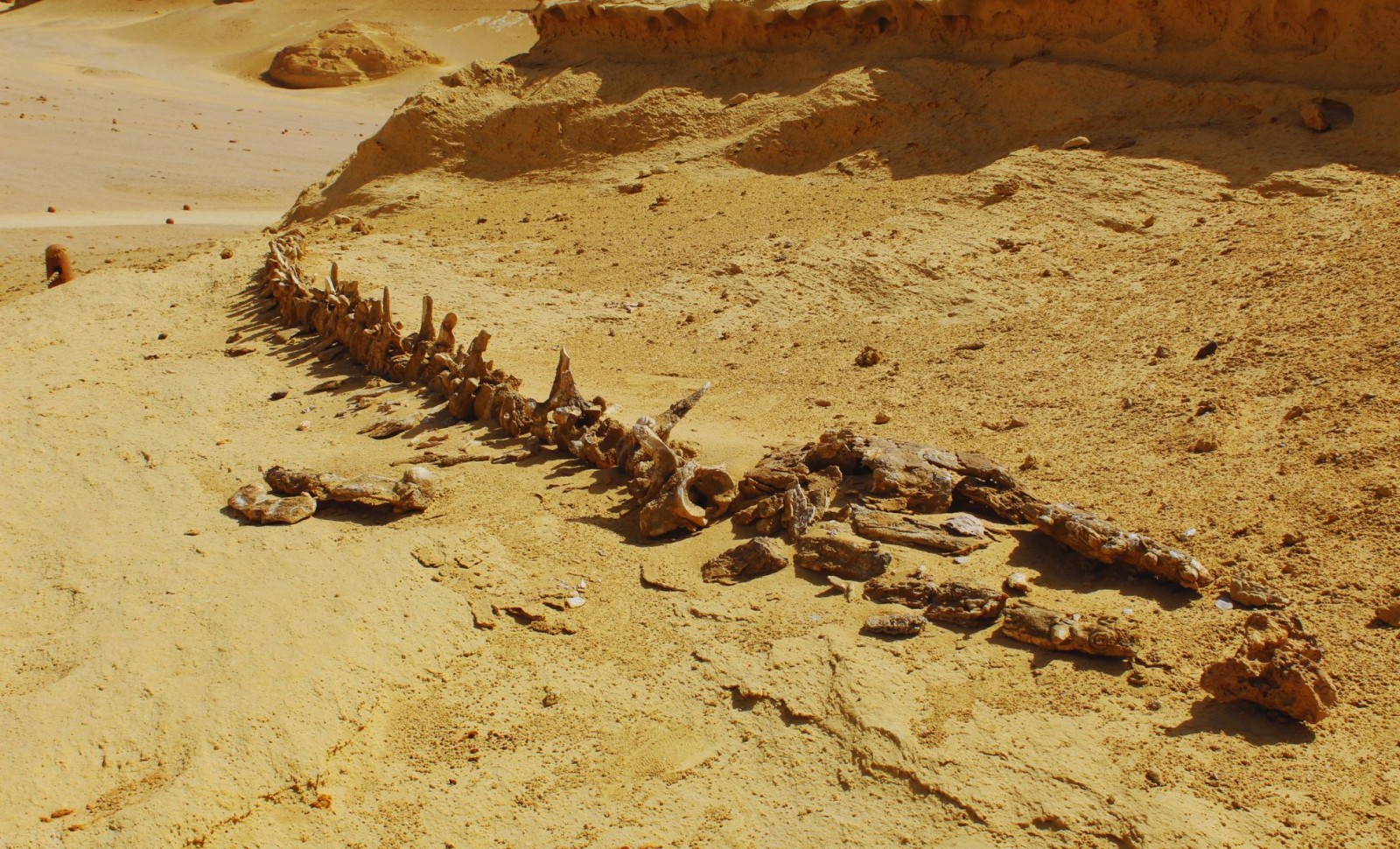
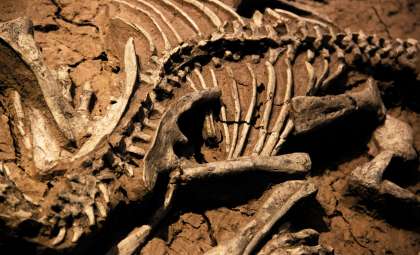
Deep within Egypt’s Western Desert, researchers have uncovered over 400 fossilized whale skeletons dating back more than 40 million years. These fossils include hind legs and toes, providing compelling evidence that ancient whales once traversed land.
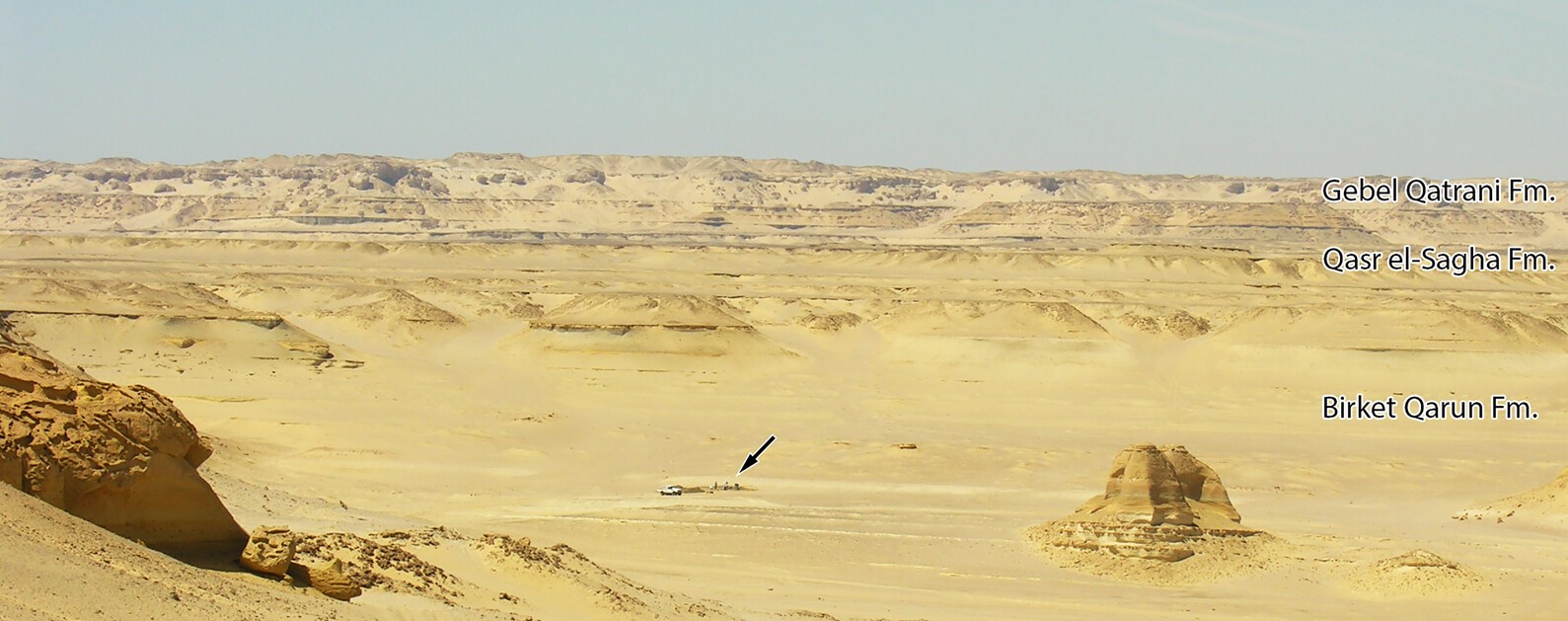
This vast desert landscape was once covered by the ancient Tethys Ocean, a rich marine habitat. The discovery site, called Wadi Al-Hitan or the Valley of the Whales, marks the period when land mammals were evolving into fully aquatic whales.
Four-legged Whales Unearthed During Their Evolutionary Shift
Documented since the early 1900s, Wadi Al-Hitan offers invaluable insight into the late Eocene epoch, approximately 34 to 56 million years ago, when early whales were making the transition from land to sea. The fossils are exceptionally well-preserved thanks to the region’s dry climate, which has remained stable since the Pliocene. Many skeletons remain partially embedded in sandstone, creating a distinctive fossilized landscape.

A landmark discovery at Wadi Al-Hitan was the 1989 excavation by teams from the University of Michigan and the Egyptian Geological Museum, where nearly complete remains of Basilosaurus isis were found. A recent study published in Geological Society Publications describes this species’ jointed legs, small feet, and distinct toes as clear anatomical proof of whales’ terrestrial origins.
First identified in 1902, Basilosaurus isis could reach lengths up to 60 feet and was likely a top predator. Marine mammal scientist Manja Voss of the Berlin Museum of Natural History describes it as "having a long snout armed with sharp incisors and cheek teeth", capable of crushing its prey’s skull before consumption.
From Ocean Depths to Desert Sands
In addition to whales, Wadi Al-Hitan has revealed fossils from diverse ancient marine life, painting a detailed picture of this prehistoric ecosystem. Discoveries include sea turtles, ancient sharks, rays, bony fishes, and early crocodilians.
Futura-Sciences notes researchers have also uncovered fossil evidence of early manatees, confirming the valley’s past as a biologically rich marine habitat. This diverse fossil collection helps scientists reconstruct food webs and predator-prey relationships within the ancient Tethys Ocean.

Evolution Etched in Stone
The fossil record at Wadi Al-Hitan reveals gradual evolutionary changes: reduction of hind limbs, relocation of nasal openings for breathing at the water’s surface, and transformation of front limbs into flippers. These adaptations are preserved in the desert’s sedimentary layers.
These evolutionary steps aren’t just history; modern whales still carry vestiges of their land-dwelling ancestors in the form of hidden pelvic bones that once supported walking legs. Visitors to Wadi Al-Hitan can walk alongside exposed whale fossils, directly connecting with this remarkable transition.
Although accessible to the public, the valley remains a protected site, continuously contributing new knowledge about the journey of mammals from land to sea.
- Categories:
- Science



0 comments
Sign in to Comment