

Scientists anticipated that planets orbiting pairs of stars would be abundant, yet only a small number have been discovered. New findings suggest that Einstein's general relativity might be responsible for eliminating many of these worlds.
For some time, this discrepancy has intrigued astronomers. Since binary star systems are frequent throughout the galaxy and planet formation happens regularly, the low count of such planets seemed contradictory.
Data from leading space missions like Kepler and TESS reinforced this unexpected trend. What once appeared to be ideal environments for exotic planet discoveries has triggered deeper investigations into gravitational effects over time.

The Unexpected Rarity of Planets Around Binary Stars
Despite there being over 6,000 confirmed exoplanets, just 14 of them orbit dual-star systems. As reported in The Astrophysical Journal Letters, expectations based on the prevalence of planets and binary stars suggested there should be hundreds. Observations make this shortage unmistakable: Kepler detected approximately 3,000 eclipsing binaries, yet only 47 planet candidates have been identified there, with only a few confirmed.
There’s also a notable blind spot—no planets have been discovered around binary stars orbiting each other in under seven days. UC Berkeley researcher Mohammad Farhat describes this absence as a true "desert" in the planetary census.
“You have a scarcity of circumbinary planets in general and you have an absolute desert around binaries with orbital periods of seven days or less,” he said. “The overwhelming majority of eclipsing binaries are tight binaries and are precisely the systems around which we most expect to find transiting circumbinary planets.”
General Relativity’s Crucial Role
The root cause appears to be a subtle gravitational effect. In these systems, both stars and orbiting planets undergo orbital shifts known as precession, but due to different influences. Research by teams at UC Berkeley and the American University of Beirut reveals that the stars’ orbits are impacted by general relativity, especially under tidal forces pulling the stars closer. This accelerates the stars’ orbital motion, while the planet’s orbital speed decreases.
Eventually, this synchronization results in a resonance that destabilizes the planet’s orbit. As Farhat explains, this causes the orbit to extend dramatically, risking the planet’s ejection from the system or its inward spiral and destruction. Simulations estimate that almost 80% of planets in these compact binaries fail to endure.
An Unstable Region That Wipes Out Planets
Another key component is the instability zone, a region around binary stars where planetary orbits cannot remain stable. Jihad Touma explains that as a planet’s orbit becomes more eccentric, it drifts into this hazardous area.
“A planet caught in resonance finds its orbit deformed to higher and higher eccentricities, precessing faster and faster while staying in tune with the orbit of the binary, which is shrinking.” Touma added, “And on the route, it encounters that instability zone around binaries, where three-body effects kick into place and gravitationally clear out the zone.”
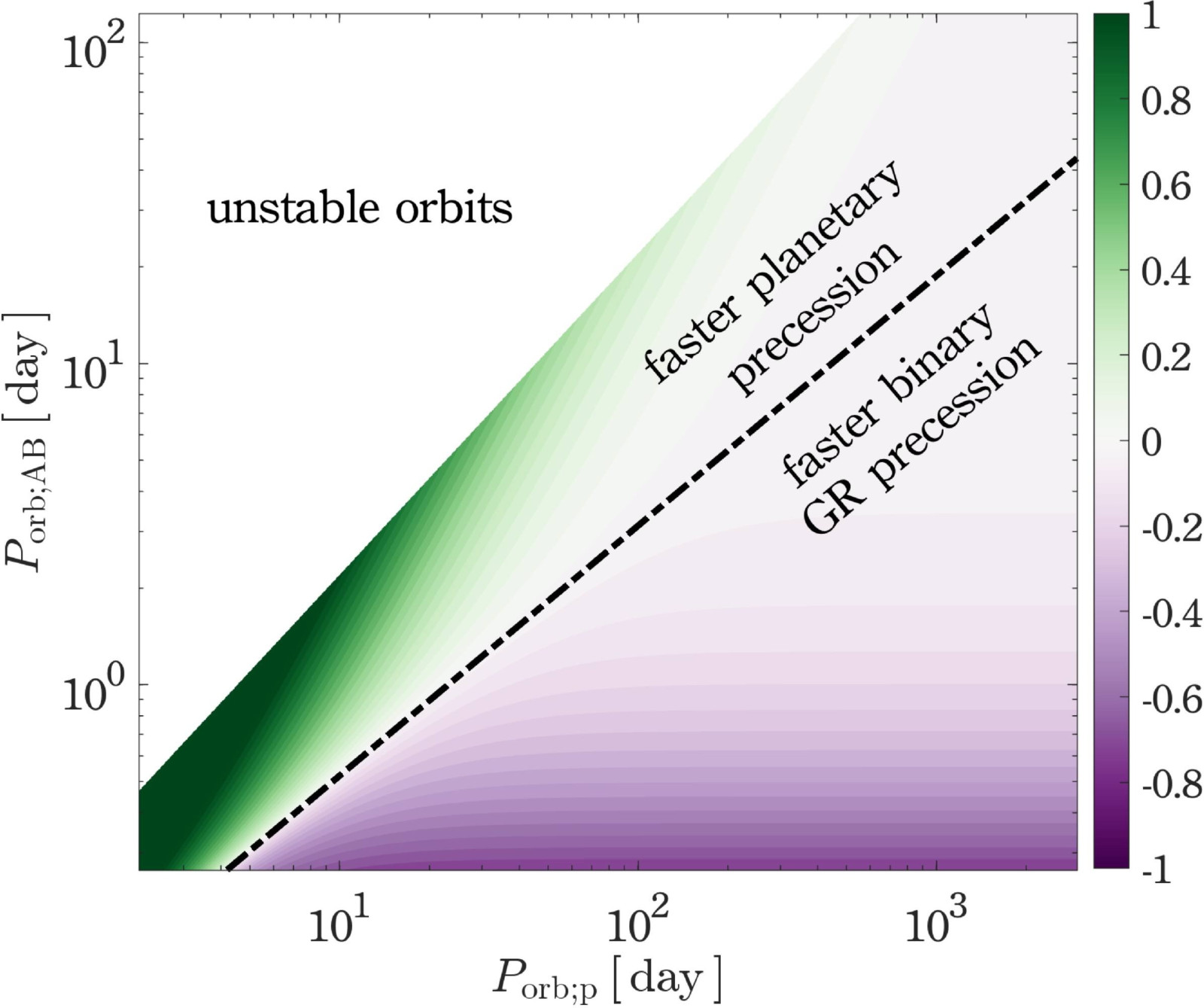
The majority of circumbinary planets observed are located just beyond this instability threshold, implying they formed farther out and gradually migrated inwards, stopping before entering unstable zones. Touma likens the challenge of planet formation near this boundary to "trying to stick snowflakes together in a hurricane," highlighting its chaotic nature.
These insights demonstrate that Einstein’s theory, formulated over a century ago in 1915, continues to influence our understanding of cosmic structures today, sometimes by preventing entire planets from surviving long enough to be detected.
- Categories:
- Astronomy










0 comments
Sign in to Comment