
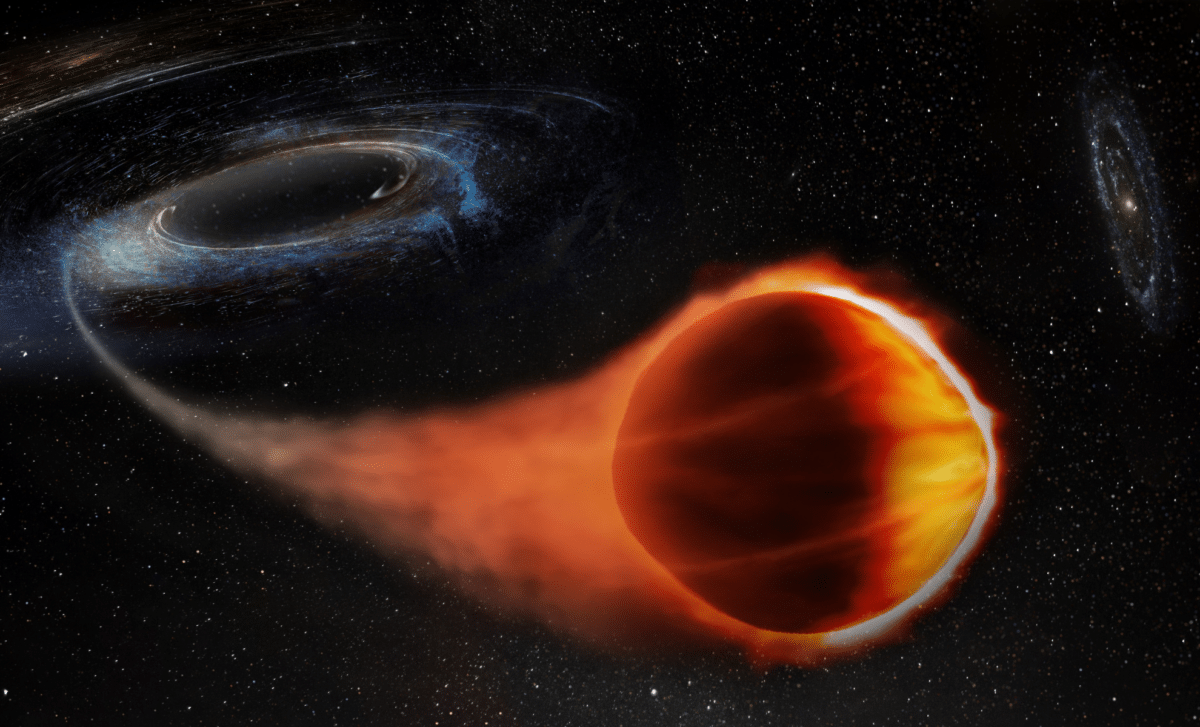
A recent landmark investigation published in Science Advances has provided definitive evidence confirming a prediction made by Albert Einstein over a hundred years ago: the twisting of spacetime, termed frame-dragging or spacetime vortices, has been observed directly near a supermassive black hole. This achievement enhances our comprehension of black hole dynamics and their effect on the fabric of the cosmos.
Impact of Rotating Black Holes on Spacetime
Frame-dragging, a phenomenon where a rotating massive body distorts the surrounding spacetime, was initially proposed by Einstein in 1913 and mathematically formulated by Lense and Thirring in 1918. While this effect has been detected around smaller celestial bodies like Earth and Jupiter, capturing this phenomenon around a supermassive black hole remained a considerable challenge until now.
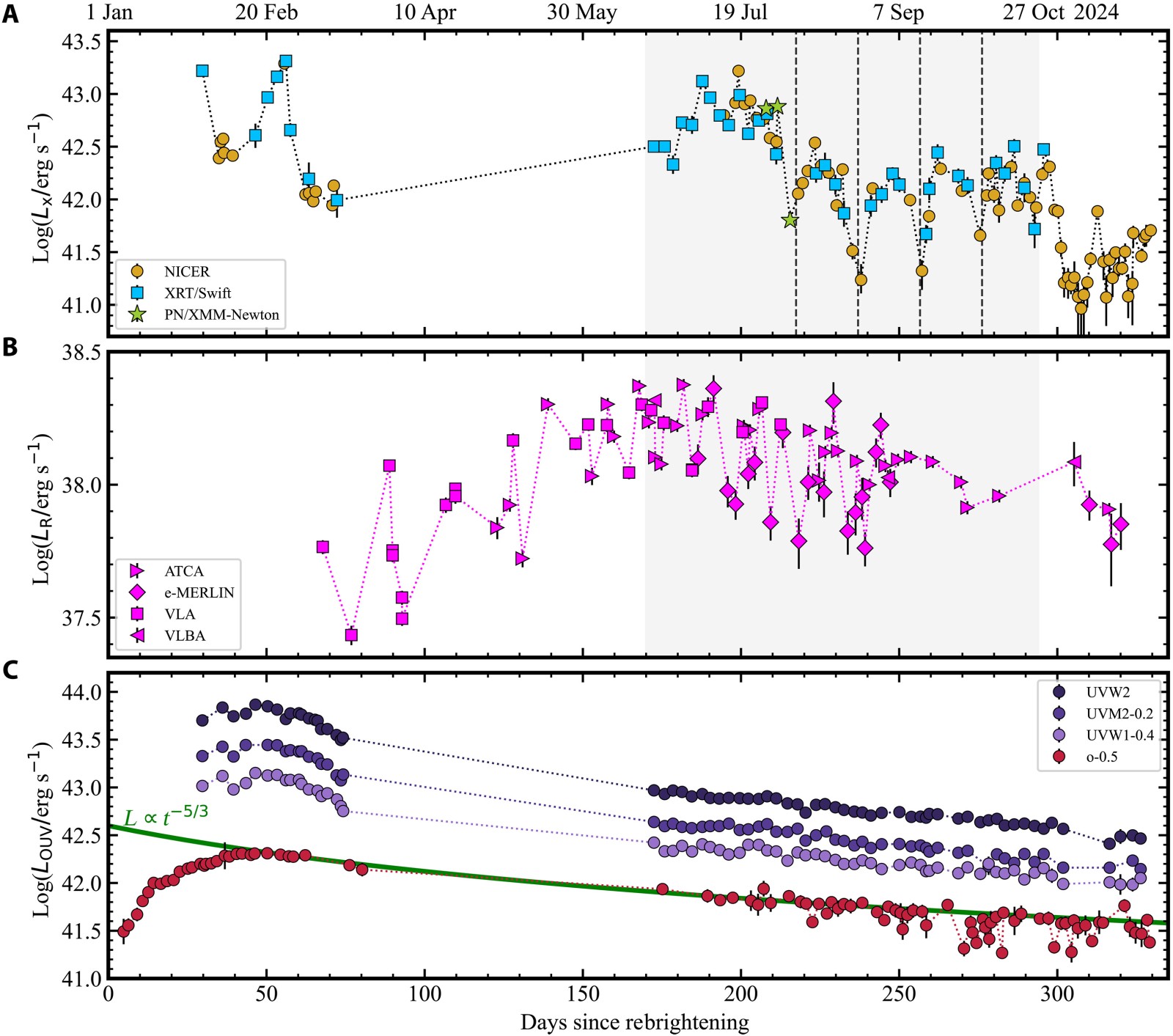
The breakthrough came through detailed analysis of a Tidal Disruption Event (TDE), a catastrophic cosmic incident where a black hole tears apart a star. The immense gravitational forces generate striking disturbances in spacetime. By scrutinizing X-ray and radio signals from a particular event, AT2020afhd, researchers identified periodic variations in the emissions consistent with frame-dragging. This marks the first time such vast-scale measurements have confirmed this effect.

Innovative Approach to Black Hole Analysis
Dr. Cosimo Inserra, a contributing author from Cardiff University, stated, “Detecting frame-dragging caused by a black hole’s rotation allows us to dissect the underlying physics of these extraordinary objects.” The report, appearing in Science Advances, introduces a transformative technique to examine black hole behavior via spacetime distortions they induce. TDEs provide a unique window into observing how spinning black holes directly influence their environments.
“So, in the same way a charged object creates a magnetic field when it rotates, we’re seeing how a massive spinning object – in this case a black hole – generates a gravitomagnetic field that influences the motion of stars and other cosmic objects nearby,” Inserra added.
This observation not only pushes forward the frontier of black hole research but also broadens our understanding of how massive objects govern cosmic structures.
Deeper Understanding of Stellar Destruction Through TDEs
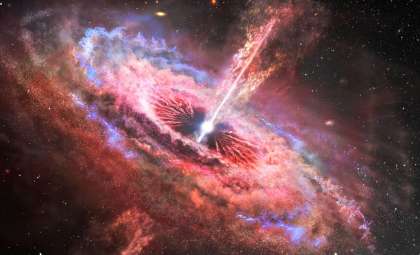
Astronomers have long been intrigued by Tidal Disruption Events, which occur when stars stray too close to black holes and are violently torn apart. For AT2020afhd, debris formed a plasma disk and an energetic jet emerged from near the black hole. Unlike typical TDEs, this event exhibited rapid fluctuations in its emissions, anomalies unexplained purely by the energy emitted from the black hole.
“These short-term changes, which we were unable to attribute to the energy release from the black hole and its surrounding components, further confirmed the dragging effect in our minds,” Dr. Inserra noted.
These distinctive signals provide a powerful new lens to investigate both the physical processes in TDEs and the fundamental nature of black holes.
Unraveling Cosmic Mysteries Through Frame-Dragging
Grasping frame-dragging’s role is essential to decoding black hole phenomena. When an immense object such as a rotating black hole spins, it drags the surrounding spacetime fabric, altering trajectories of nearby stars and matter within its accretion disk in previously unimaginable ways.
“This is a real gift for physicists as we confirm predictions made more than a century ago. Not only that, but these observations also tell us more about the nature of TDEs—when a star is shredded by the immense gravitational forces exerted by a black hole,” Dr. Inserra explained.
Access to empirical data on frame-dragging offers an unprecedented tool to explore black hole dynamics, opening avenues for deeper cosmic understanding.
- Categories:
- Astronomy








0 comments
Sign in to Comment