

With the ever-growing accumulation of space debris circling our planet posing serious risks to satellites and future space ventures, scientists have developed a cutting-edge technique utilizing electrostatic forces to maneuver objects remotely in space. Spearheaded by experts from CU Boulder’s aerospace engineering department, this initiative is inspired by the famed Star Trek tractor beam concept but grounded firmly in scientific reality and experimental testing.
An Enhanced Method to Manage Orbital Clutter
The project emerged from rising concerns over the intensifying space debris problem. Orbiting Earth are numerous defunct satellites and rocket remnants, all traveling at high velocities. Physical contact with these fragments risks triggering devastating collisions, increasing the threat to operational spacecraft.
“Touching things in space is very dangerous,” explained Kaylee Champion, one of the CU Boulder researchers involved in the study. “Objects are moving very fast and often unpredictably.”
Add Cosmo Herald as a Preferred Source

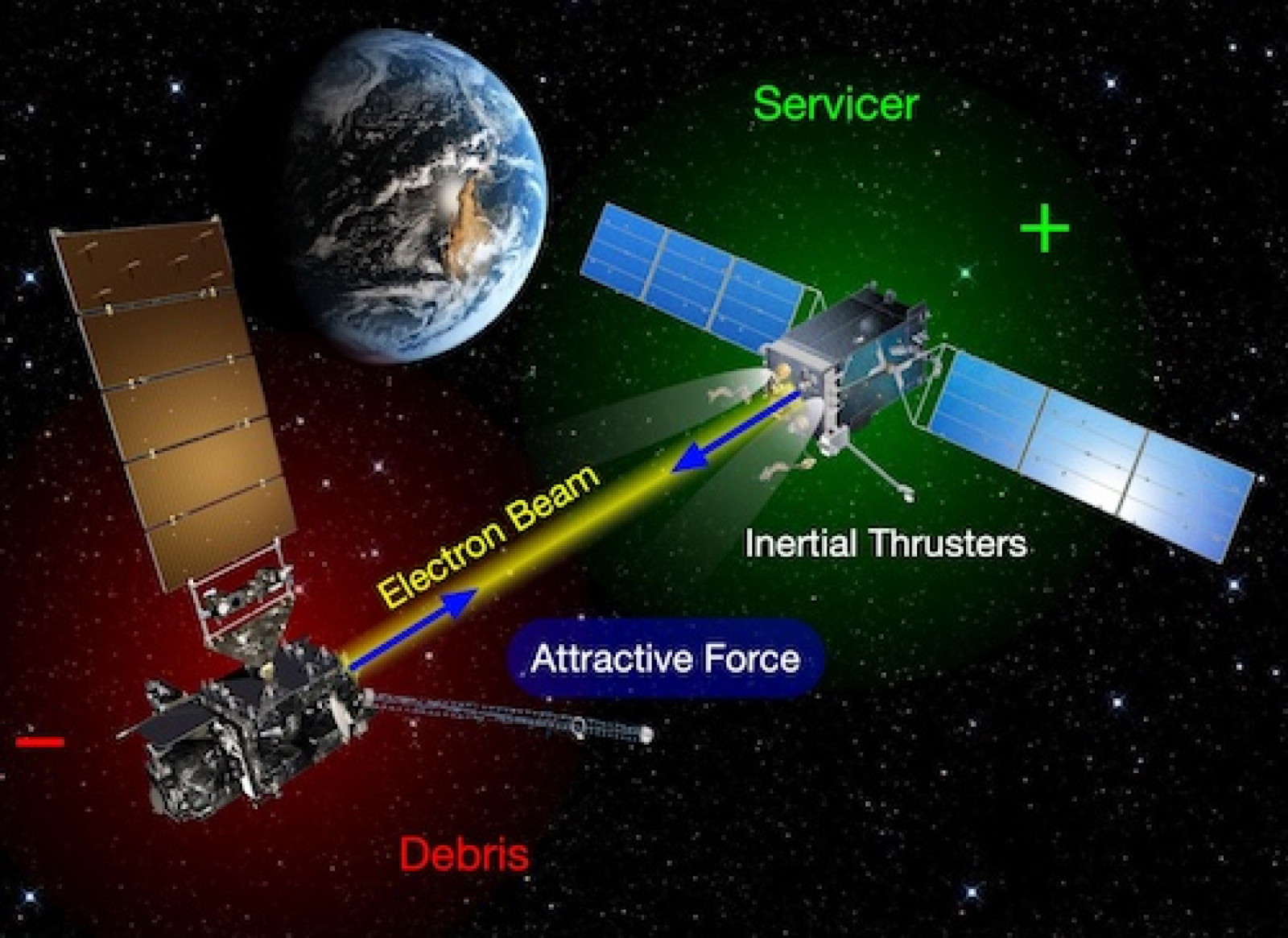
To mitigate these challenges, the research team has developed an electrostatic beam designed to attract debris without direct contact. Utilizing charged particles and carefully controlled electric fields, their solution forms a virtual tether, deployed from a service satellite that aligns and moves alongside debris, gradually altering its orbit through electrostatic attraction instead of traditional mechanical grasping tools like nets or robotic arms.
Bridging Science Fiction and Practical Engineering
This innovative idea naturally draws parallels to science fiction technologies. Hanspeter Schaub, chair of the aerospace engineering department at CU Boulder, comments, “Our beam shares similarities with the tractor beam from ‘Star Trek,’ albeit with far less power.” Unlike the fictional versions capable of moving spacecraft or planets, this device focuses on delicately manipulating metallic orbital debris through their electric charges.
Previous debris removal efforts have depended on mechanical methods like nets, harpoons, or robotic manipulators. CU Boulder’s approach provides a safer and more adaptable alternative. Julian Hammerl, a principal investigator on the project, explains, “By leveraging electrostatic forces, debris can be gently pulled away without physical contact.” This not only minimizes collision risks but also conserves propulsion fuel, paving the way for autonomous long-duration missions dedicated to orbital cleanup without direct human control.
CU Boulder Advances the Future of Orbital Safety Technologies
Supported by sophisticated computer models and endorsement from NASA and the U.S. Department of Defense, the University of Colorado Boulder research group is currently validating their system using laboratory setups that mimic space environment conditions. Their trials involve charging various lightweight materials and quantifying the beam’s ability to create attractive electrostatic forces over different distances.
This initiative blends expertise in electrical engineering, aerospace systems, and orbital mechanics. The electrostatic tractor beam represents a significant contribution to active debris removal (ADR), an expanding priority for global space agencies. As Earth’s orbital environment becomes increasingly congested, technologies like this are expected to be vital for preserving sustainable access to space.
- Categories:
- Space










0 comments
Sign in to Comment