
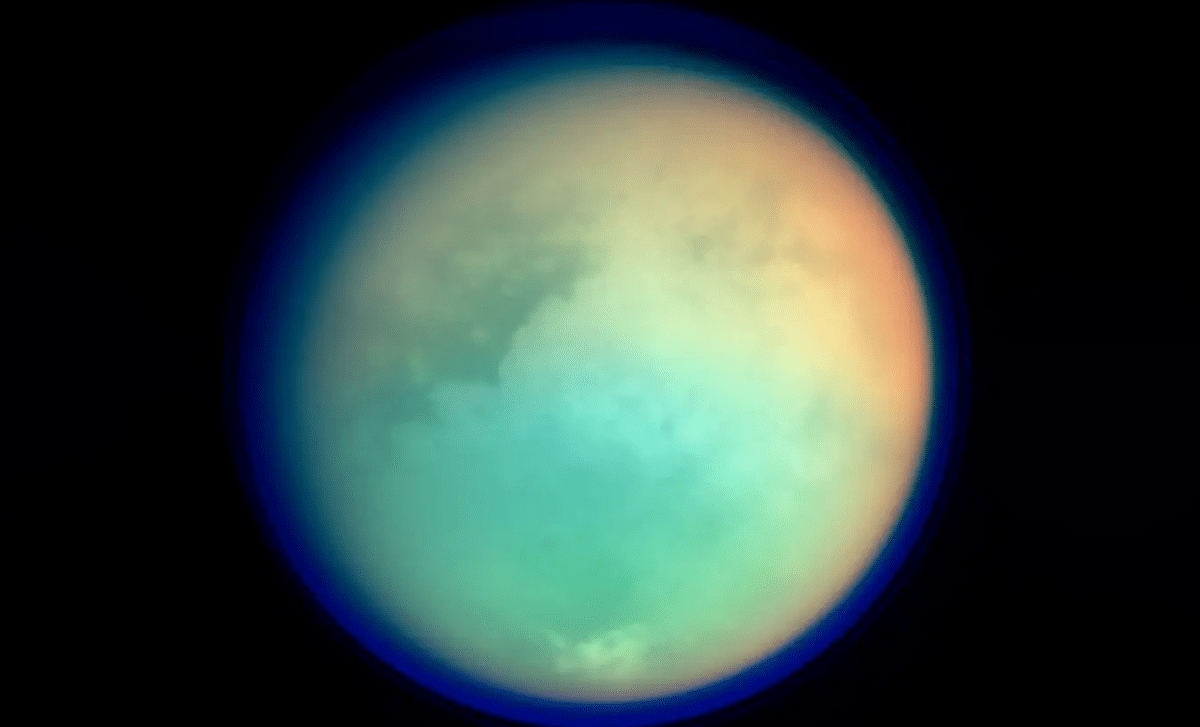
Researchers have identified a puzzling material on the surfaces of Titan and Pluto, igniting curiosity about the intricate chemical dynamics at play on these remote celestial bodies. This recent discovery, highlighted on arXiv, could provide significant insight into the organic compounds that define the icy terrains of our solar neighborhood and bolster investigations into life-supporting environments beyond Earth.
Exploring Titan and Pluto’s Chemical Mysteries
Both Titan, Saturn’s largest moon, and the dwarf planet Pluto feature surfaces coated with materials exhibiting unusual light absorption characteristics. This enigmatic substance challenges current planetary chemistry models and has long puzzled scientists. Titan’s thick atmosphere, predominated by nitrogen and methane, complicates direct examination of its surface, yet advanced spectroscopic techniques are unveiling new chemical layers previously unseen. Evidence indicates that this substance is widespread and may constitute a novel form of organic matter.
Planetary scientists leading this research stress that detecting these materials could clarify Titan’s prebiotic chemistry, critical for evaluating its habitability prospects. This understanding is vital as Titan remains a top candidate in the search for complex organic molecules elsewhere in the solar system.

How Atmospheric Processes Influence Surface Chemistry
“Since both atmospheres primarily consist of nitrogen and methane, they facilitate similar chemical reactions forming haze particles that eventually settle on the surface,” explains planetary chemist Bézard. These hazes result from photochemical processes high in the atmospheres, gradually depositing layers of organic compounds on the surfaces.
On Titan, these particles interact with surface ices, sparking complex chemical reactions that scientists are still deciphering. Pluto experiences comparable processes despite its thinner atmosphere and greater solar distance, implying that similar chemistry may be widespread among icy worlds, revealing common mechanisms in the outer solar system.
Identifying this material involves examining spectral data collected by missions like Cassini and New Horizons and running simulations of the chemical reactions that produce unusual surface features. “We have some possibilities, but it won’t be a simple molecule,” says Bézard. “The composition will be surprising.”
Advancing Knowledge of Extraterrestrial Organic Compounds
This finding holds significant importance for planetary research and the quest to understand prebiotic chemistry beyond our planet. If confirmed as complex organics, this substance could refine theories on chemical evolution on icy bodies and enhance our comprehension of how essential biomolecules might arise in alien settings.
Published on arXiv, these insights pave the way for further investigation. By integrating observational evidence with lab experiments mimicking Titan’s and Pluto’s atmospheres, researchers hope to pinpoint the substance’s nature and its impact on surface chemistry.
Furthermore, these discoveries may influence the planning of future outer solar system missions, helping to select promising targets for surface analysis by probes or landers. Understanding the formation and deposition of such materials is key to unraveling the geological and atmospheric histories of these distant worlds.
- Categories:
- Space






0 comments
Sign in to Comment