
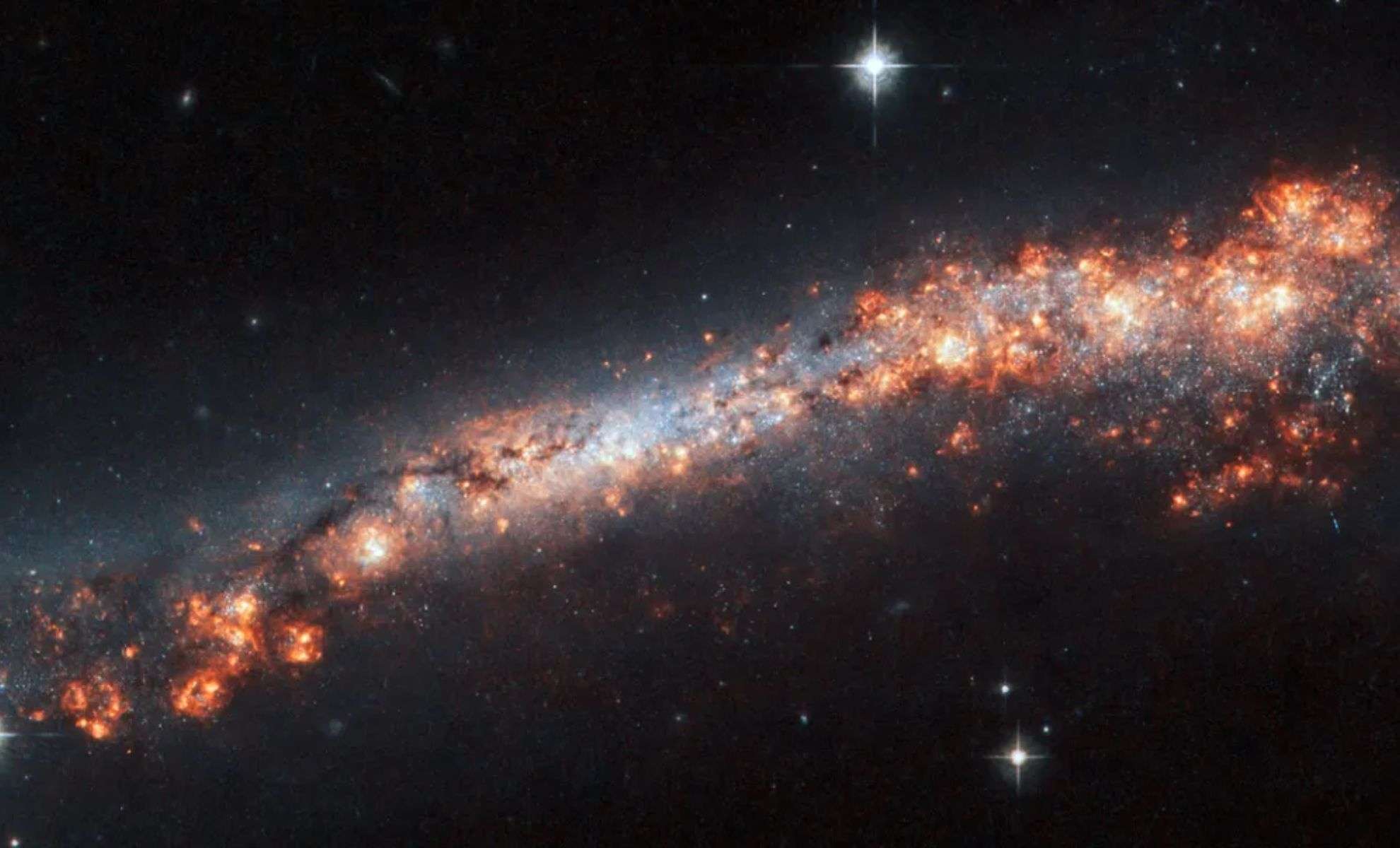
Astronomers have identified two vast cosmic formations toward the Boötes constellation that challenge fundamental beliefs about the universe’s structure. Named the giant arc and the big ring, these immense features possess sizes and characteristics that may compel scientists to reevaluate basic cosmological principles. The giant arc was initially reported in a peer-reviewed paper authored by Alexia Lopez during her doctoral work at the University of Central Lancashire, published in the Monthly Notices of the Royal Astronomical Society in 2021.
A Massive Cosmic Arc Exceeding Expected Limits
In 2021, researchers unveiled a vast galaxy structure forming a sweeping arc in the far reaches of space. This giant arc expands over approximately 3.3 billion light-years and lies roughly 9.2 billion light-years from Earth. What makes this research remarkable is that its scale represents nearly one-fifteenth of the observable universe, surpassing the theoretical size constraints predicted by standard cosmological frameworks.
The discovery of the arc was spearheaded by Alexia Lopez, then a PhD student at the University of Central Lancashire. Lopez pointed out that this giant formation contradicts the cosmological principle, which asserts that matter should appear evenly spread when observed over sufficiently large regions of space.

“When viewed on such a large scale,” she explained in a statement, “we expect to see a statistically smooth distribution of matter across the universe.”
This basic premise, initially introduced by Einstein to simplify cosmological calculations, states that the universe is homogeneous and isotropic, appearing uniform from any vantage point and in every direction.
The immense scale of the giant arc, approximately three times bigger than the previously accepted cosmic structure limit of about 1.2 billion light-years, presents significant challenges to this principle. Its presence suggests the universe may not be as uniformly distributed as classical models propose.
A Nearby Colossal Formation: The Big Ring
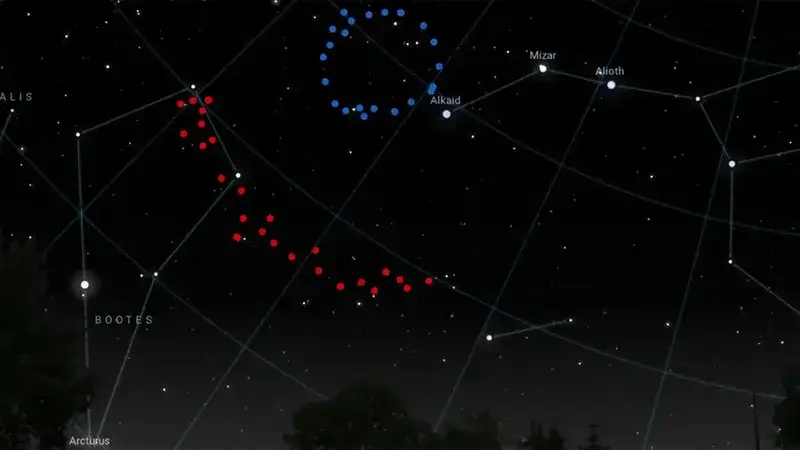
Several years following the giant arc’s identification, scientists discovered another gigantic structure in the vicinity: the big ring. Positioned just 12 degrees away from the arc, it measures about 1.3 billion light-years across with a circumference near 4 billion light-years. Although it seems circular from Earth, its true shape resembles a twisted spiral.
The big ring was detected using quasar backlighting—tracking magnesium absorption by intersecting galaxies between Earth and distant quasars. If visible, this immense structure would cover an area equivalent to 15 full moons in the night sky. Alexia Lopez led the study confirming that this ring also exceeds the theoretical maximum size established by current cosmological theories.
“From current cosmological theories, we didn’t think structures on this scale were possible,” she said. “We could expect maybe one exceedingly large structure in all our observable universe. Yet, the Big Ring and the Giant Arc are two huge structures and are even cosmological neighbors, which is extraordinarily fascinating.”
Questioning Cosmic Uniformity
The close presence of these two gigantic cosmic structures has prompted debate about whether they are statistical outliers or signify deeper issues in current cosmological models. Central to this discussion is the cosmological principle, which proposes that the universe is uniform at large scales without distinctly different regions.
If this principle fails, it may impact interpretations of phenomena such as dark matter, the cosmic microwave background, and galaxy formation. Some scientists have looked to baryonic acoustic oscillations for answers, but Lopez explains that the big ring’s extreme size and irregular shape “is not really compatible with the BAO explanation”.
What Secrets Could These Giant Cosmic Features Hold?
Ongoing and future advanced astronomical surveys—including projects led by the Vera C. Rubin Observatory and the Euclid mission—are expected to shed light on whether these structures are unique anomalies or part of a wider cosmic pattern. Lopez summarized their significance:
“Neither of these two ultra-large structures is easy to explain in our current understanding of the universe. And their ultra-large sizes, distinctive shapes, and cosmological proximity must surely be telling us something important, but what exactly?”
Currently, both the giant arc and the big ring remain unexplained, prompting questions about whether they expose fundamental gaps in our comprehension of cosmic evolution.
- Categories:
- Space





0 comments
Sign in to Comment