
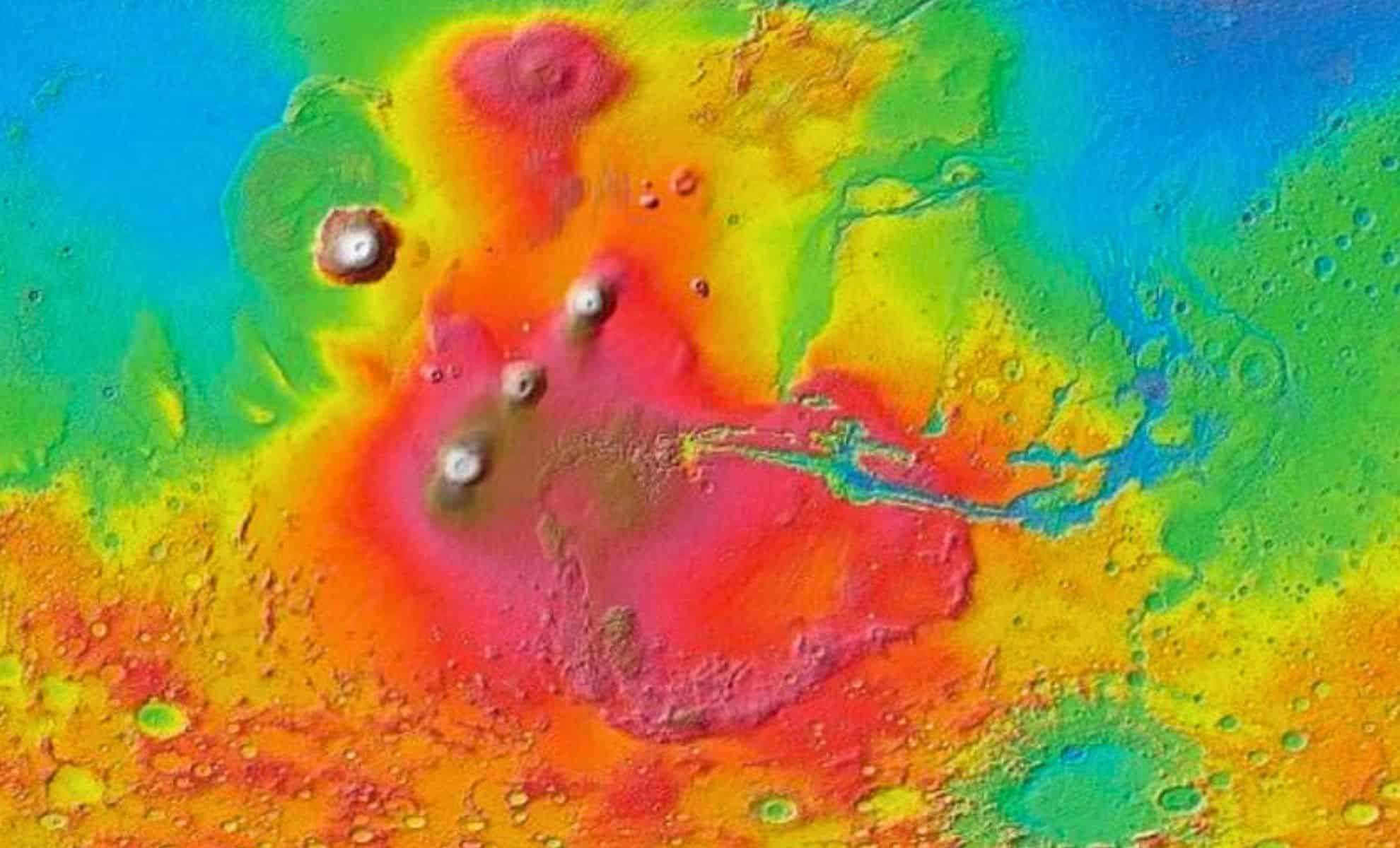
New investigations beneath Mars’ crust have unveiled enormous subterranean formations that challenge our current interpretation of the planet’s geological framework. Among these are a strikingly large underground mass and several other compact, dense anomalies that could reshape scientific understanding of Mars’ internal processes and its evolutionary path.
Mars has been central to planetary science, with its surface and geological past offering vital clues about its history and potential ongoing activity. The latest research highlights a vast underground entity beneath the Tharsis Montes region, home to the colossal Olympus Mons. This, together with additional gravitational irregularities, points toward the possibility that Mars remains geologically lively, contradicting earlier assumptions.
Immense Subsurface Mass Under the Tharsis Region
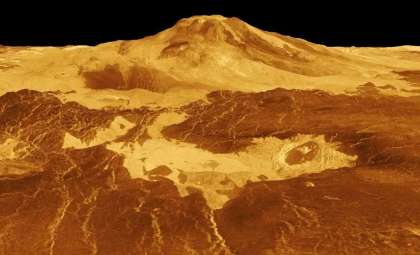
A principal focus of this study is an immense subterranean structure measuring about 1,750 kilometers across and located roughly 1,100 kilometers deep beneath the Tharsis Montes volcanic province, which includes the iconic Olympus Mons—the tallest mountain and volcano in the known solar system. The team, led by Bart Root from Delft University of Technology, hypothesizes this feature to be a mantle plume, representing a powerful upwelling of hot material from deep within Mars’ interior.

This potential mantle plume is more than just a geological curiosity. Researchers explain, “There seems to be a big mass (something light) deep in Mars’ layer, possibly rising from the mantle. It shows that Mars might still have active movements happening inside it, making new volcanic things on the surface.” Confirming this would mean that Mars maintains volcanic activity, a discovery that challenges prior notions of the planet’s internal silence.
Defying Flexural Isostasy Principles
This finding runs counter to the concept of flexural isostasy, which predicts that heavy surface loads cause the planet’s crust (the lithosphere) to depress. Instead, the elevated topography of Tharsis Montes suggests the enormous underground mass is exerting upward pressure. This revelation compels a reevaluation of Mars’ lithospheric behavior and underlying geological mechanics.
- Core Concept: Flexural isostasy.
- Observation: The Tharsis Montes sits above an uplift, not a depression.
- Interpretation: Upward forces from Mars’ interior may be sustaining the lithosphere.
Implications for Martian Volcanism
The identified subsurface feature is around 1,750 kilometers wide and located at a depth of nearly 1,100 kilometers, positioned underneath the volcanic Tharsis Montes region, which contains the immense Olympus Mons. Lead researcher Bart Root and colleagues propose that this structure acts as a mantle plume—an intense, buoyant plume of molten material rising from Mars’ deep interior.
If this mantle plume reaches or approaches the crust, it indicates Mars could still harbor active internal dynamics. As the team notes, “It shows that Mars might still have active movements happening inside it,” raising prospects for renewed volcanic outbreaks on the Red Planet.
Mysterious Dense Formations in the Northern Polar Region
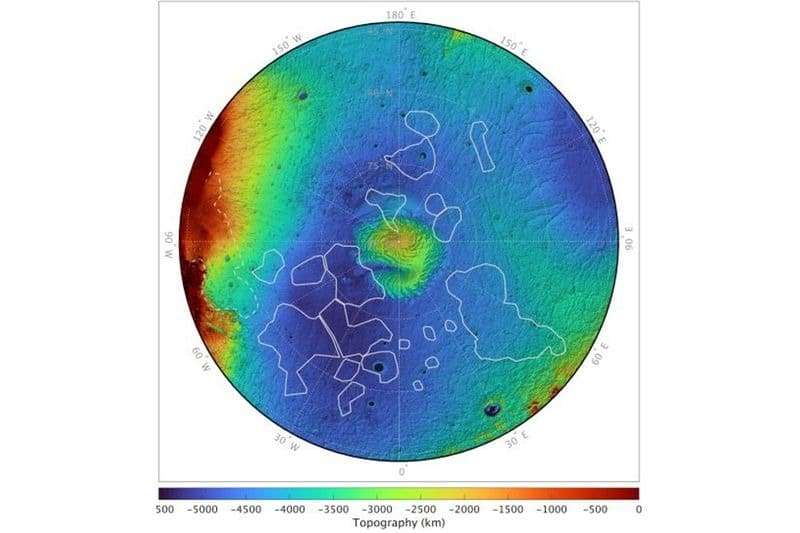
Beyond Tharsis, scientists have pinpointed several dense features buried beneath Mars’ northern polar plains. These formations have densities 300 to 400 kg/m³ heavier than surrounding matter. Their exact nature remains uncertain—they may be ancient volcanic remnants or compressed debris from historical impacts.
Invisible from Above
Unlike similar subsurface anomalies detected on Earth’s Moon, these dense structures on Mars show no discernible surface clues. Their existence is inferred solely through gravitational analysis. One such formation amusingly resembles the silhouette of a dog, adding a curious twist to the exploration.
Advocating for the MaQuls Mission
To delve deeper into these underground mysteries, researchers emphasize the need for the Martian Quantum Gravity (MaQuls) mission. Equipped with cutting-edge gravity mapping tools, MaQuls aims to uncover Mars’ subsurface characteristics with unprecedented detail, enriching our grasp of the planet’s geological evolution and present-day activity.
Transforming Our View of Mars’ Geological Activity
These revelations point to a Mars that may be more geodynamically vibrant than once believed. The possibility of active mantle plumes and future volcanism challenges the idea that Mars is a dormant world. This insight holds significance for ongoing exploration and the search for potential biosignatures.
Revisiting Geological Frameworks
The data call for an updated perspective on geological concepts such as flexural isostasy. Finer models which factor in Mars’ unique lithospheric response to internal forces are needed to truly comprehend its surface formations and hidden structures.
- Significance: Revises established geological assumptions.
- Development: New theoretical frameworks for Mars’ interior.
- Insight: “This means we need to rethink how we understand the support for the big volcano and its surroundings.”
These remarkable results reveal that Mars is far from a geologically inactive planet. Indications of an operational mantle and possible future volcanic events suggest an evolving planetary narrative. As initiatives like MaQuls progress, the scientific community may soon gain deeper knowledge about Mars’ hidden past and dynamic interior.
- Categories:
- Space






0 comments
Sign in to Comment