
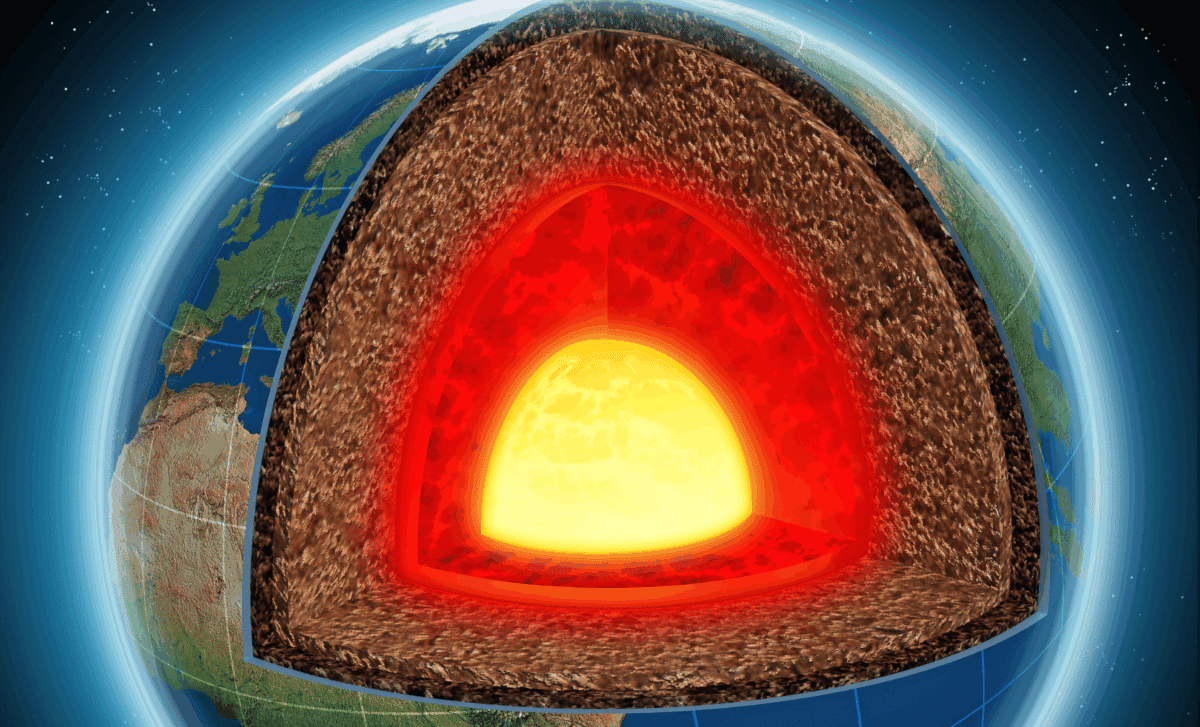
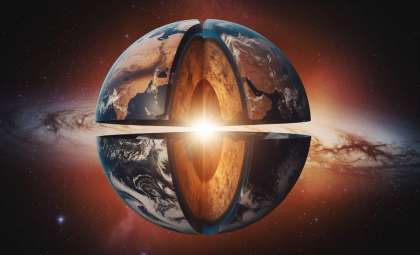
Far beneath the Earth’s crust lie two massive, mysterious blobs that have baffled researchers for years. Recent findings provide groundbreaking perspectives on their development and importance, suggesting these dense formations could reveal crucial details about our planet’s primordial history. Featured in Nature Geoscience, the investigation explores the possibility that these blobs, situated near the core-mantle boundary, formed through processes previously unconsidered. These revelations challenge established ideas, marking a significant advancement in understanding Earth’s genesis.
Unraveling the Enigma of the Giant Mantle Blobs
Since their detection more than three decades ago, scientists have been captivated by two vast, dense regions deep within Earth's mantle beneath Africa and the Pacific Basin. Identified as large low-shear-velocity provinces (LLSVPs), these blobs disrupt seismic wave patterns, indicating they differ in composition from the mantle around them. Although theories have ranged from fragments of ancient tectonic plates to vestiges of a colossal impact, recent research suggests these blobs hold far greater geological significance.
“These are not random oddities,” says Yoshinori Miyazaki, a geodynamicist from Rutgers University. “They are fingerprints of Earth’s earliest history. If we can understand why they exist, we can understand how our planet formed and why it became habitable.”
Add Cosmo Herald as a Preferred Source

This perspective highlights the growing agreement in the scientific community that these subterranean formations may offer a direct connection to Earth’s foundational periods.
During the 1980s, seismic investigations first unveiled these blobs by examining wave patterns generated by earthquake activity. The anomalies were observed as deep mantle areas where seismic velocities decreased, indicating a denser or chemically different structure compared to nearby rocks. As research has progressed, explanations for their existence have expanded significantly.
Revisiting Origins: Core-Derived Material Shapes Mantle Anomalies
Prior models proposed the blobs were leftover fragments of tectonic plates or debris from ancient planetary collisions, including the hypothesis that material from the giant impactor Theia may have contributed. Yet, the latest research introduces a fresh angle: these blobs may have emerged from substances leaking out of Earth’s core. Over billions of years, such material could have blended progressively into the mantle, giving rise to these prominent dense regions.
The paper, published in Nature Geoscience, outlines an innovative model where Earth's cooling core led to the crystallization of lighter elements like magnesium oxide and silicon dioxide, which then buoyantly migrated toward the mantle. This ongoing process may have resulted in the accumulation of lighter material at the core-mantle interface, ultimately forming the massive blobs observed today.
“That contradiction was the starting point,” Miyazaki explains. “If we start from the magma ocean and do the calculations, we don’t get what we see in Earth’s mantle today. Something was missing.”
Identifying the role of core leakage provides a compelling alternative to conventional explanations and suggests a more intricate narrative for Earth's development. This insight also enhances understanding of the interactions between the core and mantle and the geological dynamics influencing our planet's surface.
Magma Oceans and Their Impact on Earth’s Formative Years
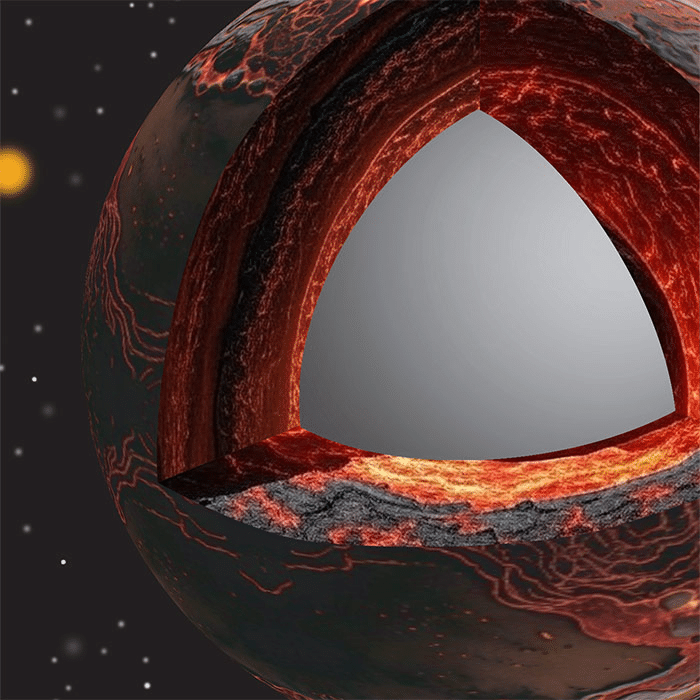
Exploring the formation of these blobs requires a look back at Earth's early conditions. One widely supported concept posits that after its formation, Earth was enveloped by a vast "magma ocean"—a deep, molten layer containing rock and metal. As this ocean cooled, materials separated by density, with heavy elements descending toward the core and lighter materials rising.
However, this magma ocean narrative alone cannot fully explain the irregular nature of the blobs. Seismic measurements reveal that Earth’s mantle isn’t as stratified as once thought. Instead, the LLSVPs exhibit a complex, uneven structure. New findings imply the blobs formed partly due to materials from the core integrating into the mantle during Earth's earliest phases.
“Even with very few clues, we’re starting to build a story that makes sense,” Miyazaki says. “This study gives us a little more certainty about how Earth evolved, and why it’s so special.”
This perspective paves the way for deeper investigation into the composition of Earth's interior and the processes behind its evolution. The blobs may be key to unlocking the mysteries of early planetary cooling and the forces that have sculpted the Earth’s interior landscape today.
- Categories:
- Science






0 comments
Sign in to Comment