

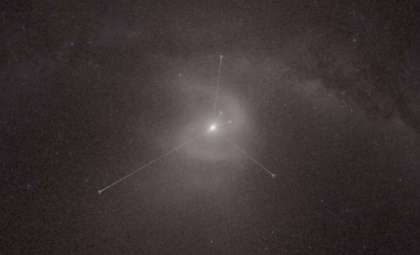
Astronomers have made a remarkable discovery by detecting direct molecular emissions from comet C/2014 UN271, also known as Bernardinelli-Bernstein. This enormous comet, situated in the distant Oort Cloud, ranks as both the largest and the second most remote active comet ever recorded. The findings, published in The Astrophysical Journal Letters, were enabled by the highly sensitive Atacama Large Millimeter/submillimeter Array (ALMA) in Chile. ALMA allowed researchers to investigate this icy colossus at an extraordinary distance exceeding 16 times the Earth-Sun span, placing it beyond Neptune's orbit.
An Enormous Comet from the Oort Region
C/2014 UN271 is truly exceptional. Its diameter of approximately 85 miles (140 km) makes it vastly larger than typical comets, which are often far smaller. First spotted in 2010, this behemoth from the Oort Cloud has captivated scientists due to its immense size and remote location. The Oort Cloud itself is an expansive zone filled with icy remnants at the solar system’s edge, holding vital clues about the early solar system’s formation. Observations from ALMA have shed light on the comet’s behavior, deepening knowledge about cometary activity in such distant, primordial regions.
Revealing Molecular Emissions from the Depths of Space
The recent ALMA data marks a major breakthrough. By capturing detailed carbon monoxide gas emissions around the comet, astronomers obtained the first direct proof of molecular activity so far from the Sun. Despite being more than 16 astronomical units away, C/2014 UN271 showed bursts of gas jets, offering unprecedented insight into how an object this cold and distant can remain active. While earlier hypotheses proposed that comets far from the Sun might vent gases, this study presents concrete confirmation of such activity in the solar system’s outermost regions.

Intense Gas Jets Spark New Scientific Queries
The comet’s pronounced outgassing behavior prompts fresh questions about its internal composition and processes. Nathan Roth, who led the research at American University and NASA's Goddard Space Flight Center, commented, “These observations give us an unprecedented perspective on the mechanisms driving this giant icy body. The explosive gas jets challenge our understanding and raise new questions about how this comet will transform as it journeys closer to the Sun.” As it approaches the inner solar system, the outgassing is expected to increase, revealing more about the comet’s structure and evolution. This work represents a vital step toward understanding how cometary activity changes with solar proximity.
A Deeper Insight into the Oort Cloud’s Composition
Using ALMA, researchers have gained rare details regarding the chemical makeup and dynamics of one of the solar system's most remote inhabitants. As the comet moves sunward, additional volatile compounds are likely to sublimate, offering further clues about its ancient composition. Through precise measurements of its dust content and nucleus dimensions, the study confirms this as the largest documented Oort Cloud comet. Investigating its thermal features and gas emissions helps scientists better understand the early solar system’s environment and the processes involved in planetary system formation.
Implications for Life’s Origins and Cosmic Chemistry
The results from studies of C/2014 UN271 extend beyond objects in our solar system, touching upon the search for extraterrestrial life. Examining these remote icy bodies deepens our knowledge of the organic molecules that might seed life-friendly conditions elsewhere. The detection of compounds like carbon monoxide in the comet's outgassing provides important insights into the molecular environment that could support life. Understanding the delivery of such materials to Earth-like planets helps frame theories about how life’s essential ingredients may be distributed across the universe.
- Categories:
- News






0 comments
Sign in to Comment