
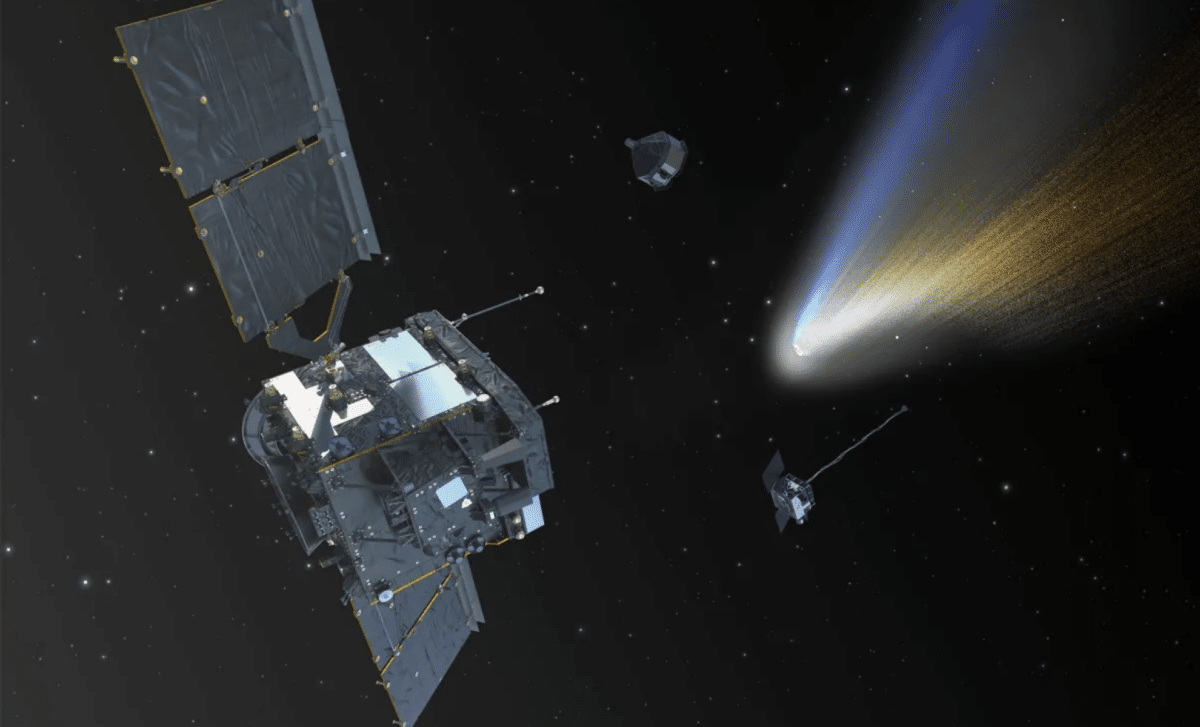
The European Space Agency (ESA) is gearing up for a groundbreaking mission named Comet Interceptor, which aims to rendezvous with and investigate a pristine comet or possibly an interstellar object entering our solar system for the very first time. This mission, now accelerating its launch schedule, promises to unveil materials unchanged since the inception of the Solar System.
An Accelerated Launch Brings New Advantages
Initially planned for a later date, the Comet Interceptor mission has been rescheduled to an earlier launch due to delays in other ESA projects, according to Space News. This advancement offers a significant benefit: the mission will now utilize the enhanced capabilities of the Ariane 62 launcher and begin sooner, marking an exciting new chapter for ESA's scientific exploration.
ESA has confirmed that the spacecraft’s departure is set for 2029 from Europe’s Spaceport in French Guiana. Once launched, the main spacecraft will be stationed at the L2 Lagrange point, patiently awaiting an ideal candidate—a comet making its initial journey into the inner solar system.

Upon identifying a suitable target, the spacecraft will execute a trajectory to intercept. As it approaches, it will deploy two diminutive probes designed to capture multi-perspective, high-resolution images of the comet’s nucleus along with detailed measurements of its gas and dust environment. This approach allows scientists to construct a three-dimensional map of a celestial object untouched by solar influences.
ESA’s Comet Interceptor mission moves up launch https://t.co/vOycGPn6bV pic.twitter.com/9zTFvCzR1o
— SpaceNews (@SpaceNews_Inc) January 14, 2026
Decoding the Secrets of Ancient Solar System Materials
A partnership between the ESA and the Japan Aerospace Exploration Agency (JAXA) underpins the Comet Interceptor mission, with a joint goal to unveil the composition of primordial ingredients that assembled planets and perhaps life itself billions of years ago.
Often described as cosmic time capsules, comets preserve original material from the Solar System's formation. Unlike most studied comets that have undergone transformation through multiple solar encounters, the mission seeks a truly untouched comet, having drifted undisturbed in the cold outer Solar System since its birth.
Equipped with ten scientific instruments distributed among the three spacecraft, the mission will examine the target’s chemical makeup, plasma surroundings, and particulate matter. This collaborative analysis will illuminate how volatile substances like water and organic molecules were spread across early solar nebula, shedding light on their delivery routes to Earth.
Legacy and Beyond: Advancing Cometary Exploration
The Comet Interceptor mission follows the legacy of iconic comet explorers such as Giotto, which flew past Halley’s Comet in 1986, and Rosetta, which studied Comet 67P/Churyumov-Gerasimenko between 2014 and 2016. Those missions dramatically advanced our knowledge but focused on comets altered by solar radiation and heat.
This mission aims to push boundaries by investigating an object from the Solar System’s remotest, least-altered regions. Comet Interceptor could provide unprecedented insights into comet formation, their long-term evolution, and their interactions with interstellar space.
As ESA highlights, the success hinges on patience and precision: the spacecraft will loiter in a stable orbit, waiting for astronomers to identify the perfect target, whether it originates from the Oort Cloud or potentially from beyond our solar neighborhood.
Engineering Perseverance Aimed at Cosmic Discovery
Crafting a spacecraft capable of remaining dormant for years and then rapidly pursuing a high-velocity comet presents formidable engineering trials. The probes must survive prolonged inactivity, endure deep space’s harsh conditions, and function autonomously during a short-lived yet critical encounter.
The mission comprises a main spacecraft accompanied by two smaller craft: Probe A and Probe B, the latter developed by JAXA. Together, they will gather complementary observations from varying perspectives, producing a comprehensive understanding of the comet’s physical and chemical characteristics.
ESA engineers recently reported successful completion of intense vibration tests confirming the spacecraft structure’s resilience to launch stresses. Upcoming priorities include system integration and ensuring smooth communication between instruments once the probes are operational in proximity to the target.
- Categories:
- News






0 comments
Sign in to Comment