
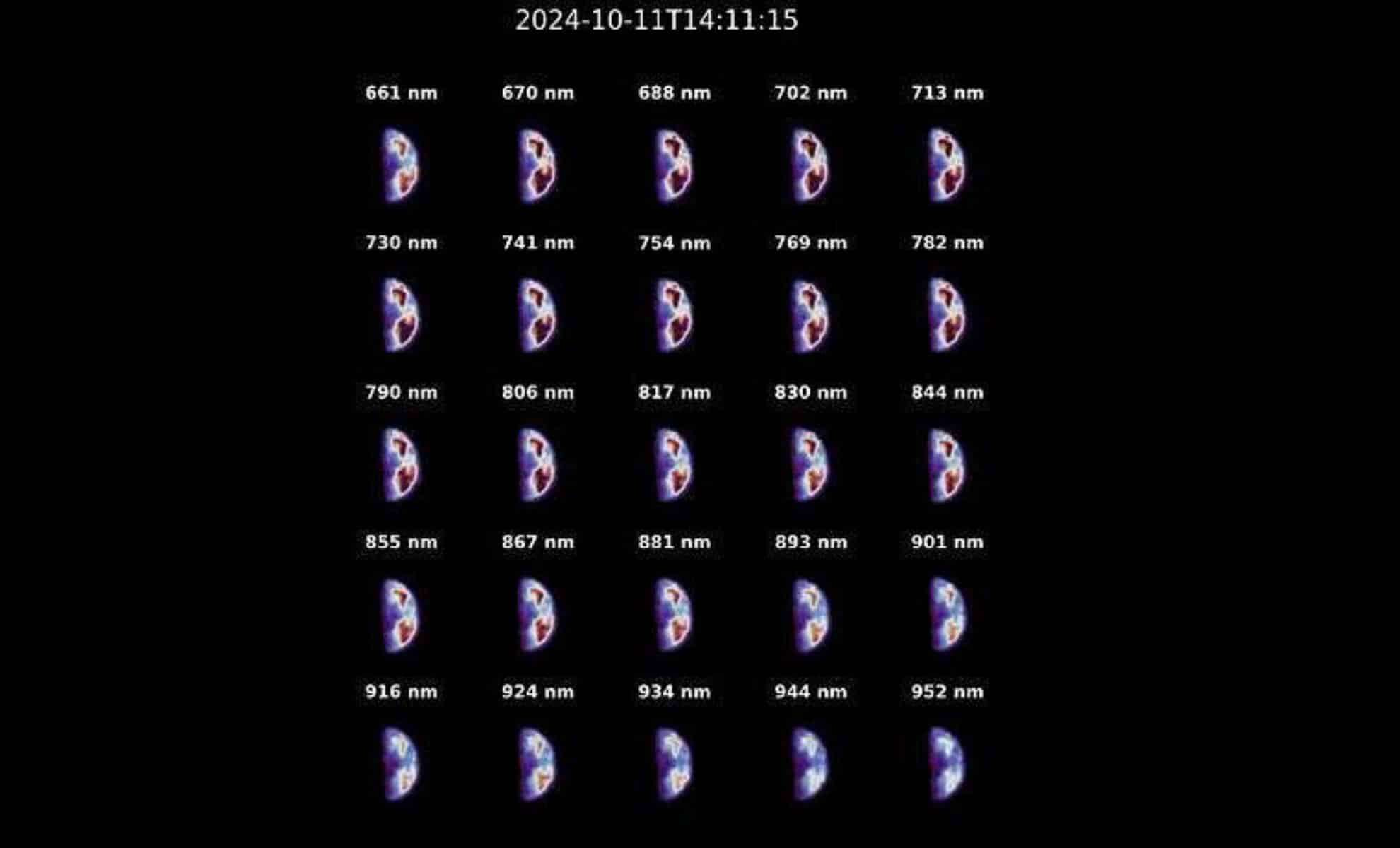
ESA’s Hera spacecraft has captured an extraordinary and spectral view of Earth using its advanced HyperScout H instrument. From nearly two million kilometers distant, this compact hyperspectral imager recorded striking spectral images of our planet, producing a ghostly perspective that fittingly coincides with the Halloween period.
This pioneering observation signifies a major achievement for Hera as it embarks on a mission that will enhance future planetary defense techniques.
Ghostly Earth Images Rendered in a Unique ‘TwilightShifted’ Spectrum
On October 11, 2024, HyperScout H—a sophisticated imaging device operating across 25 different spectral bands—generated remarkable false-color images of Earth. The data ranged from visible light to near-infrared wavelengths (650 to 950 nm) and utilized a specialized “TwilightShifted” color scheme to depict light intensities. This palette shifts colors from bluish-black through purplish-white to reddish-black, crafting an eerie visual effect that reveals atmospheric details such as cloud formations with unprecedented clarity. Marcel Popescu from the University of Craiova, Romania, who is part of the instrument team, remarked, “This enables us to examine cloud structures on Earth from almost 2 million kilometers away while also verifying the precision of our data analysis methods.”

These spectral images were acquired during Hera’s Near-Earth Commissioning Phase after its successful launch on October 7, 2024. During this phase, Hera’s Asteroid Deck—housing the spacecraft’s instruments—was oriented toward Earth and the Moon to validate system functionality. This calibration also allowed scientists to refine HyperScout H’s data processing pipeline. Julia de León, the principal investigator from the Instituto de Astrofísica de Canarias, noted, “This initial calibration test was a thrilling milestone, confirming both the instrument and its data processing chain are operating effectively.”
Showcasing Cutting-Edge Technology Aboard Hera
HyperScout H represents the most recent advancement in a series of hyperspectral imagers developed by cosine Remote Sensing in the Netherlands, in collaboration with ESA. While earlier models have been employed for Earth observation in orbit, this is the first occasion this technology has been deployed for deep space observation. Marco Esposito, Managing Director at cosine Remote Sensing, expressed enthusiasm: “It’s thrilling to observe the Earth-Moon system as our initial target, capturing the unique interaction from a spectral perspective as we proceed swiftly towards Mars.”
The importance of HyperScout H’s multi-band spectral analysis cannot be overstated. By gathering detailed information about surface composition, mineralogy, and atmospheric properties, this instrument is central to Hera’s upcoming investigations of the Dimorphos asteroid. This asteroid was notably struck by NASA’s DART mission in 2022. HyperScout H will chart Dimorphos’s mineral composition, advancing the mission’s aim to establish asteroid deflection as a scientifically robust planetary defense approach.
Hera: A Pioneer in Global Planetary Protection
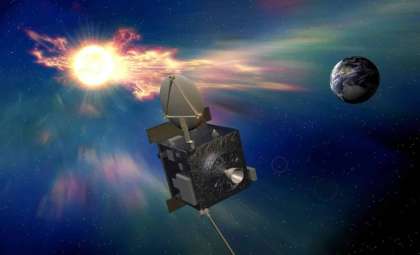
ESA’s Hera mission, the agency’s inaugural planetary defense initiative, exemplifies international collaboration aimed at shielding Earth from asteroid threats. Hera’s principal objective is to study Dimorphos—the first asteroid whose orbit was intentionally altered by human action. By gathering detailed data on Dimorphos’s structural, compositional, and impact response characteristics, Hera will deliver critical insights that can guide future planetary defense strategies.
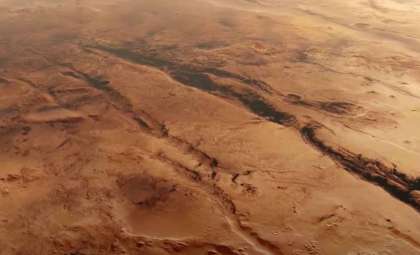
Prior to reaching Dimorphos, Hera is scheduled to pass by Mars and its moon Deimos in March 2025. This flyby will provide additional chances for HyperScout H and other onboard instruments to collect important data, further assessing their capabilities in preparation for the asteroid investigation. Julia de León emphasized HyperScout H’s vital contribution to planetary defense work by stating, “Once at Dimorphos, HyperScout H will examine the asteroid’s mineralogy.”
The Hera project highlights the significance of international cooperation in space science and asteroid hazard mitigation. As the spacecraft continues its voyage, the spectral images of Earth serve as a stark reminder of our planet’s vulnerability and the essential efforts underway to understand and reduce cosmic dangers. The haunting spectral views from HyperScout H both inspire wonder and demonstrate the technological progress enabling a more secure planetary future.
- Categories:
- Astronomy ,
- News






0 comments
Sign in to Comment