
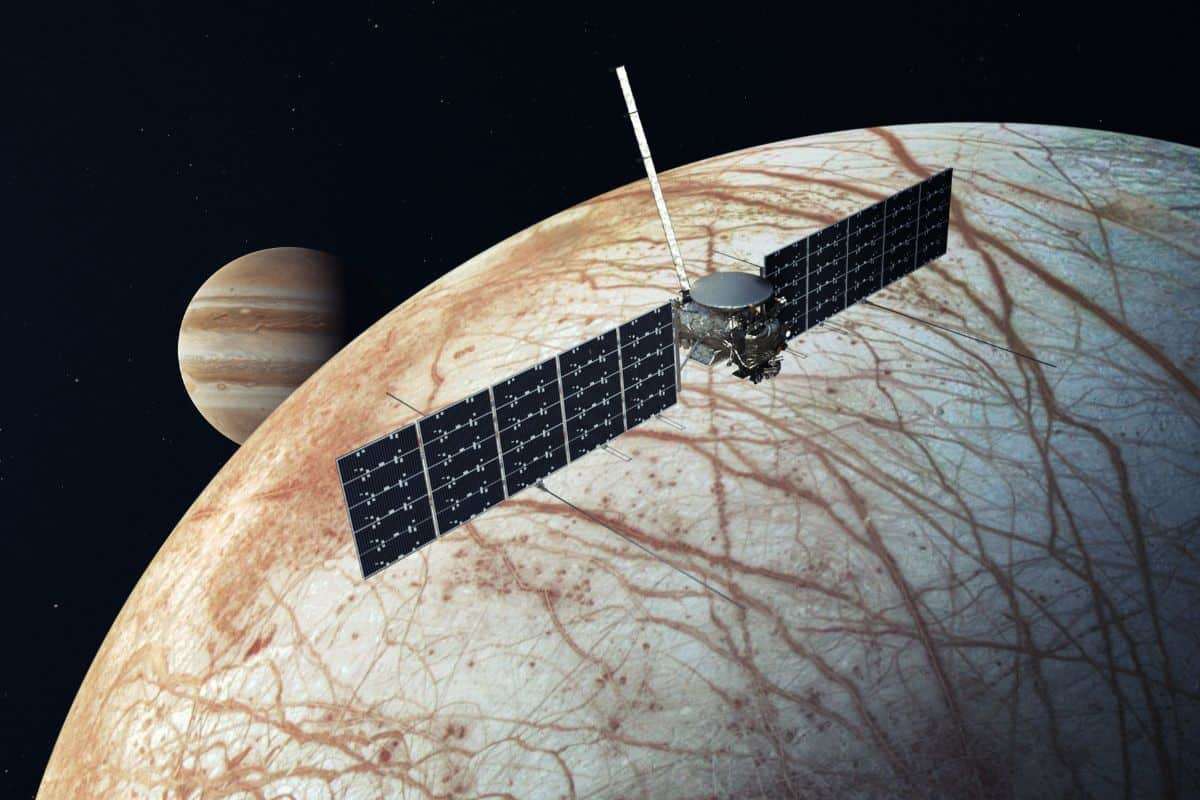
NASA's Europa Clipper spacecraft recently executed a vital flyby, zooming just 550 miles (884 km) above the surface of Mars as it continues its voyage to explore Jupiter’s frozen moon, Europa. This close pass wasn't merely a sightseeing opportunity—it was a carefully calculated move leveraging Mars’ gravitational pull to adjust the spacecraft’s path and propel it deeper into the solar system.
A Vast Expedition Across the Solar System
After its launch on October 14, 2024, from NASA’s Kennedy Space Center, Europa Clipper embarked on an ambitious journey covering about 1.8 billion miles (2.9 billion kilometers) toward the Jupiter system. This $5.2 billion mission marks NASA’s first dedicated exploration of Europa, a tantalizing world where a hidden ocean beneath a thick ice surface might hold the ingredients for life.
The spacecraft itself is a massive technological marvel, stretching nearly the length of a basketball court, with enormous solar arrays making it one of the agency’s largest planetary explorers. Initially, its trajectory included a safety margin around Mars to prevent any risk of accidental collision in the mission’s early phase. Confident in the spacecraft’s flawless performance, mission controllers authorized a precise flyby maneuver.

Harnessing Mars’ Gravity for a Boost
This encounter with Mars serves a critical purpose beyond proximity to another planet. Through a method called gravitational assist, astronauts and engineers exploit the planet’s gravity to modify the spacecraft’s speed and trajectory without burning extra fuel. Flying close by Mars at the perfect angle allows Europa Clipper to gain momentum from the planet’s movement, adjusting its course toward Jupiter and the icy moon Europa.
“Navigating like this is akin to a solar system billiards game,” explained Ben Bradley, a mission strategist at NASA’s Jet Propulsion Laboratory (JPL). “The celestial alignment must be precise to achieve the intended gravity assist.”
The spacecraft’s closest approach occurred yesterday at 12:57 p.m. EST (1757 GMT), zipping past Mars at roughly 15.2 miles per second (24.5 km/s). Once it moved beyond Mars' gravitational influence, its speed adjusted slightly downward to around 14 miles per second (22.5 km/s), according to Space.com.
Instrument Calibration Amid the Flyby
While the flyby mainly supports navigational goals, it also offers a unique occasion to test critical scientific instruments aboard Europa Clipper before reaching its ultimate destination.
One key instrument, the thermal imager, was activated to capture vibrant images of Mars, providing essential calibration data and confirming the instrument’s operational status.
Additionally, the radar system—vital for penetrating Europa’s ice crust to detect subsurface lakes or oceans—underwent its initial in-space trial. This radar, one of Europa Clipper’s most important scientific tools, couldn’t be fully tested on Earth due to its large antenna size, making this flyby an invaluable opportunity to assess its capabilities in the environment for which it was designed.
As noted by NASA, this early space test of the radar system is crucial for refining instrument performance ahead of Europa arrival.
- Categories:
- News








0 comments
Sign in to Comment