
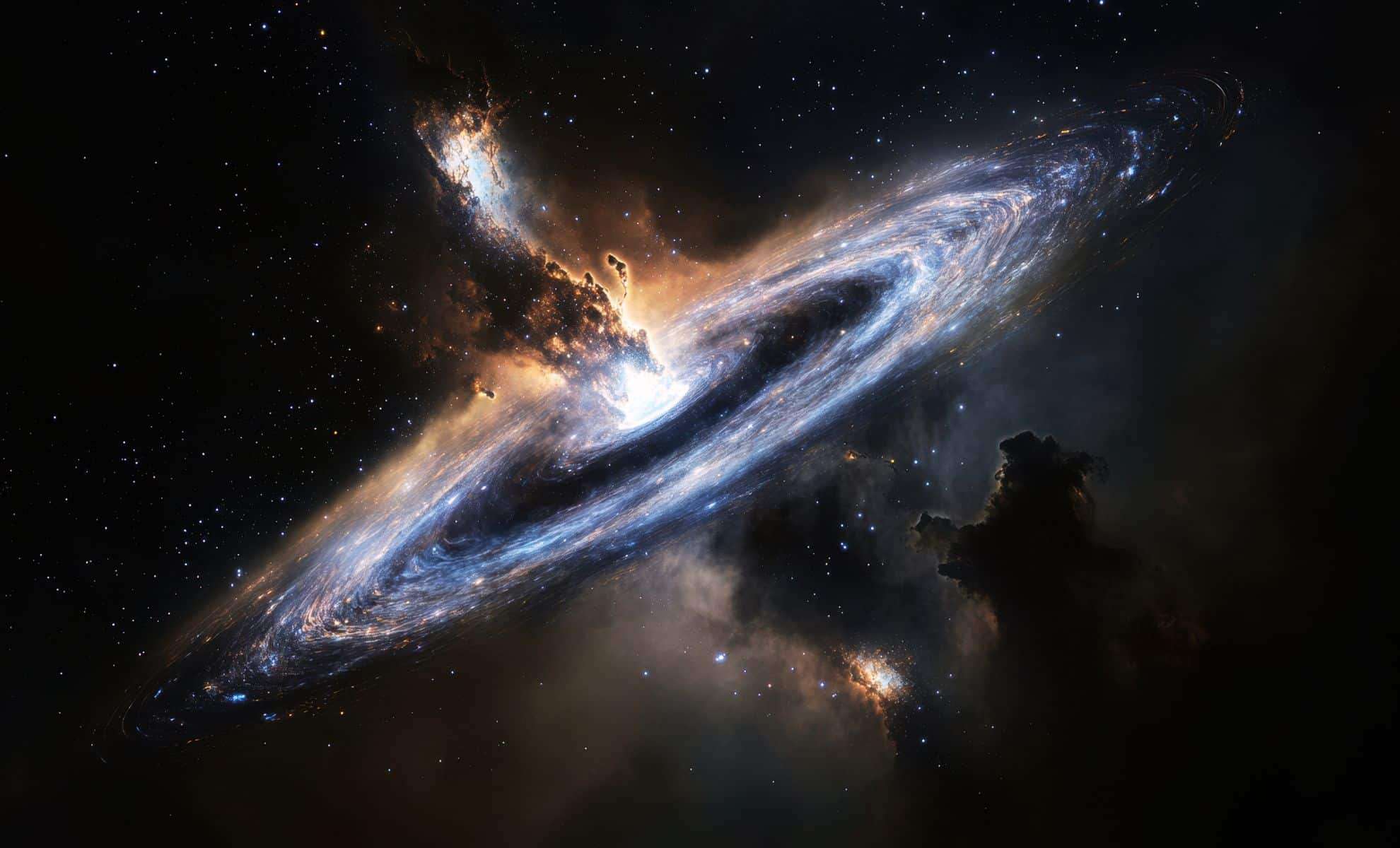
A groundbreaking study published in The Astrophysical Journal reveals that dust grains have endured an incredible journey through the hostile environment of a galaxy, made observable thanks to the James Webb Space Telescope (JWST). These resilient particles originated in the distant Makani Galaxy and have traveled uninterrupted despite the harsh conditions of space that typically destroy such material.
Unexpected Durability of Intergalactic Dust
The dust analyzed comes from the Makani Galaxy, a small yet highly active galaxy currently experiencing intense periods of star creation. These starbursts have generated massive galactic winds extending over 326,000 light-years, which have propelled clouds of gas and dust into the surrounding circumgalactic medium (CGM). This CGM consists of an enormously hot gas halo, reaching temperatures near 10,000 °C, conditions normally expected to obliterate dust particles. Contrary to expectations, a significant portion of this dust has remained intact.
Sylvain Veilleux, the lead researcher and an astronomy professor at the University of Maryland, emphasized the crucial role of the JWST in this finding. He noted, “No previous observations had directly detected dust on such an extensive scale.”

Utilizing the telescope’s infrared sensitivity, the team detected emission from polycyclic aromatic hydrocarbons (PAHs), complex organic molecules that cling to the dust grains. These PAH signals provided a means to track the dust’s movement through the galaxy’s extreme surroundings.
Enduring the Galaxy’s Fiery Environment
The scientists noticed that moving farther from the galaxy’s core, the PAH molecules exhibit signs of shrinkage and increased ionization, indicating ongoing erosion. Despite this wear, the dust grains persist, which amazed the researchers. Veilleux explained, “Dust exposed to gas at 10,000 degrees should vaporize, yet it continues to exist.” This endurance likely stems from dust grains nestled within cooler gas pockets, providing protection from the intense heat.
They propose a process termed “cloud-wind mixing,” where dust remains shielded by cooler gas while hotter gas gradually dissipates, allowing the PAH emissions to remain visible even at great distances from the galaxy’s center.
Illuminating the Cycle of Cosmic Matter
Tracking the journey of dust offers valuable clues about how essential materials recycle throughout galaxies, fueling new star formation. The team anticipates that further JWST observations, potentially extending into intergalactic space, will enhance understanding of how galactic matter moves and transforms over millions to billions of years.
Veilleux highlighted the dynamic nature of galaxies: “From the Big Bang to the present, galaxies behave like living systems continually evolving. Understanding the ebb and flow of gas is crucial to predicting their future.” Continued research with JWST aims to uncover more secrets about the exchange of cosmic material.
- Categories:
- News



0 comments
Sign in to Comment