

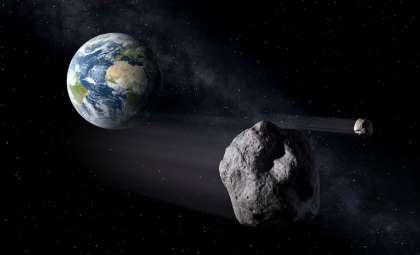
On June 5, 2025, a colossal asteroid designated 424482 (2008 DG5) is scheduled to make a close approach to our planet. Measuring between 310 and 690 meters (1,017 to 2,264 feet) in diameter, this space rock is notably larger than typical asteroids and will receive careful observation during its near-Earth pass. To put its size in perspective, 2008 DG5 exceeds the height of New York City's Empire State Building, a globally recognized skyscraper. Despite its massive scale, this asteroid will maintain a distance of about 2.17 million miles from Earth—almost nine times the distance between Earth and the moon—ensuring no threat of impact. The SpaceReference.org reports that 2008 DG5 was first spotted in 2008 by the Catalina Sky Survey.
Overview of Asteroid 424482 (2008 DG5)
This asteroid, 424482 (2008 DG5), is part of the Apollo group, a collection of near-Earth objects whose orbits intersect that of our planet around the sun. It completes one revolution around the sun approximately every 514 Earth days. Discovered near Tucson, Arizona, by the Catalina Sky Survey in 2008, this asteroid stands out for its immense size and relative closeness to Earth during its orbit.
With dimensions ranging from 1,017 to 2,264 feet, 2008 DG5 dwarfs even the Eiffel Tower, which is about 1,083 feet tall. This asteroid ranks within the top 3% of the largest known asteroids, making its upcoming flyby a significant event for astronomers. While its presence is impressive, it will not present any danger when it approaches in 2025.

Projected Distance During Flyby
Asteroid 2008 DG5 will pass Earth at an approximate distance of 2.17 million miles (3.49 million kilometers) on June 5, 2025. This gap is nearly nine times greater than the average distance to the moon, equating to roughly nine lunar round trips. Although this may sound close in cosmic terms, it remains a very safe separation.
The European Space Agency (ESA) notes that close encounters with large asteroids like 2008 DG5 are uncommon. Despite the apparent proximity, experts assure that there is no danger involved, as the orbit and size of the asteroid are well understood. Its passage will offer a remarkable observational opportunity for scientists and space enthusiasts alike.
Why the “Potentially Hazardous Object” Designation?
NASA classifies asteroid 2008 DG5 as a “potentially hazardous object” due to its large size and Earth-crossing orbit. This label applies to any asteroid over 150 meters (492 feet) wide that comes within about 4.6 million miles of Earth. Although this doesn't imply an immediate threat, it indicates that such space rocks have potential impact risks.
“Potentially hazardous” status is reserved for asteroids capable of causing significant regional damage if they collided with Earth. However, most of these objects safely pass by our planet without incident. Scientists keep a vigilant watch on them to enable early warning and the development of contingency plans if needed.
Possible Impact Consequences
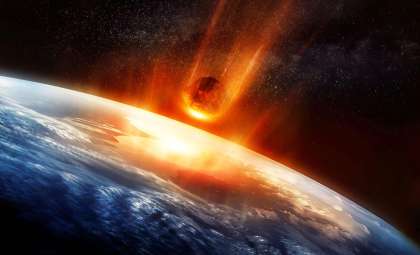
While 2008 DG5 presents no danger during its upcoming passage, considering the impact effects of similarly sized asteroids is important. The 1908 Tunguska Event was caused by a much smaller asteroid, about 130 feet (40 meters) in diameter, and resulted in extensive destruction in a Siberian forest. The blast knocked down over 80 million trees and unleashed energy comparable to 1,000 Hiroshima bombs.
An object the size of 2008 DG5 colliding with Earth could generate devastating shockwaves, ignite large-scale fires, and potentially trigger tsunamis if impacting an ocean. Although such an event is highly improbable, it underscores the immense forces associated with large asteroid impacts.
Tracking Near-Earth Asteroids
NASA’s Near-Earth Object Observation Program plays a vital role in discovering and monitoring asteroids like 2008 DG5. This initiative tracks thousands of near-Earth objects within a 30 million mile radius, enabling risk assessments and preparing possible deflection tactics.
Early detection is paramount to ensuring Earth's safety, allowing international space agencies to devise countermeasures if any object is projected on a collision path. The Planetary Defense Test exemplifies efforts to explore asteroid deflection techniques capable of preventing destructive impacts.
Uncommon Close Approaches of Large Asteroids
The flyby of 2008 DG5 is considered a rare occurrence. Although smaller asteroids frequently cross Earth's orbit, large ones such as this rarely pass so close. Usually, space rocks of this magnitude travel farther away or follow orbits that don't intersect directly with Earth.
Such infrequent visits from sizable asteroids emphasize the importance of continuous monitoring and research. Understanding the dynamics of these objects is critical for developing effective planetary defense methods, ensuring potential threats are identified and managed in advance.
- Categories:
- News









0 comments
Sign in to Comment