

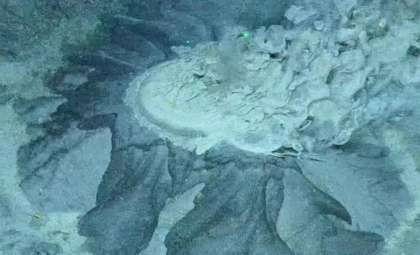
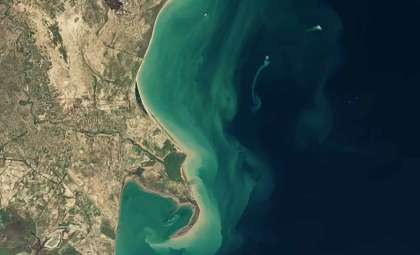
Far below the surface of the Atlantic Ocean, near the Guinea-Bissau coastline in West Africa, researchers have identified massive fossilized mud waves situated over 1,000 meters beneath the ocean floor. These enormous sediment formations, some towering up to 300 meters tall and stretching more than a kilometer, provide fresh evidence about the Atlantic’s origin and its role in influencing global climate about 117 million years ago.
Transforming Ocean Currents Through a Critical Gateway
Known as contourite drifts, these mud waves developed in a distinctive geological area called the “equatorial gateway,” which marks the point where Africa and South America began drifting apart during the fragmentation of the ancient supercontinent Gondwana in the Mesozoic era — an epoch when dinosaurs roamed the Earth.
Earlier studies estimated the gateway’s opening between 113 and 83 million years ago, but recent data reveals it started closer to 117 million years ago. This seemingly small adjustment has “significant implications for reconstructing the climate of that era,” say the researchers.

The Role of Tectonics in Ancient Climate Shifts
The formation of the equatorial gateway triggered “major shifts in the distribution of water between the denser, saltier South Atlantic and the less saline central Atlantic.” Variations in water density created a powerful underwater cascade that sculpted these enormous mud waves.
Uisdean Nicholson, a lead scientist on the project, noted the gateway’s opening “initially caused temporary warming by limiting carbon sequestration in newly formed basins.” As ocean connectivity strengthened, “the global ocean circulation organized itself, leading to sustained cooling at the close of the Cretaceous.”
Revealing Past Ocean Dynamics to Predict Future Climate Changes
Nicholson also highlighted the relevance of these findings for today: “Ocean currents are crucial in managing Earth’s temperature balance. Disruptions, such as those from current ice sheet melting, could bring significant climate impacts.”
Published in Global and Planetary Change, this study illuminates the intricate links between tectonic activity, oceanic flow, and climate regulation over millions of years. It underscores that “our planet’s equilibrium is often controlled by unseen deep processes, sometimes hidden for eons,” and grasping these may help “anticipate — and potentially soften — future climate disruptions.”
This discovery not only revises the history of the Atlantic’s development but also deepens our understanding of how ancient Earth processes shaped climate systems essential for life.
- Categories:
- News







0 comments
Sign in to Comment