
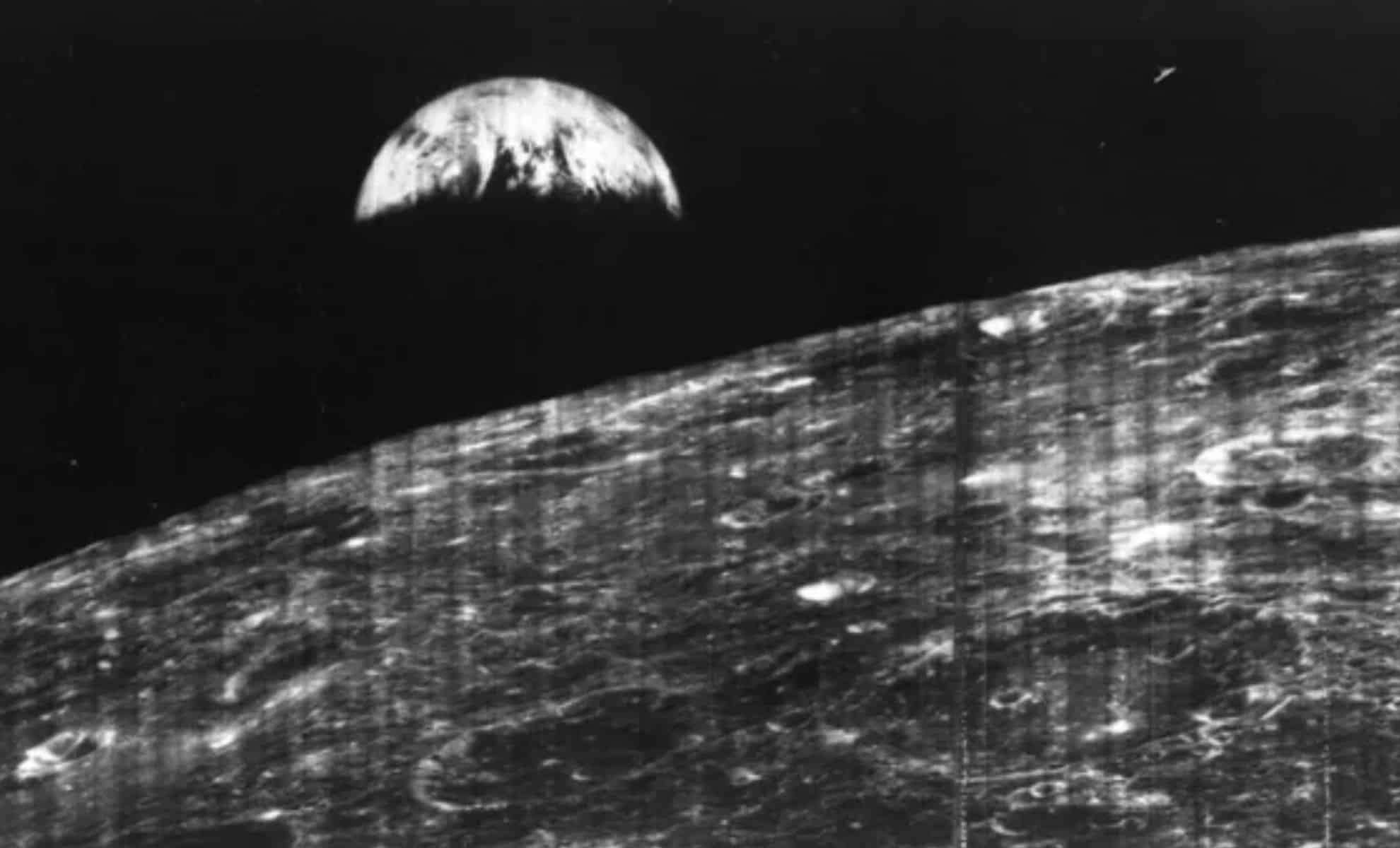
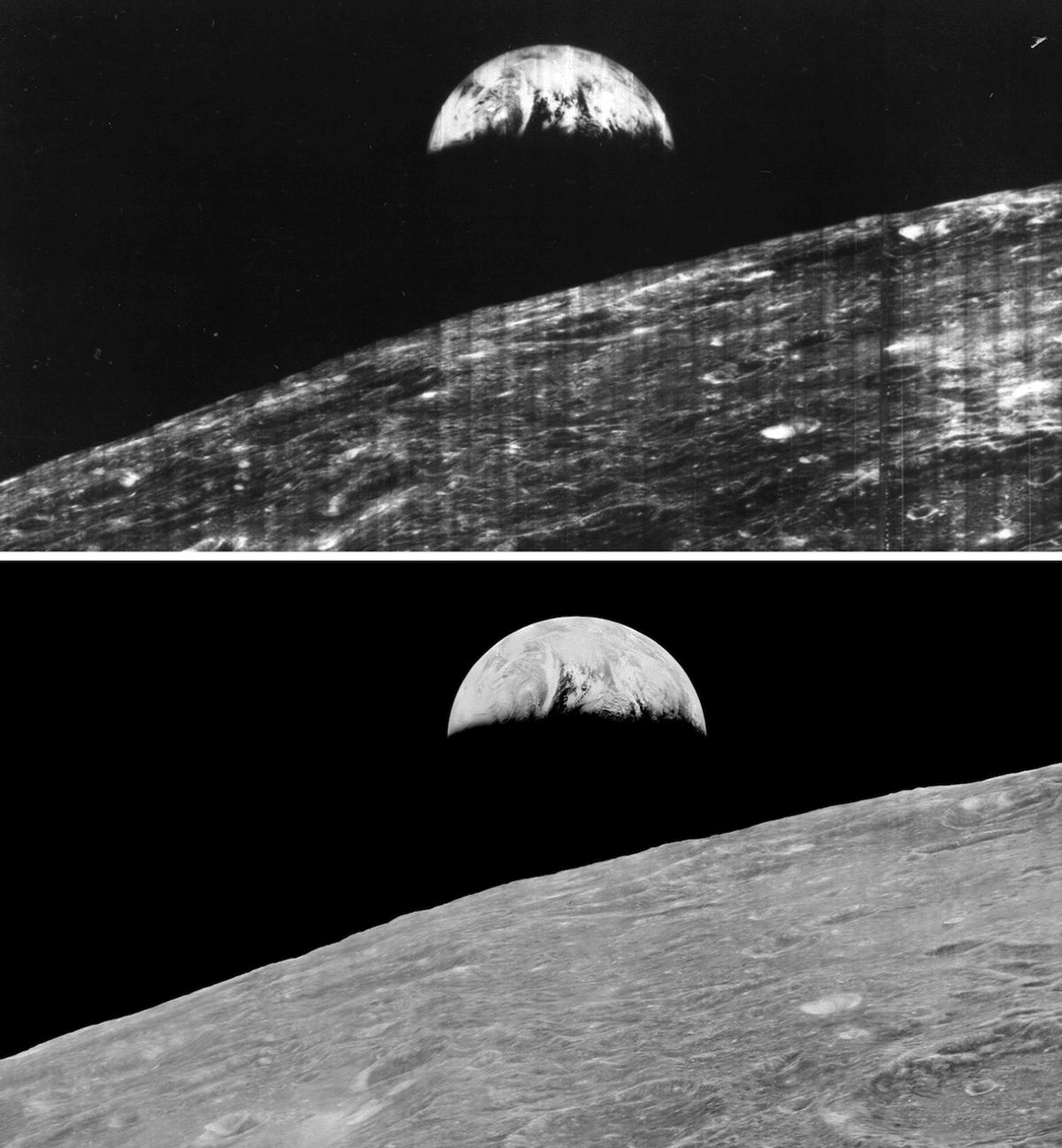
On August 23, 1966, NASA’s Lunar Orbiter 1 captured the inaugural photograph of Earth as seen from near the Moon, depicting our planet as a thin crescent emerging over the lunar horizon. Although the renowned Apollo 8 “Earthrise” shot from 1968 garnered widespread acclaim, this earlier monochrome image marked a pivotal technical milestone that laid the foundation for later lunar missions. As detailed in NASA’s archives and a Live Science report, the photo was an unplanned capture that unexpectedly offered humanity’s first glimpse of Earth from a vantage point beyond our world.
An Overlooked Early Glimpse of Earth from the Moon
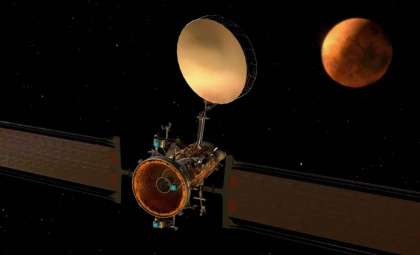
Launched on August 10, 1966 via an Atlas-Agena D rocket from Cape Canaveral, the Lunar Orbiter 1 mission primarily aimed to map lunar terrain for safe landing areas supporting upcoming Surveyor and Apollo missions. Just days after deployment, the spacecraft entered lunar orbit and began methodically photographing potential touchdown spots.
During its 16th orbit on August 23, at precisely 16:35 GMT, Lunar Orbiter 1 aimed its camera toward Earth, capturing a striking black-and-white image of our planet as a narrow crescent hovering over the stark lunar surface. Sent to the Robledo de Chavela ground station near Madrid, this historic photograph represented the first visual confirmation of Earth taken from another celestial body 239,000 miles away.

This photo did not attract as much publicity as Apollo 8’s later image due to its lack of color and dramatic composition. However, this 1966 picture marks the true beginning of humanity’s ability to observe Earth from afar beyond our atmosphere.
The Innovative Camera Technology on Lunar Orbiter 1
The groundbreaking camera aboard Lunar Orbiter 1 was created by Eastman Kodak, originally developed during the Cold War for the National Reconnaissance Office’s Samos spy satellite program. Having already demonstrated effectiveness in orbit, it was modified to handle the challenges of deep-space operation.
This system featured an advanced process where exposed film was developed onboard, scanned line-by-line via a photomultiplier, and then transmitted back to Earth. Although the resulting images lacked the clarity of today’s digital cameras, they were impressively detailed for the era, enabling unprecedented lunar surface mapping.
The spacecraft photographed nine primary Apollo landing candidates plus seven backup sites, establishing the groundwork for humanity’s initial crewed Moon landings. That the mission also yielded the first-ever Earth photo from the Moon was an unexpected but profound bonus—a snapshot symbolizing mankind’s growing reach into space.
From a Scientific Breakthrough to a Symbolic Image
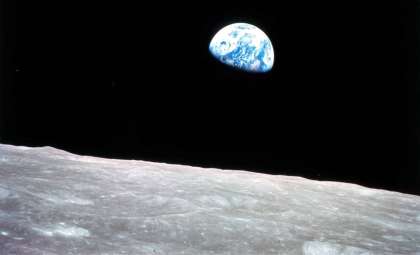
Despite its significance, Lunar Orbiter 1’s Earth image initially lacked broad emotional impact. That shifted on December 24, 1968, when Apollo 8 astronaut Bill Anders snapped the legendary Earthrise photo during the crew’s pioneering lunar orbit. This vibrant color image of Earth as a bright blue-and-white globe rising above the Moon captured global attention during the peak of the Space Race.
The distinction between these two moments extends beyond photo quality to context and timing. The Lunar Orbiter image came from an uncrewed probe within a mainly technical period of space exploration. In contrast, Apollo 8’s photo was taken by a human experiencing the view firsthand, just before mankind’s first Moon landing. It quickly became a universal emblem for environmental awareness, highlighting Earth’s vulnerability and singularity.
Historians now recognize that without the pioneering steps of Lunar Orbiter 1, the inspiration and path to Apollo’s successes—and the cultural reverberations of Earthrise—would not have been possible.
- Categories:
- News








0 comments
Sign in to Comment