
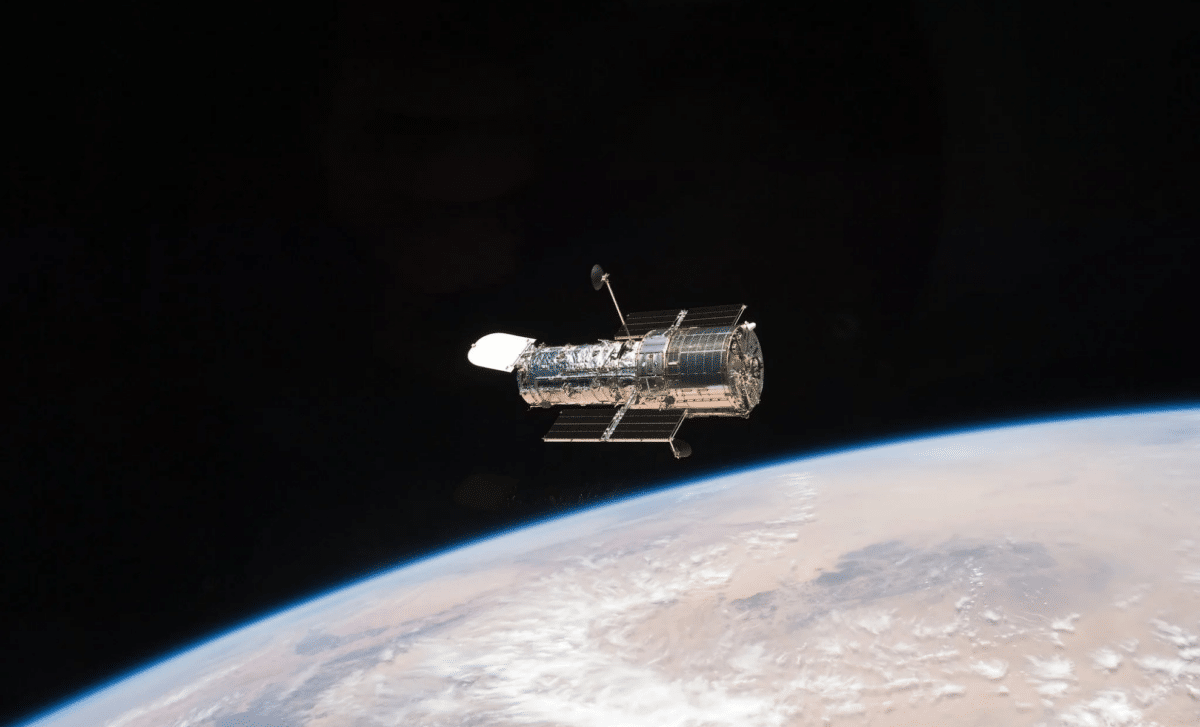
The legendary Hubble Space Telescope, a cornerstone in advancing astronomical knowledge for over 30 years, is approaching the twilight of its orbital mission. Recent analyses suggest it could plunge back into Earth’s atmosphere as early as 2029, possibly dispersing fragments across a wide expanse. NASA specialists caution that although the danger to people is minimal, this eventual descent signals the end of a remarkable era for this groundbreaking observatory.
A Voyage Across Billions of Kilometers
Launched in 1990, the Hubble has been orbiting Earth at speeds reaching roughly 28,163 kilometers per hour (17,500 mph), covering a distance exceeding 6 billion kilometers. Over the years, it has amassed more than 1.3 million observations, unveiling some of the most striking images of the cosmos. Its detailed studies of Type Ia supernovae and Cepheid variable stars were instrumental in narrowing down the universe’s age to approximately 13.8 billion years and confirming the presence of dark energy.
Human spaceflights played an essential role in prolonging Hubble’s mission. As NASA details, “Following a series of three to five days of spacewalks by astronauts to perform maintenance, STOCC controllers alongside Johnson Mission Control readied the telescope for redeployment.” They often used the shuttle’s thrusters to boost Hubble’s orbit, staving off its natural orbital decay caused by atmospheric drag. These precise operations enabled the telescope to continue surpassing its initial mission goals and enrich scientific discovery.

Because it's been a while, here is an update of my plot on the altitude of the Hubble Space Telescope versus time
— Jonathan McDowell (@planet4589.bsky.social) 2026-02-25T06:11:10.872Z
Confronting the Challenges of an Aging Observatory
Hubble wasn’t built to remain in orbit indefinitely. Even at the upper edge of Earth’s atmosphere, lingering atmospheric resistance gradually reduces its speed, lowering its altitude over time. Since the Space Shuttle Program ended, options for a controlled capture or disposal have vanished, meaning the telescope's eventual reentry will be uncontrolled.
Recent modeling of Hubble’s orbital decay under average solar activity predicts reentry around 2033, with debris possibly spreading across an area ranging from 350 to 800 kilometers. This wide uncertainty complicates pinpointing impact zones. Worst-case projections include reentry over densely inhabited areas like Macao, Hong Kong, or Singapore, carrying a low but nonzero chance of causing casualties.
Evaluating the Hazards of Reentry
NASA stresses that estimating Hubble’s precise reentry timeline is challenging due to factors like solar weather, geomagnetic shifts, and orbital variations. The study estimates casualty risk averaging 1 in 330 across Hubble’s inclined orbital path—substantially above NASA’s acceptable limit of 1 in 10,000. While the odds of significant injury remain slim, the potential for debris striking populated regions underscores the importance of vigilant tracking.
To improve safety measures, researchers suggest incorporating refined solar cycle forecasts and enhanced population mapping into future models. This forward-looking strategy helps protect communities and honors Hubble’s extraordinary contributions by managing its final descent responsibly.
- Categories:
- Nasa







0 comments
Sign in to Comment