
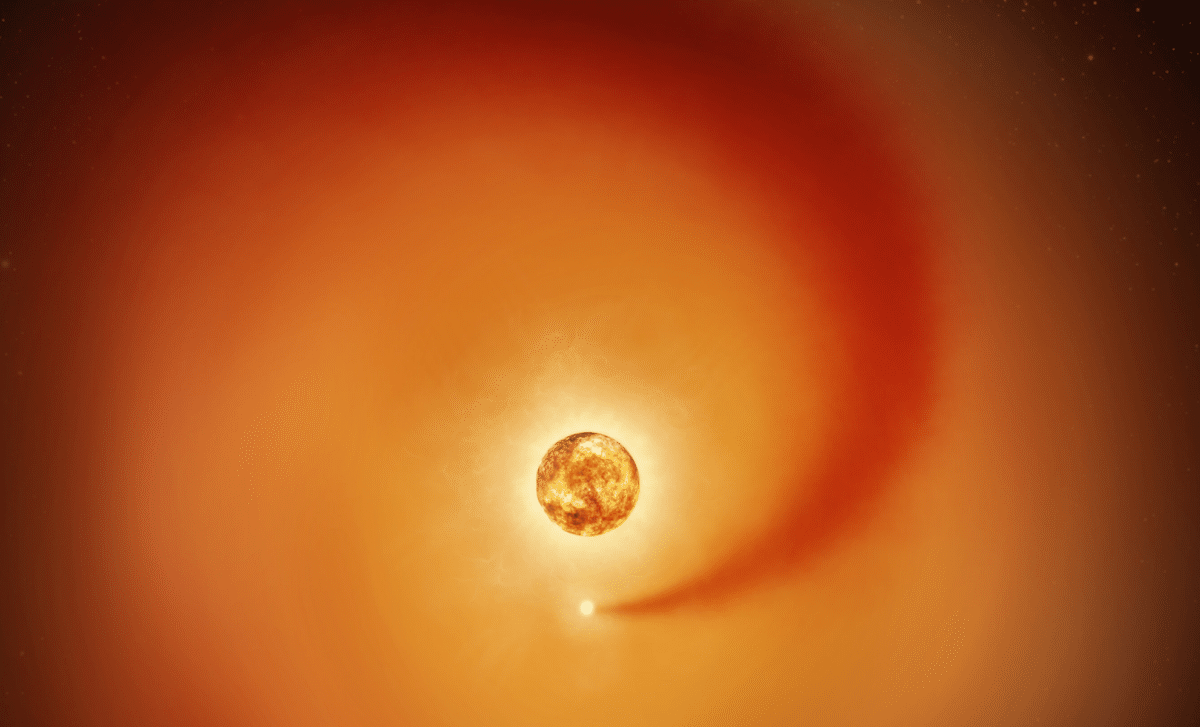
Researchers from the Harvard & Smithsonian Center for Astrophysics have presented the first direct proof of a previously hypothesized companion star orbiting the red supergiant Betelgeuse. Utilizing observations from NASA’s Hubble Space Telescope alongside terrestrial telescopes, the team detected a dense trail of gas trailing this elusive companion, now called Siwarha.
This breakthrough, outlined in a study accepted by The Astrophysical Journal and accessible through the arXiv preprint platform, sheds new light on Betelgeuse’s peculiar brightness fluctuations and enigmatic characteristics.
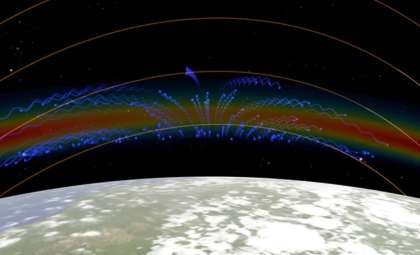
Tracing the Gas Trail Left by Siwarha
Following nearly ten years of monitoring, astronomers have confirmed that Betelgeuse, renowned for its active surface dynamics and sudden dimming events, indeed harbors a concealed companion within its expansive atmosphere. The wake formed by this companion, Siwarha, is no longer hypothetical. By examining fine changes in ultraviolet emissions from ionized iron (Fe II), scientists observed a pronounced blueshift when Siwarha passed in front of Betelgeuse, while the signal diminished when the companion moved behind, absorbed by a dense gas trail trailing it.

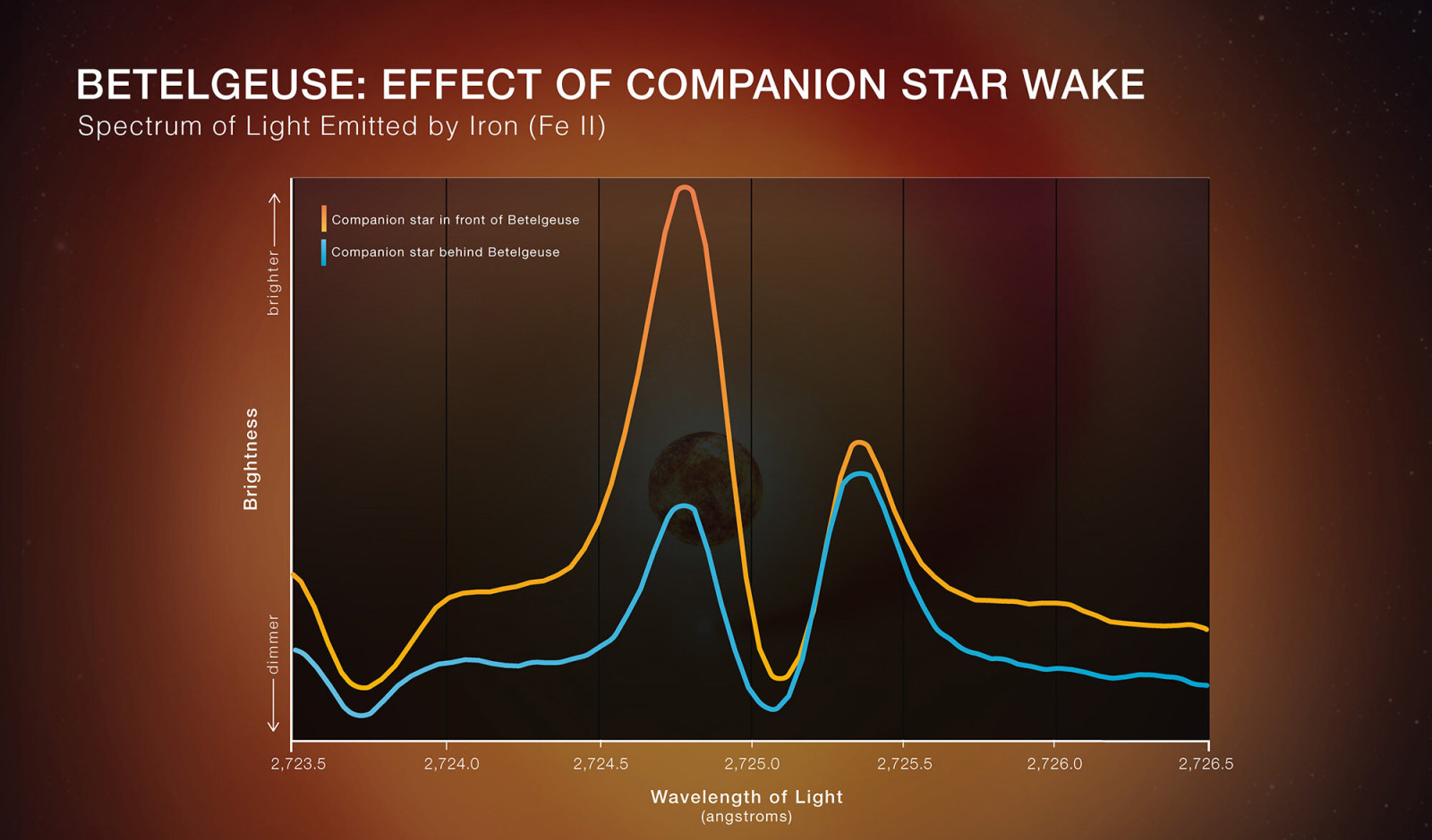
Scientists liken this to observing the ripples a boat leaves on water. “It resembles the wake a boat creates while moving through water. Siwarha stirs Betelgeuse’s atmosphere, and we can actually track these effects in the data,” explained Andrea Dupree, the study’s lead investigator. “For the first time, we're directly seeing a gas trail that verifies the existence of a hidden companion influencing Betelgeuse’s appearance and activity.”
This observational evidence aligns with theoretical models, solving a long-standing astronomical puzzle. Betelgeuse’s surface fluctuations and its puzzling 2,100-day brightness cycle are now attributed to the gravitational impact of this orbiting star disturbing the supergiant's outer layers.
Unlocking Decades-Old Mysteries
Betelgeuse’s unpredictable nature has intrigued scientists for many years. Situated roughly 650 light-years from Earth within the Orion constellation, it is one of the rare stars close and large enough for detailed study. With a volume capable of engulfing hundreds of millions of suns, Betelgeuse's atmosphere exhibits perplexing irregularities. Notably, between late 2019 and early 2020, the star underwent a dramatic dimming visible to the naked eye, fueling speculation about an impending supernova.
Scientists had long anticipated the presence of a hidden, compact companion influencing these phenomena, but direct evidence remained elusive — until now.
“The idea that Betelgeuse had an undetected companion has been gaining in popularity for the past several years, but without direct evidence, it was an unproven theory,” said Dupree. “With this new direct evidence, Betelgeuse gives us a front-row seat to watch how a giant star changes over time. Finding the wake of its companion means we can now understand how stars like this evolve, shed material, and eventually explode as supernovae.”
The confirmed 2,100-day orbit of Siwarha provides astronomers with a predictable timeline to observe wake-related effects. The companion star will next transit in 2027, prompting anticipatory observation campaigns focused on studying the star system's interactions and refining models describing the end stages of massive stars.
Future Prospects for Betelgeuse and Its Partner
This finding goes beyond explaining Betelgeuse’s erratic behavior; it paves the way for new research avenues into massive stellar binaries nearing the end of their lifecycles. Betelgeuse, a prototypical red supergiant, offers a rare opportunity to validate theories about mass loss, magnetic activity, and pre-supernova dynamics in real time.
Observing Siwarha’s wake provides astronomers with a novel method to explore similar supergiant stars, many of which exhibit unexplained variability possibly due to closely orbiting companions concealed within their expansive atmospheres. Such stellar partnerships might be far more prevalent than previously recognized, hidden by their host stars’ intense brightness and scale.
By correlating the 2,100-day brightness variations with Siwarha’s orbit and its resulting wake, this research, available on the arXiv preprint server, invites a reevaluation of red supergiant behavior during their final phases. Betelgeuse remains a crucial cosmic laboratory, and with Siwarha unveiled, its value as a window into stellar evolution has significantly increased.
- Categories:
- Space





0 comments
Sign in to Comment