
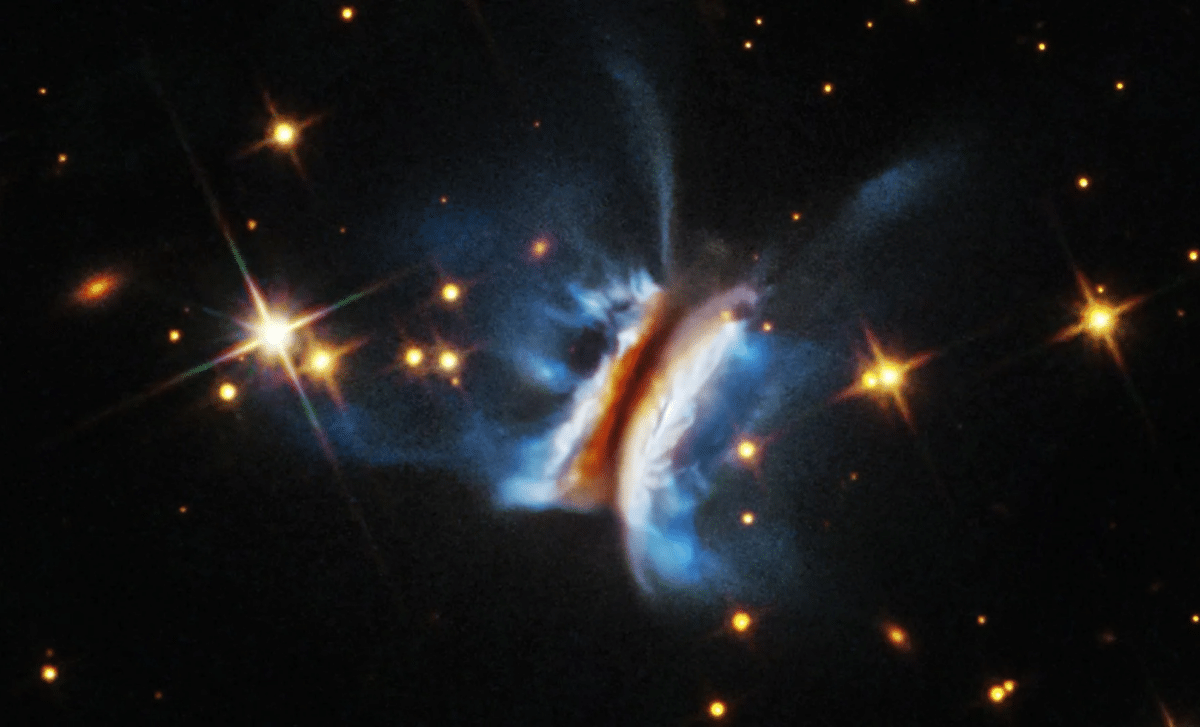
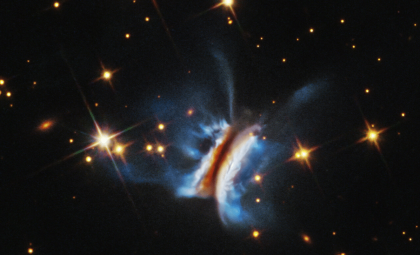
Using the unparalleled capabilities of NASA’s Hubble Space Telescope, astronomers have captured the most detailed visible-light imagery to date of an enormous planet-forming disk encircling a young star system nearly a thousand light-years from Earth. Highlighted by the NASA Hubble Mission Team, this finding reveals a chaotic realm filled with towering tendrils of dust and gas, challenging existing theories on planetary system formation. Known as IRAS 23077+6707 and colloquially referred to as “Dracula’s Chivito,” this huge disk extends about 400 billion miles across, ranking among the largest protoplanetary disks ever identified.
An Immense Disk Within a Dynamic Stellar Environment
The immense size and unusual shape of this system immediately caught astronomers' attention. It’s estimated to span roughly 40 times the width of our solar system when measured to the Kuiper Belt. At its heart lies a young star, or potentially a binary pair, obscured by dense clouds of gas and dust. Seen almost edge-on from Earth, the structure looks like a glowing cosmic sandwich with a dark stripe slicing through bright layers above and below. However, the most eye-catching aspect isn’t size but the intense disorder within.
Unlike many smoother protoplanetary disks, this disk features colossal filaments and wispy formations erupting energetically from one side, while the other side remains sharply defined and comparatively clear. This marked imbalance is unusual and has surprised scientists, as such pronounced asymmetry is rarely seen in planet-forming environments.

“These detailed images are exceptional in planetary disk observation, revealing that planet-forming systems can be far more turbulent and complex than previously believed,” explained lead researcher Kristina Monsch from the Center for Astrophysics | Harvard & Smithsonian (CfA). “Observing the disk nearly edge-on highlights the delicate wisps and uneven structures vividly. While Hubble and NASA’s James Webb Space Telescope have detected similar features in other disks, IRAS 23077+6707 offers a unique vantage point — enabling us to explore its substructures in visible light with unmatched clarity. This disk is an unprecedented natural laboratory to study planet formation and its intricate surroundings.”
The observations afford a rare window into the mechanics of massive disks during the crucial earliest phase of planetary growth. Scientists theorize that the unusual textures may be caused by infalling material, gravitational influences from nearby cosmic sources, or internal violent events sculpting future planets.
Mysterious One-Sided Filaments Puzzle Researchers
One of the most puzzling characteristics of Dracula’s Chivito is the presence of gigantic, filament-like plumes visible on only one flank of the disk. Hubble’s visible-light images display vast, plume-shaped extensions erupting on one edge, contrasting sharply with the opposite margin’s truncated and unusually smooth appearance. The cause behind this uneven matter distribution remains under investigation.
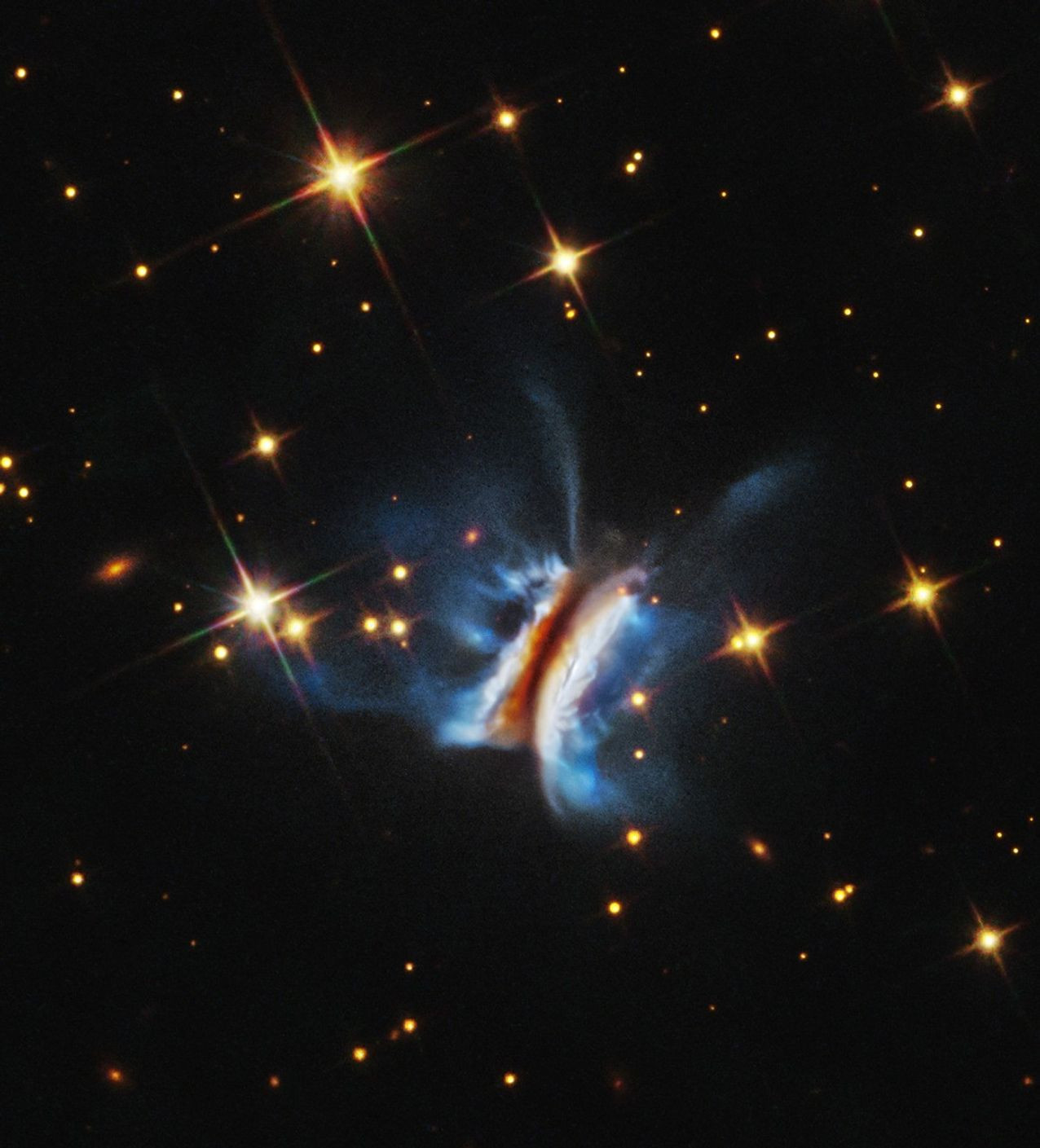
This atypical layout may indicate that outside forces disrupt the disk’s structure. Alternatively, it could reflect inherent instability within the system, with turbulence and gravitational effects distorting the gas and dust. Since protoplanetary disks provide the material to build new planets, understanding these asymmetries is key to grasping how massive planets evolve amid chaos.
“The stark asymmetry of this disk was surprising,” stated co-investigator Joshua Bennett Lovell, another astronomer at the CfA. “Hubble offers us a direct glimpse of the turbulent forces shaping disks as planets form — phenomena we have yet to fully comprehend but can now explore more thoroughly.”
This discovery supports growing evidence that planet formation is far more energetic and volatile than prior models suggested. Historically, astronomers envisioned young planetary systems as more tranquil disks where planets gradually formed over millions of years. However, observations from Hubble and James Webb Space Telescope now indicate many systems undergo violent episodes marked by turbulence, uneven material accretion, and large structural distortions.
Vast Material Reserves to Build Massive Planets
Current mass estimates of the disk fall between 10 and 30 times the mass of Jupiter. This quantity of gas and dust could give rise to several giant planets, perhaps assembling a planetary system vastly larger than our own. Scientists describe the environment as a massive analog of the early solar system, albeit evolving under far more extreme conditions.
Due to thick dust clouds enveloping the central star, its detailed structure remains elusive. Ongoing and future observations may reveal whether a single star or a binary pair occupies the core, a factor that heavily influences the formation and arrangement of surrounding planets. Binary systems frequently generate complicated gravitational fields that warp the disks around them.
“Theoretically, IRAS 23077+6707 could host an enormous planetary system,” Monsch noted. “While planet formation processes might vary in such massive environments, the fundamental principles are likely alike. For now, many questions remain, but these groundbreaking images lay the groundwork for understanding how planets emerge across diverse cosmic settings.”
The moniker “Dracula’s Chivito” reflects the backgrounds of the researchers involved. One hails from Transylvania, while another is from Uruguay, home to the chivito sandwich. The nickname stuck because the edge-on disk resembles a glowing cosmic sandwich drifting through space.
- Categories:
- Space



0 comments
Sign in to Comment