
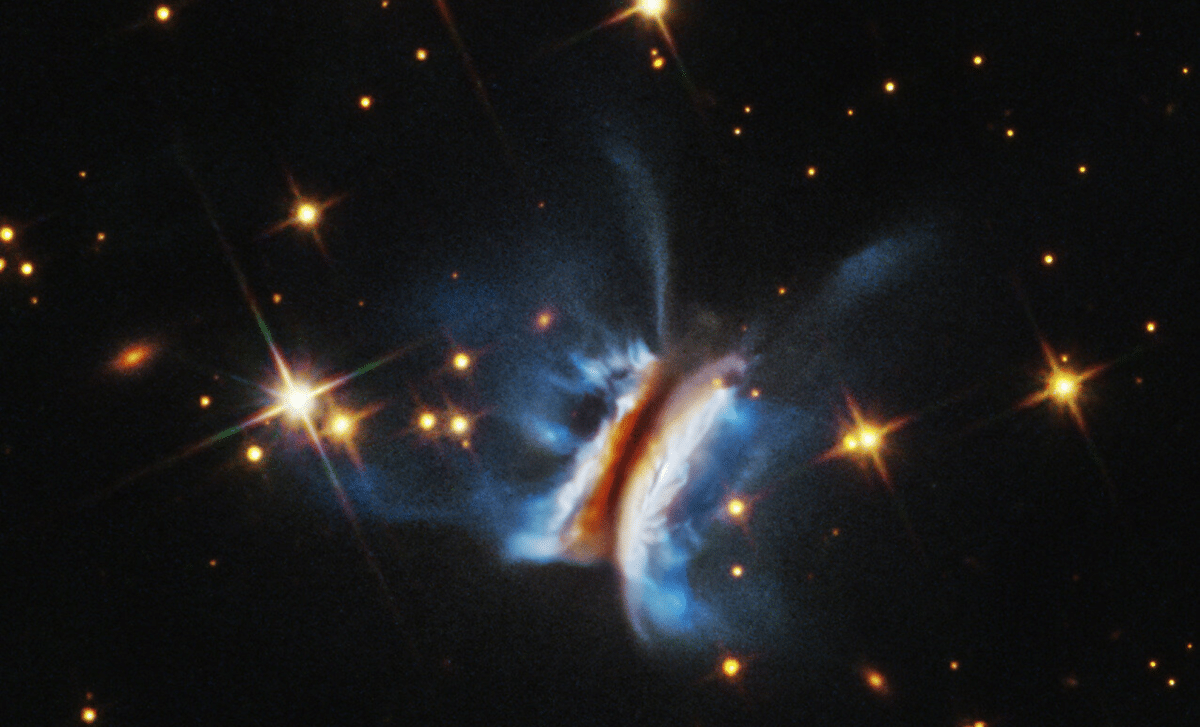
Situated roughly 1,000 light-years away from Earth, an enormous and turbulent disk is providing astronomers with an unprecedented view into the origins of planets. Identified as IRAS 23077+6707, this protoplanetary disk spans an incredible 400 billion miles, making it the biggest disk of its kind detected to date.
Utilizing the powerful capabilities of NASA’s Hubble Space Telescope, scientists are peeling back the layers of this exceptional system. The findings, detailed in The Astrophysical Journal, illuminate the intricate and often chaotic conditions that contribute to planet formation, unveiling a vibrant environment where new worlds may be emerging before our very eyes.
Expanding Horizons on Planet Formation
Scientists have long examined protoplanetary disks—clouds of dust and gas surrounding young stars that are fertile grounds for planet birth. Until now, studies focused mostly on smaller, more conventional disks. The discovery of IRAS 23077+6707 breaks new ground as the most expansive disk observed, nearly 400 billion miles wide.

To grasp its enormity, this disk measures approximately 40 times the diameter of our solar system. What captivates researchers is not solely its sheer size but also the extraordinary detail captured in the latest Hubble images. These observations reveal a highly dynamic and disordered setting, granting astronomers a rare chance to explore how planetary systems develop under extreme conditions.
“This disk is almost like a laboratory in space,” says Kristina Monsch, lead author of the study from the Center for Astrophysics | Harvard & Smithsonian. “The level of detail we’re seeing is rare in protoplanetary disk imaging, and these new Hubble images show that planet nurseries can be much more active and chaotic than we expected.”
The imagery delivers unparalleled views of this planet-forming region, enabling astronomers to map the disk’s features in visible light for the first time and gain vital understanding about the evolution of planetary systems.
The Turbulent Structure of IRAS 23077+6707
One of the standout aspects of this Astrophysical Journal study is the disk’s irregular composition. Unlike many other protoplanetary disks identified by Hubble and NASA's James Webb Space Telescope, IRAS 23077+6707 exhibits an asymmetrical formation.
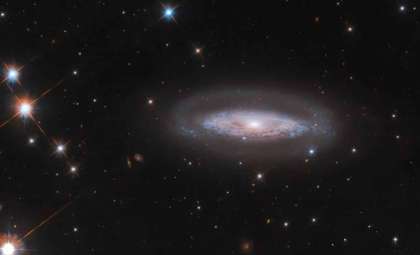
Bright strands of gas and dust emanate well above and below the main disk plane, producing a lopsided look. This previously unseen large-scale irregularity points toward energetic phenomena, such as recent influxes of material or gravitational interactions with nearby objects.
“We’re seeing this disk nearly edge-on, and its wispy upper layers and asymmetric features are especially striking,” explains Monsch. “Both Hubble and NASA’s James Webb Space Telescope have glimpsed similar structures in other disks, but IRAS 23077+6707 provides us with an exceptional perspective—allowing us to trace its substructures in visible light at an unprecedented level of detail. This makes the system a unique, new laboratory for studying planet formation and the environments where it happens.”
This vantage point grants scientists a rare glimpse into how planets might evolve within such intricate and volatile environments.
Defining Characteristics of This Giant Disk
Beyond its remarkable scale, IRAS 23077+6707, also nicknamed “Dracula’s Chivito,” stands out for its distinctive makeup. Stretching extensively across space, this disk could support a planetary system vastly bigger than ours. Experts estimate its mass to range between 10 and 30 times that of Jupiter, enough to spawn multiple gas giant planets. Yet, its asymmetric traits hold the most fascination—one side is decorated with towering filaments while the opposite side remains comparatively smooth and flat.
“We were stunned to see how asymmetric this disk is,” says co-investigator Joshua Bennett Lovell, an astronomer at the Center for Astrophysics. “Hubble has given us a front-row seat to the chaotic processes that are shaping disks as they build new planets—processes that we don’t yet fully understand but can now study in a whole new way.”
This intricate level of observation is enabling researchers to delve deeper into the mechanisms that regulate the birth of planetary systems than ever before.
Implications for Planet Formation in Extreme Conditions
Though IRAS 23077+6707 might represent an extraordinary case of planet formation, it bears similarities to the early stages of our own solar system several billion years ago. The disk may serve as a scaled-up analogue of those primordial conditions, providing a window into how planets develop in such expansive and energetic environments. If it follows comparable evolutionary paths, this disk might eventually give rise to an enormous planetary system.
“In theory, IRAS 23077+6707 could host a vast planetary system,” says Monsch. “While planet formation may differ in such massive environments, the underlying processes are likely similar. Right now, we have more questions than answers, but these new images are a starting point for understanding how planets form over time and in different environments.”
Continued exploration of this extraordinary disk promises to deepen our knowledge of star and planet formation at the galaxy’s outer edges.
- Categories:
- Space



0 comments
Sign in to Comment