

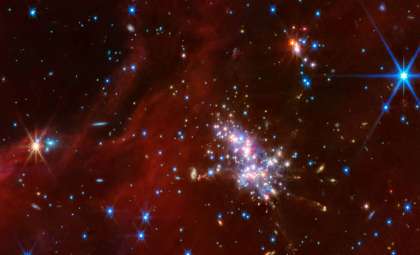
To mark the 35th year since its launch, the NASA/ESA Hubble Space Telescope has captured a breathtaking image of NGC 346, an energetic star-forming region nestled in the Small Magellanic Cloud, a neighboring dwarf galaxy to our own Milky Way.
NGC 346: A Cosmic Nursery in a Nearby Galaxy
As reported by ESA/Hubble, NGC 346 lies roughly 200,000 light-years from Earth in the Tucana constellation, within the Small Magellanic Cloud. This galaxy boasts a distinctive composition, featuring fewer elements heavier than helium—referred to by astronomers as "metals"—compared to the Milky Way. Such metal-deficient environments provide valuable clues about star formation processes similar to those in the early cosmos.
NGC 346 stands out due to its intense stellar activity. It harbors over 2,500 infant stars, vibrant with life, while the largest stars emit a brilliant blue radiance.

Tracking Stellar Movements and Birth Patterns
Utilizing Hubble’s exceptional clarity and precision, astronomers have monitored the movement of stars within NGC 346 over more than a decade. This data revealed an intriguing phenomenon: “researchers traced the motions of NGC 346’s stars, revealing them to be spiralling in toward the center of the cluster.”
This spiraling motion is likely driven by streams of gas funneling into the cluster's core, stimulating continuous bursts of new star formation. The cluster thus exhibits a dynamic, rotating pattern characteristic of evolving stellar nurseries.
Young Stars Mold Their Cosmic Surroundings
NGC 346’s role goes beyond birthing stars—it actively reshapes its cosmic neighborhood. The cluster’s young, massive stars act as sculptors of space, emitting powerful radiation and energetic stellar winds that create a vast bubble within the surrounding nebula. These forces disperse leftover clouds of gas and dust from star formation, significantly reshaping the nebula's architecture.
This nebula, identified as N66, is touted as “the brightest example of an H II (pronounced ‘H-two’) region in the Small Magellanic Cloud.” Such glowing regions shine due to ultraviolet light from hot, young stars, with their vivid pink coloration fading within a few million years—roughly the same lifespan as the stars energizing them.
N66’s presence highlights the youthfulness of the cluster, granting astronomers a glimpse into the formative, active stages of stellar evolution.
Honoring Hubble’s Legacy with Modern Techniques
This remarkable image is part of ESA/Hubble’s initiative to revisit classic space vistas using up-to-date data combined with advanced image enhancement methods. The goal is to honor Hubble’s visual heritage while uncovering new cosmic details.
“Although several images of NGC 346 have been released previously,” the announcement states, “this view includes new data and is the first to combine Hubble observations made at infrared, optical, and ultraviolet wavelengths into an intricately detailed view of this vibrant star-forming factory.”
The final composite draws upon multiple Hubble observation campaigns led by Antonella Nota, Phillip Massey, Elena Sabbi, and Claire Murray, highlighting the collaborative effort driving astronomical breakthroughs.
The Role of Young Stars in Sculpting the Cosmos
This updated image of NGC 346 does more than dazzle the eye. It tells a story of stellar birth, the growth of star clusters, and the powerful forces that influence galaxy structure.
Celebrating 35 years in orbit, the Hubble Space Telescope continues to enrich our understanding of the Universe, persistently revealing the stunning complexity and grandeur of the cosmos.
- Categories:
- Space




0 comments
Sign in to Comment