
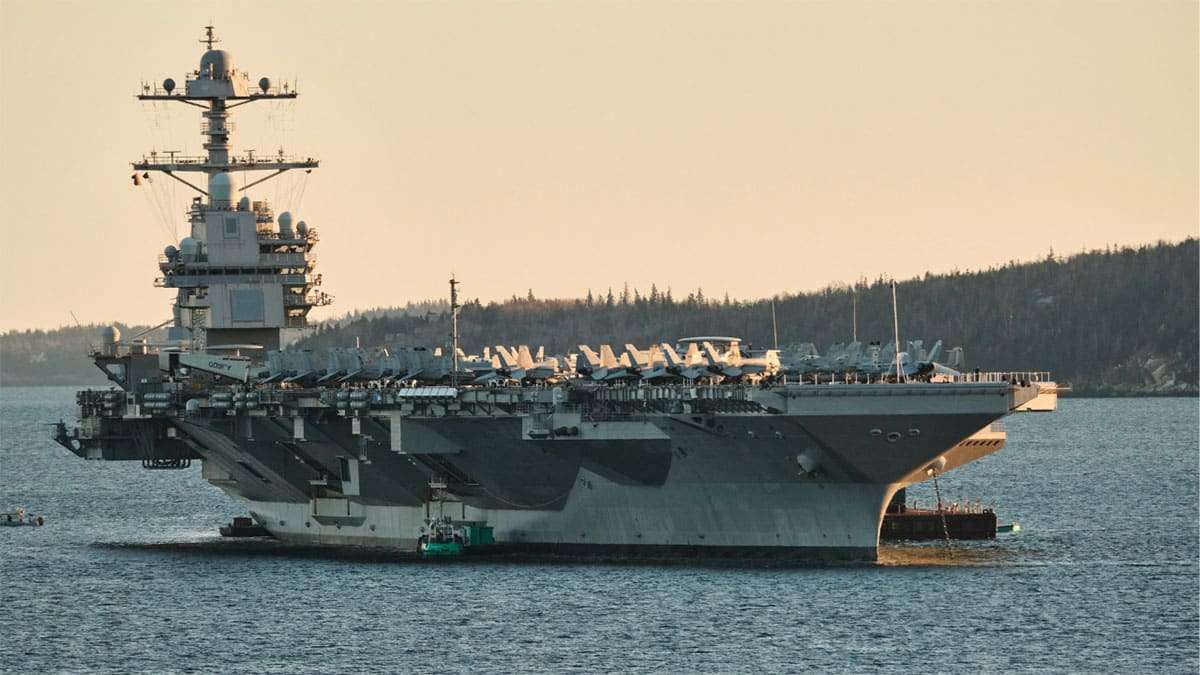
The USS Gerald R. Ford exemplifies advanced naval design, showcasing cutting-edge aircraft carrier technology. Stretching an extraordinary 337 meters from front to back, it surpasses all previous carriers in length, establishing a new benchmark in military sea power.
A Giant Maritime Base Like No Other
Named after the 38th president of the United States, the Gerald R. Ford-class aircraft carrier is far more than a warship—it functions as a massive floating city. Since its launch in 2017, its formidable dimensions have drawn significant attention:
- Overall length: 337 meters
- Beam (width): 78 meters
- Displacement: Roughly 100,000 tons
- Maximum speed: 30 knots (approximately 55 km/h)
To appreciate its magnitude, this naval giant slightly exceeds the Eiffel Tower’s height. Its structure supports nearly 4,500 crew members, breaking naval records for manpower aboard a single vessel. The carrier is equipped with essential amenities for long missions, including:

- Residential cabins
- Mess halls and kitchens
- Medical facilities
- Leisure and recreational spaces
- Operations and command centers
This immense size enables the USS Gerald R. Ford to operate as a mobile command platform, projecting military force across oceans and supporting a wide variety of global defense initiatives.
Revolutionizing Naval Aviation
The Gerald R. Ford-class particularly shines in its role as a launch pad for aircraft. Capable of carrying a striking arsenal of around 90 aircraft, its air wing includes:
- Combat fighter jets
- Helicopters
- Reconnaissance aircraft
- Unmanned drones (UAVs)
Its pioneering launch and recovery technologies mark a major advance in naval aviation. Notably, the electromagnetic aircraft launch system (EMALS) has replaced older steam catapults, enhancing operational efficiency and cutting maintenance time. This system allows faster deployment and supports a wider variety of aircraft.
Here’s a comparison with other leading carriers worldwide:
Carrier Nation Length (m) Aircraft Capacity USS Gerald R. Ford USA 337 ~90 Charles de Gaulle France 261 40 HMS Queen Elizabeth UK 280 ~60
The Journey of Naval Air Power
The origins of aircraft carriers trace back over a century, with the first plane taking off from a ship in 1910 aboard the American cruiser Birmingham. This milestone paved the way for the creation of specialized carriers.
Since then, these vessels evolved from modified warships to dedicated floating airbases. The Gerald R. Ford-class represents the latest advancement, integrating state-of-the-art technology and innovative design elements. Key improvements include:
- Next-generation nuclear propulsion
- Integrated combat systems
- Advanced protection measures
- Automation to reduce crew size
These capabilities ensure that the USS Gerald R. Ford and sister ships remain at the forefront of naval strategy, projecting aerial power around the globe amid evolving geopolitical tensions.
Multiple Roles Beyond Combat
Though primarily a military asset, the Gerald R. Ford-class carrier fulfills diverse roles within the naval framework, such as:
- Providing humanitarian aid and disaster relief
- Serving as a tool of diplomatic presence and deterrence
- Supporting scientific expeditions
- Conducting search and rescue missions
Its rapid deployment capability and extensive support infrastructure render it a critical asset in crises, from natural disasters to diplomatic engagements, exemplifying modern maritime versatility.
In an era where oceans drive global influence, the USS Gerald R. Ford’s 337-meter span not only makes it the world’s longest aircraft carrier but also a symbol of technological innovation and naval dominance in the 21st century.
- Categories:
- Aircraft








0 comments
Sign in to Comment