
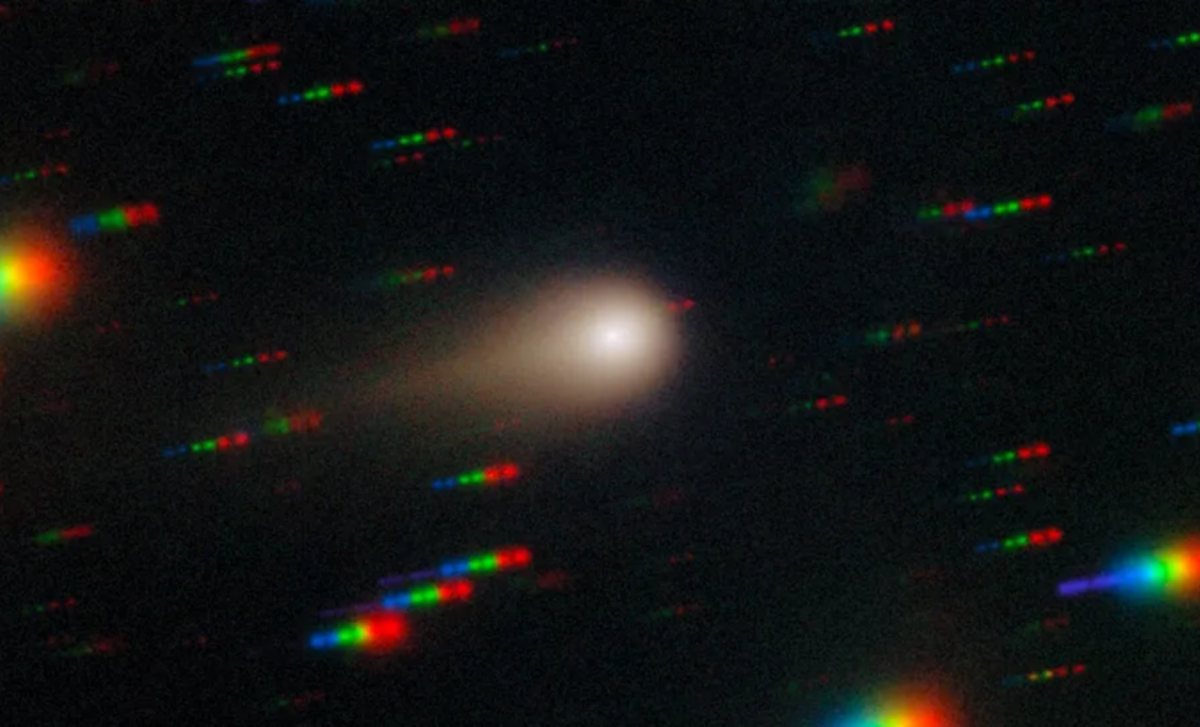
Across the immense stretches of space and time, certain celestial bodies serve as windows into the distant past. Among these is the enigmatic interstellar comet 3I/ATLAS, which journeyed into our solar system from far beyond. Recent studies suggest this visitor could be as ancient as 12 billion years, potentially ranking it among the oldest known objects encountered by astronomers.
Uncovering the Age of 3I/ATLAS: A Cosmic Time Traveler
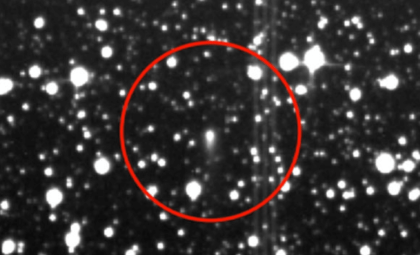
3I/ATLAS garnered attention as one of the few interstellar objects detected entering our solar space. The fascinating aspect lies in its suggested age. Investigations leveraging data from the James Webb Space Telescope’s Near-Infrared Spectrometer (NIRSpec) indicate that this comet’s age ranges between 10 and 12 billion years.
This estimate is based on meticulous examination of its isotopic characteristics, especially ratios involving carbon and deuterium. The comet’s molecular makeup is rich in carbon-12 with a marked scarcity of carbon-13 relative to typical solar system comets. This discrepancy points toward a formation epoch predating the galactic enrichment of carbon-13, aligning with the Milky Way’s nascent era during its early evolutionary phases.

Aligning isotopic evidence with models of galactic development, researchers propose that 3I/ATLAS formed within the universe’s initial billion years after the Milky Way’s birth. This early origin implies the comet comes from an ancient region of the galaxy, far preceding the solar system’s existence.
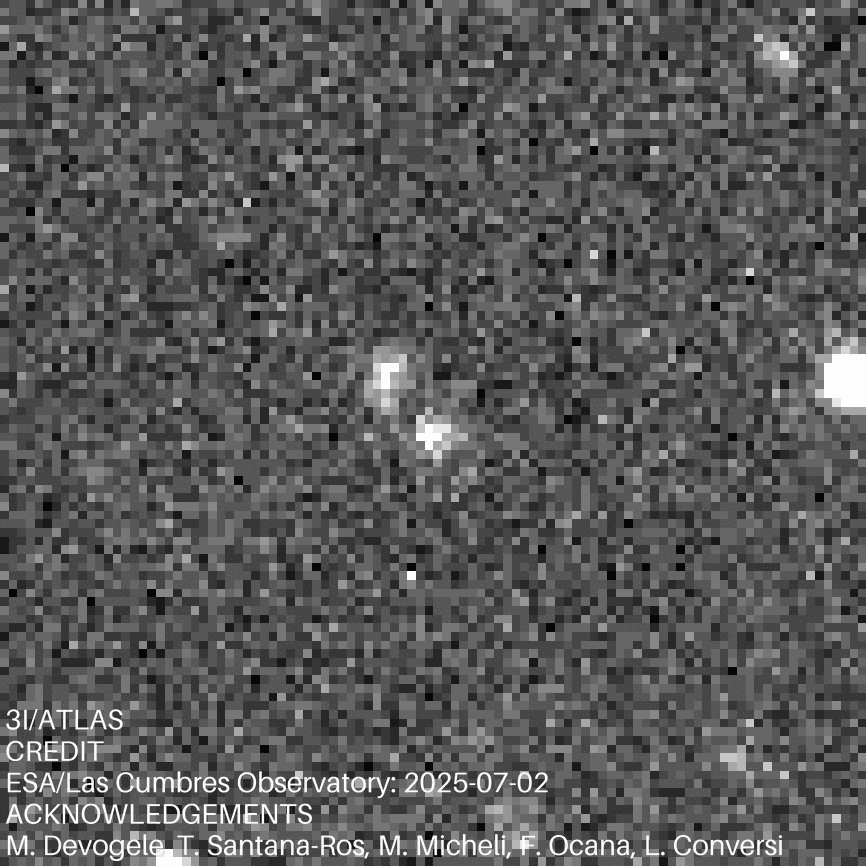
An Ancient Survivor from a Lost Stellar Neighborhood
Martin Cordiner of NASA Goddard and his colleagues explored 3I/ATLAS’s origins through its unique chemical fingerprint. Its high carbon content combined with low carbon-13 levels suggest the comet formed before stellar explosions had significantly altered the Milky Way’s chemical landscape. During the comet’s formation, star formation cycles had yet to fully distribute heavier elements through the galaxy.
Following their chemical analyses, Cordiner’s team described 3I/ATLAS as a relic from an early planetary system that has likely disappeared. Published on arXiv, their paper quotes Cordiner, “That seems more probable the older 3I/ATLAS is.” This highlights how the comet may be one of the last remnants from a long-vanished stellar environment.
This ancient comet provides valuable information about the genesis of primordial planetary systems. Unlike solar system comets formed near the sun’s warmth, 3I/ATLAS presumably originated in a much chillier outer zone of its star’s domain, supported by the elevated deuterium levels in its water ice—a signature synonymous with ultra-cold interstellar spaces.

Insights into Early Planetary Chemistry
The complexity of 3I/ATLAS’s chemical profile deepens its intrigue. It harbors abundant carbon-rich molecules such as methanol, formaldehyde, and methane—key components associated with organic chemistry and, by extension, the precursors of life. These organic compounds hint that the early galaxy harbored the essential ingredients for life well before our solar system emerged.
“We believe that cometary materials in general are representative of the building blocks of planets outside the water snow-line in the protoplanetary disk,” Cordiner shared with Space.com.
This implies that 3I/ATLAS holds vital evidence about how planets and potentially life formed in star systems far removed from our own. Its diverse chemical composition reflects planetary formation under conditions distinct and far older than those observed in our cosmic neighborhood.
For those invested in planetary science and astrobiology, the implications are profound. The comet’s rich organic inventory and water chemistry point to a variety of planetary environments in the cosmos’s early epochs, shaped by primordial processes that differ from present-day solar system conditions.
Unraveling 3I/ATLAS’s Galactic Journey
Despite its remarkable age, the precise birthplace of 3I/ATLAS remains elusive. Its trajectory through the galaxy has been influenced by many gravitational encounters over billions of years, complicating efforts to trace its precise path. However, its chemical traits offer hints that it likely hails from the Milky Way’s thick disk—a galactic region where star formation began as early as 13 billion years ago.
“We believe that the older 3I/ATLAS is, the more probable it is that it came from the thick disk of the Milky Way,” Cordiner remarked. Stars observed in this sector support the idea that it could be a wellspring of many ancient cosmic bodies, possibly including 3I/ATLAS.
Ultimately, while the full story of 3I/ATLAS’s origins might remain out of reach, studying this timeworn interstellar visitor grants scientists a rare peek into our galaxy’s formative history and sheds light on the nature of planet and life formation in distant star systems.
- Categories:
- Astronomy










0 comments
Sign in to Comment