
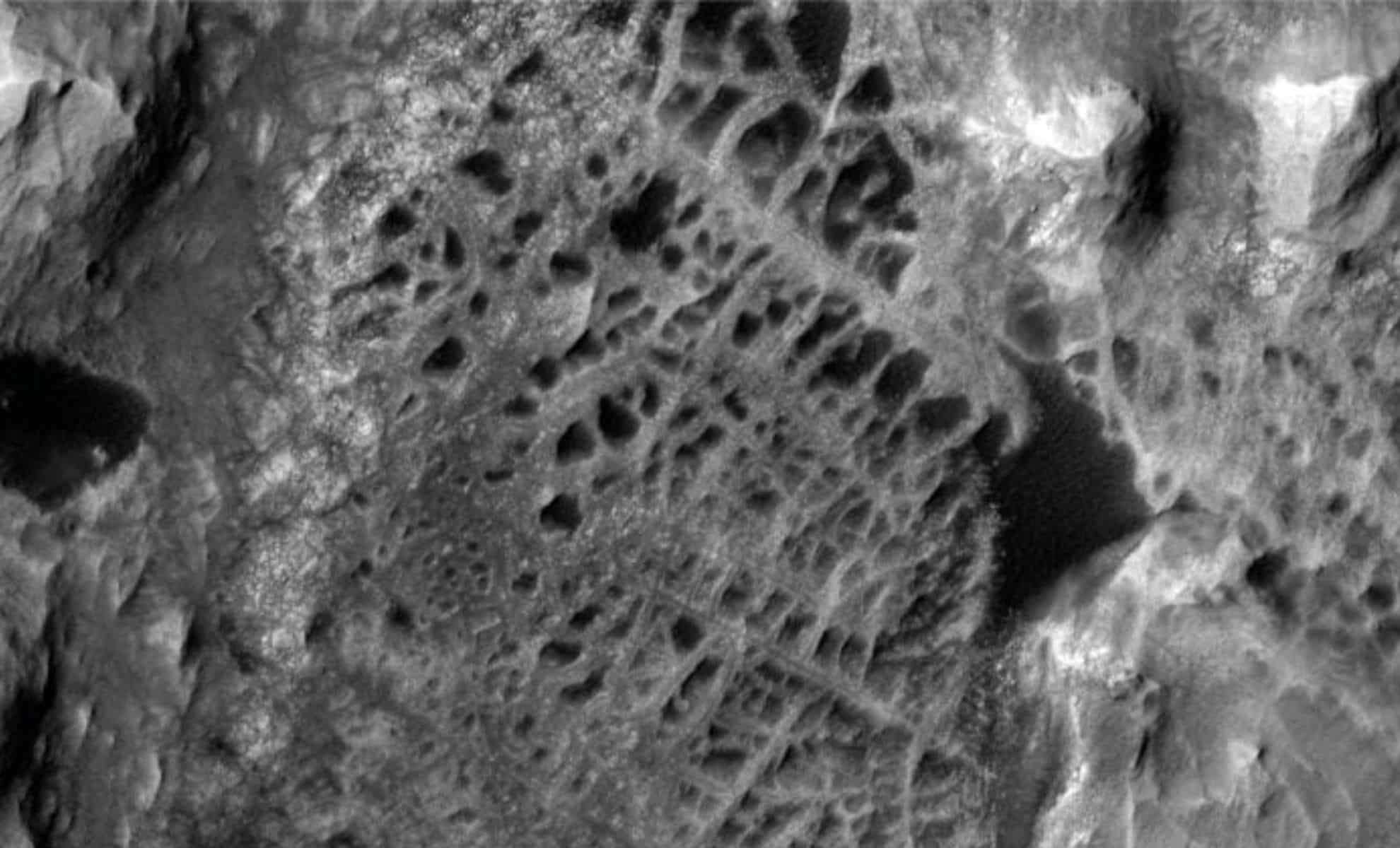
NASA’s Curiosity rover has uncovered a fascinating pattern of interwoven rock structures within Gale Crater on Mars. Originally observed in satellite images captured by the Mars Reconnaissance Orbiter back in 2006, this discovery might represent a “boxwork” formation, potentially reshaping what scientists know about Mars’ ancient water activity. Ashley Stroupe, a Mission Operations Engineer at NASA’s Jet Propulsion Laboratory, provided a thorough update on the findings in a report published on SciTechDaily on May 22, 2025.
Interlaced Ridges Signal Past Groundwater Presence
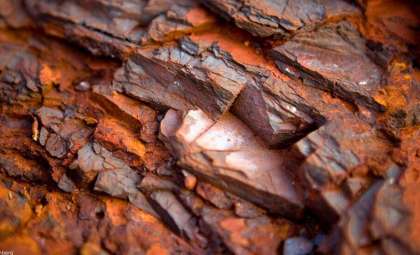
The rock formations being studied feature a complex network of ridges that resemble boxwork patterns seen on Earth. These terrestrial formations form when mineral-rich groundwater deposits durable material in cracks, later exposing those ridges as the softer surrounding rock erodes. Scientists propose a similar process took place on Mars, implying that groundwater endured longer and was more widespread than previously believed.
Although these ridges were first identified from orbit, close examination was postponed because one of Curiosity’s front wheels was positioned atop a small stone, risking slippage during arm deployment. As a result, current investigations rely on remote sensing techniques.

Enhanced Imaging and Spectral Studies in Progress
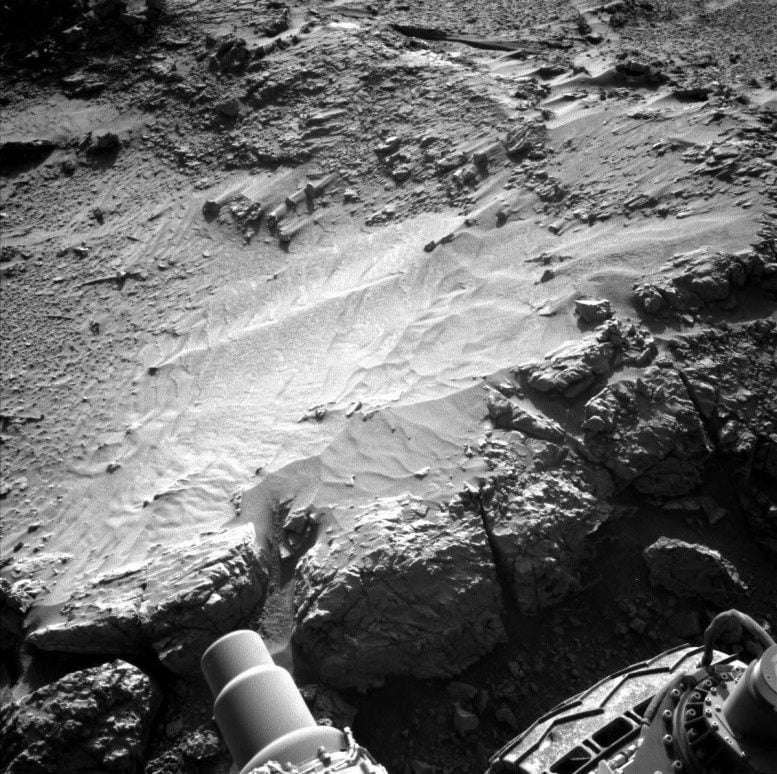
With limited mobility, Curiosity has been operating its Mastcam and ChemCam instruments to perform detailed analyses of the site. Mastcam is generating wide-ranging panoramic images to chart elevation shifts and to record features such as the "Temblor Range" along with nearby depressions whose origins remain unknown.
Meanwhile, ChemCam employs laser-induced breakdown spectroscopy (LIBS) to determine the chemical composition of "Glendale Peak," a jagged feature thought to be part of the boxwork network. It also collected high-definition mosaics of "Texoli Butte" to provide comparative data.
This complementary approach combines chemical profiling and structural mapping, enabling researchers to piece together how these ridges developed, essential for decoding Mars’ geological evolution.
Maintaining Rover Systems for Optimal Performance
Beyond scientific tasks, engineers have performed routine maintenance on Curiosity’s Heat Rejection System (HRS), which circulates coolant to regulate internal temperatures generated by the rover’s radioisotope power source. Monthly assessments confirm the functionality of the backup pump, a crucial component if the primary system malfunctions.
Such upkeep is vital to ensure rover reliability, especially as it maneuvers through rugged terrain that could jeopardize stability or movement.
Upcoming Maneuver to Allow Direct Sample Examination
After completing remote studies, mission teams plan to reverse Curiosity by approximately 30 centimeters, sufficient to free it from the obstructing rock and position the target formations within reach of its robotic arm.
This adjustment will facilitate use of contact instruments including the APXS (Alpha Particle X-ray Spectrometer) and MAHLI (Mars Hand Lens Imager), which are instrumental in conducting direct compositional analyses.
This phase will provide hands-on insights into the mineral makeup of the ridges, confirming whether they match boxwork features known from Earth.
Ongoing Atmospheric Monitoring and Autonomous Target Selection
The mission also continues atmospheric research, tracking dust density through solar tau measurements using Mastcam, alongside capturing Navcam suprahorizon videos and surveying dust devils.
Curiosity further employs AEGIS, its autonomy software, that intelligently selects new ChemCam targets. This AI-driven system allows the rover to conduct scientific observations independently of delayed Earth commands, maximizing data collection opportunities.
Unraveling the secrets of this potential boxwork formation could provide definitive proof of sustained subterranean water on Mars, strengthening the case for a once-hospitable Martian environment.
- Categories:
- News




0 comments
Sign in to Comment