
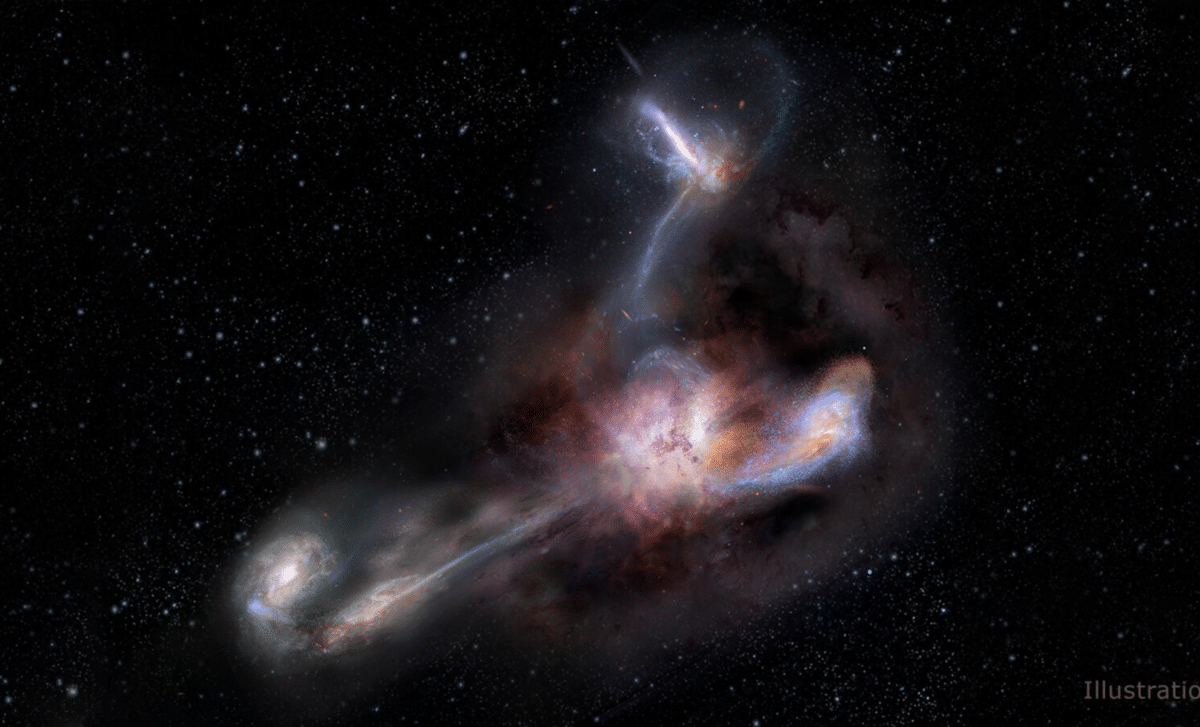
Recently published research in the Monthly Notices of the Royal Astronomical Society sheds new light on the extraordinary brightness of W2246−0526, a unique “Hot DOG” galaxy captured from just 1.2 billion years after the Big Bang. Leveraging observations from the James Webb Space Telescope, astronomers identified extensive polar dust clouds encircling the galaxy's central black hole, which likely boost its intense infrared emission, clarifying why this cosmic giant ranks among the brightest objects ever detected.
A Colossal Galaxy Veiled in Dense Cosmic Dust
The galaxy W2246−0526 belongs to an uncommon group known as hot dust-obscured galaxies or Hot DOGs. These galaxies are some of the universe’s most powerful infrared emitters, radiating energy exceeding 100 trillion times that of our Sun. Their dazzling luminosity is fueled by voracious supermassive black holes shrouded within thick dust clouds. Visible light telescopes see many of these galaxies as nearly invisible since the dust absorbs the high-energy radiation and re-emits it primarily in the infrared spectrum.
With a redshift of 4.6, W2246−0526 stands out as the farthest and most luminous Hot DOG discovered to date. Earlier studies revealed dust heated to almost 450 Kelvin (about 180 degrees Celsius), indicative of an active galactic nucleus where inflowing material around a black hole releases tremendous energy. Despite extensive research, the reasons behind the galaxy’s exceptionally strong infrared output—far beyond that of similar objects—remained elusive.

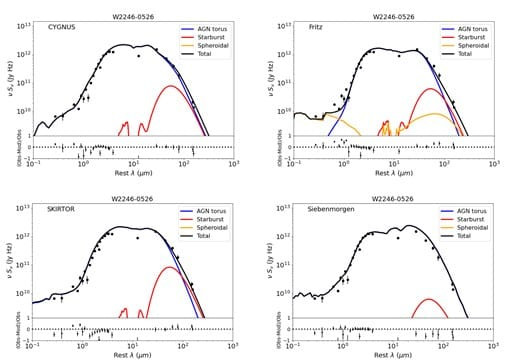
The recent study, led by Charalambia Varnava from the European University Cyprus, utilized multiwavelength data combined with sophisticated modeling techniques to dissect the galaxy’s spectral energy distribution. The team incorporated new infrared observations obtained by the James Webb Space Telescope, whose heightened sensitivity enabled scientists to peer through heavily obscuring dust layers. Their objective was to pinpoint the internal components shaping the galaxy’s distinctive light emission.
Testing various models involving the black hole's dusty torus, star-forming zones, and host galaxy structures, initial simulations matched some aspects but consistently failed to explain the galaxy’s pronounced mid-infrared radiation. This shortfall suggested the presence of an additional energy source hidden within the galaxy.
New Insights Highlight Polar Dust as the Key Contributor
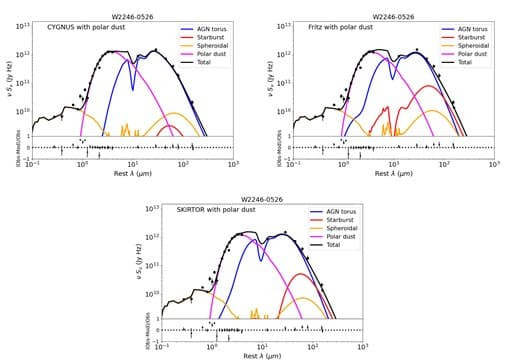
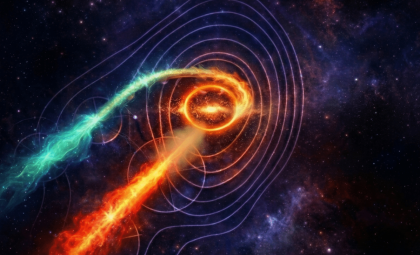
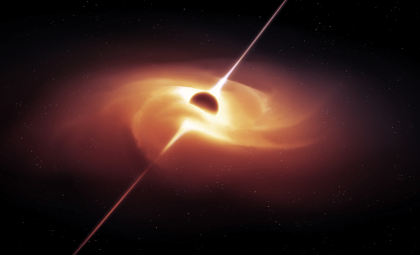
Breakthrough came when researchers introduced a novel element into their models: polar dust clouds positioned along the poles of the black hole’s axis, rather than confined solely to the surrounding torus. This altered structure produced a significantly better match with observed data. The study proposes these dense dust clouds absorb powerful radiation emitted by the active galactic nucleus and then re-emit it in the infrared band, intensifying the galaxy's luminosity.
The analysis supports a scenario featuring an almost edge-on perspective of the black hole’s torus, accompanied by thick polar dust extensions protruding from the central region. This configuration provides a compelling explanation for the galaxy’s unusual infrared signature, which had puzzled astronomers for years. Published in the Monthly Notices of the Royal Astronomical Society, the findings present some of the best evidence to date that polar dust significantly enhances the luminosity of extreme Hot DOG galaxies in the early cosmos.
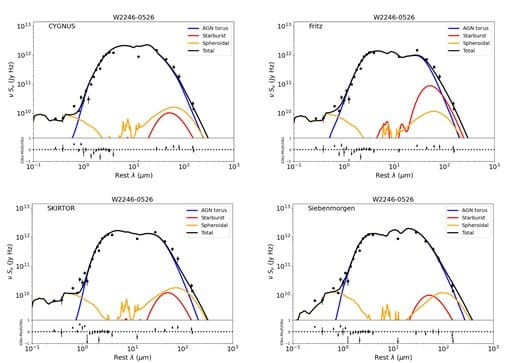
“For all models, the inclusion of polar dust statistically significantly improves their fit to the data of W2246−0526,” the authors state in their publication. “We propose that the observed infrared SED of W2246−0526 is best explained by re-radiation from optically thick dust clouds in the polar regions of the torus, along with an optically thick torus viewed nearly edge-on.”
While this evidence remains indirect, relying on how well the revised models replicate the observed emission, the findings are considered robust. Previously, no models could explain the infrared surplus as accurately.
An Astonishingly Rapidly Growing Black Hole
The research also updated the physical parameters of W2246−0526, revealing a gargantuan black hole with a mass estimated at 23 billion Suns, ranking it among the most massive known at such a youthful stage in the universe. Strikingly, this black hole is responsible for producing between 72% and 81% of the galaxy’s overall energy output.
The team detected signs of a vigorous starburst event within the galaxy. Star formation rates appear to surpass those of the Milky Way by thousands of times, signaling an intense yet brief growth period. This starburst phase seems relatively recent, likely only tens of millions of years old, prompting vital questions about how galaxies and their central black holes evolved so rapidly after the Big Bang.
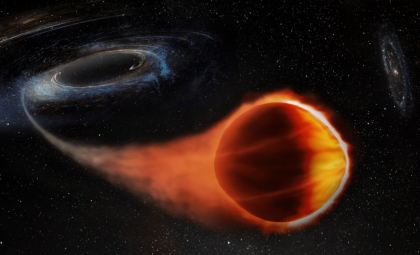
The updated mass estimates exceed earlier calculations by roughly two to threefold, suggesting the black hole is fueling itself at an extraordinary rate. One explanation involves super-Eddington accretion, a process where matter accretes onto the black hole faster than traditionally predicted limits. Confirmation would make W2246−0526 one of the most extreme cases of black hole growth ever found.
Moreover, these findings hint that many alike galaxies might be obscured throughout the distant universe, hidden behind thick dust layers that conventional telescopes cannot easily penetrate. By applying these new modeling techniques, astronomers may soon unveil a previously unrecognized population of heavily obscured, intensely active galaxies.
- Categories:
- Astronomy

0 comments
Sign in to Comment