
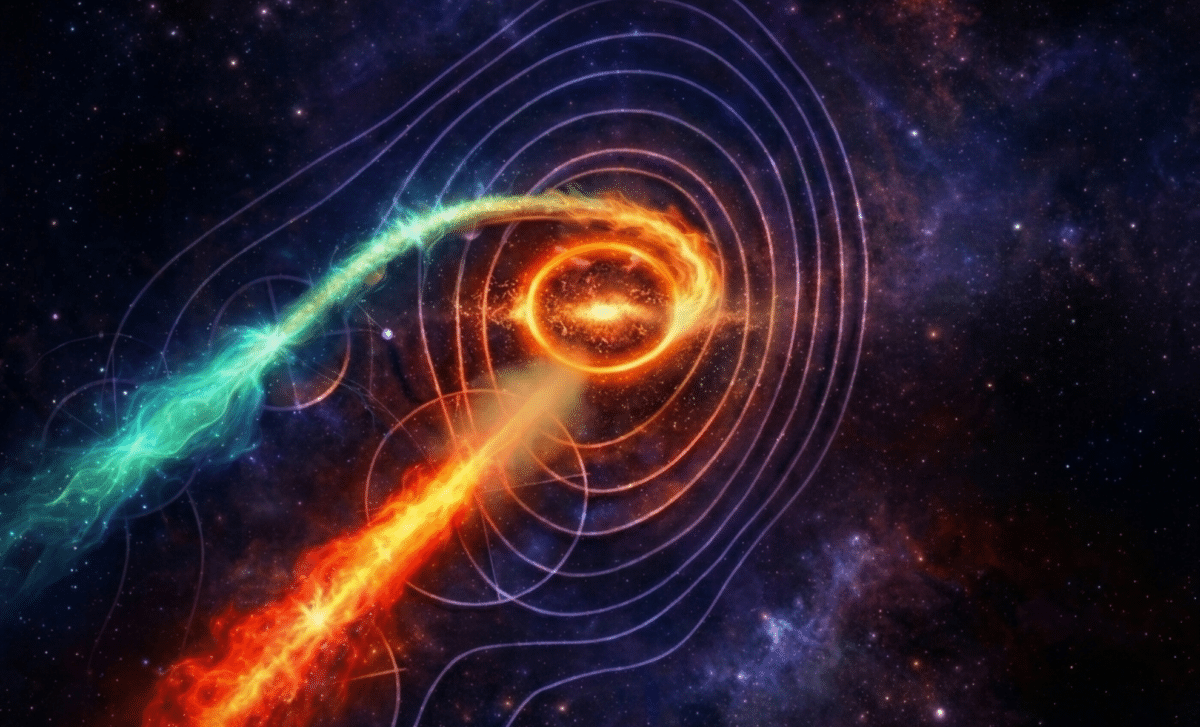
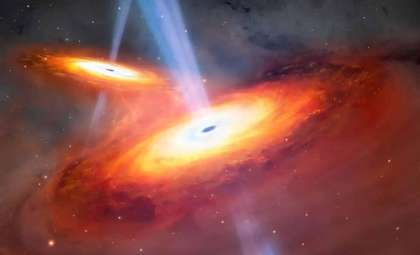
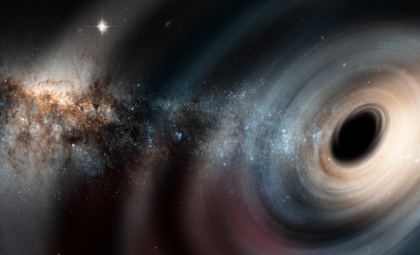
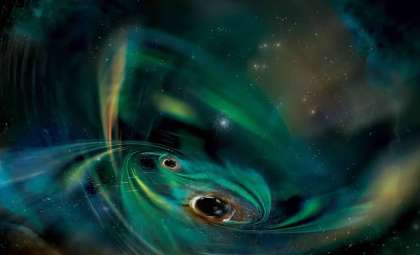
Astronomers have unveiled what could be the inaugural confirmed case of two massive black holes locked in a mutual orbit, poised to eventually merge. Featured in the Monthly Notices of the Royal Astronomical Society, this extraordinary discovery opens a window onto an awe-inspiring cosmic event—the collision of two supermassive black holes. Beyond enriching our grasp of these enigmatic objects, the finding promises to shed light on galaxy evolution and the emission of gravitational waves as these titans spiral inward.
Unveiling a Rare Supermassive Black Hole Binary
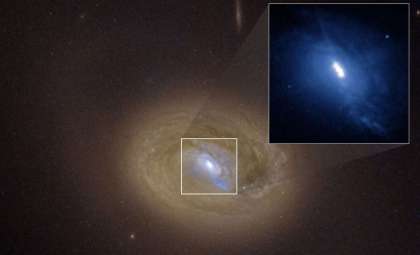
While theoretical models have long predicted that closely bound supermassive black holes should exist within galactic cores, concrete evidence has been lacking—until now. Led by Silke Britzen of the Max Planck Institute for Radio Astronomy in Bonn, a team has documented compelling signals indicative of a pair of supermassive black holes intertwined at the center of the galaxy Markarian 501.
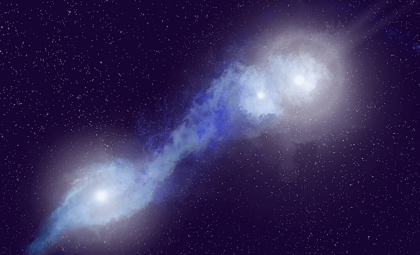
This pioneering research, published in the Monthly Notices of the Royal Astronomical Society, draws on years of detailed radio telescope observations. Scientists identified two distinct, powerful jets streaming from the galaxy’s core—previously attributed to a single black hole but now revealed to come from a pair locked in gravitational orbit. These colossal black holes, each weighing between 100 million and a billion times the mass of our Sun, are spaced roughly 250 to 540 astronomical units apart.

Jets Expose the Concealed Companion
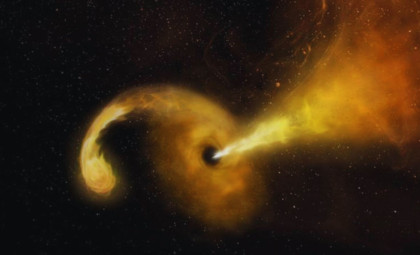
The revelation of a second supermassive black hole took the scientific community by surprise. For many years, researchers observed one dominant jet directed toward Earth emanating from Markarian 501. It was only after analyzing over two decades of multi-frequency radio data that a second jet moving in a divergent direction was detected.
“We searched for it for so long, and then it came as a complete surprise that we could not only see a second jet, but even track its movement,” says Britzen.
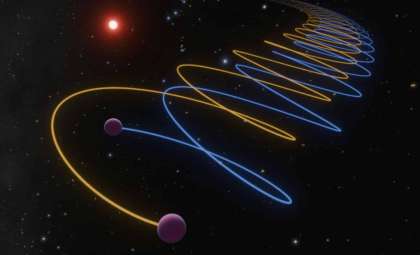
The second jet’s orientation initially rendered it difficult to spot, but continuous observations revealed it orbiting counterclockwise around the primary black hole, completing a full cycle every 121 days.
The Celestial Ballet of Two Black Holes
These paired black holes form a dynamic cosmic duet whose jets sway and fluctuate as their orbital planes tilt. According to Britzen, analyzing the data felt like "being on a ship," as the entire jet configuration appeared to move fluidly. This motion confirms the black holes’ close proximity and highlights how their immense gravity distorts the light emitted from the system.
Britzen further comments: “Evaluating the data felt like being on a ship. The entire jet system is in motion. A system of two black holes can explain this: The orbital plane sways.” This rare observation grants researchers a valuable glimpse into the complex behavior of supermassive black holes nearing coalescence, enabling the exploration of their cosmic choreography with unprecedented clarity.
Upcoming Prospects: Gravitational Waves and Advancing Black Hole Research
As the duo continues their orbital dance, their separation will shrink, culminating in a monumental merger. This closing gap may produce gravitational waves—ripples in the fabric of spacetime—that could be captured by cutting-edge technology like pulsar timing arrays (PTAs).
“If gravitational waves are detected, we may even see their frequency steadily rise as the two giants spiral toward collision, offering a rare chance to watch a supermassive black hole merger unfold,” notes co-author Héctor Olivares. This event stands to provide direct observation of one of the universe’s most energetic and transformative phenomena, deepening knowledge of black hole physics and galaxy formation.
- Categories:
- Astronomy


0 comments
Sign in to Comment