
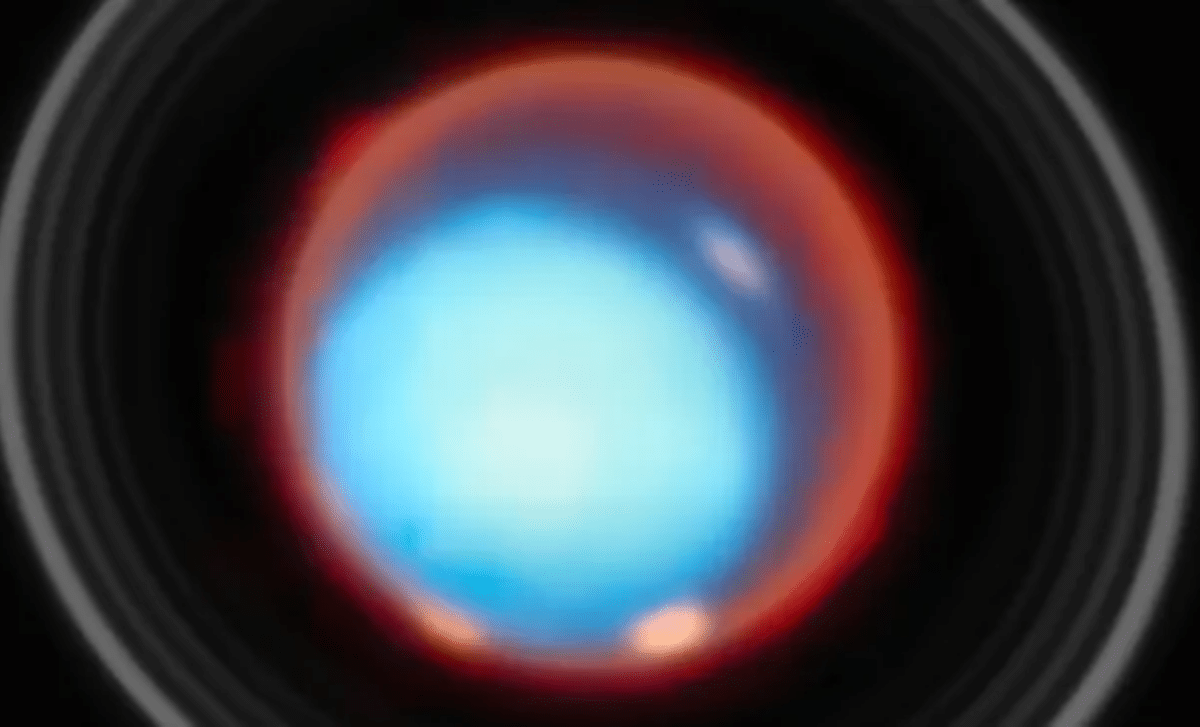
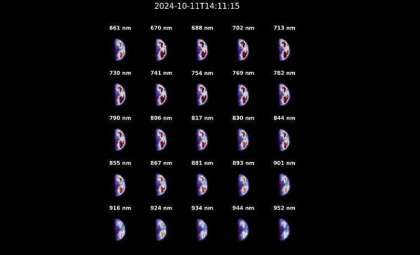
Uranus has long intrigued scientists with its unusual magnetic properties and enigmatic auroras. Now, the James Webb Space Telescope (JWST) has enabled astronomers to create the planet’s first-ever three-dimensional aurora maps. Recently published in Geophysical Research Letters, this research unravels fresh details about the planet’s atmosphere and magnetic environment, offering new perspectives for studying far-flung worlds beyond our solar system.
Uranus’s Magnetic Field: A Galactic Oddity
Uranus stands out due to its highly irregular magnetosphere, setting it apart from other planets. “Uranus’s magnetosphere is among the most peculiar within our solar system,” explained Paola Tiranti from Northumbria University in the U.K. This planet’s magnetic field is uniquely tilted and displaced relative to its rotational axis. In contrast to Earth’s well-aligned magnetic field, Uranus’s skewed field gives rise to auroras that are dynamic and unpredictable, making atmospheric and solar wind studies particularly daunting.
The JWST’s remarkable sensitivity has allowed researchers to examine Uranus’s auroras with unprecedented clarity, uncovering how the planet’s magnetosphere governs atmospheric behavior. By capturing these auroras in three dimensions, scientists can now illustrate the transfer of energy through Uranus’s upper atmosphere in ways that were previously unattainable. These breakthroughs enhance understanding not only of Uranus but also of auroral mechanisms on other planets, including exoplanets beyond our solar system.

Revealing the Upper Atmosphere in 3D
Viewing Uranus’s upper atmospheric layers in three dimensions marks a breakthrough in planetary research. “This marks the first occasion we’ve mapped Uranus’s upper atmosphere in 3D,” noted Paola Tiranti. Prior to this, analyses were limited to flat, two-dimensional perspectives that only partially illustrated the atmospheric structure. Equipped with Webb's sophisticated imaging, scientists can now track how energy ascends through Uranus’s atmosphere, a complex process that earlier telescopes struggled to capture.
The detailed 3D data also highlight the effects of Uranus’s uneven magnetic field, which directs energy flows in a non-uniform manner. These results are crucial for advancing knowledge about Uranus itself and offer insights applicable to other icy and gas giants across the cosmos. Observations made by Webb will be instrumental in shaping upcoming research of distant exoplanets featuring similar magnetic and atmospheric traits.
Uranus’s Atmospheric Cooling Continues
An intriguing aspect of the JWST findings is the continuing cooling trend in Uranus’s upper atmosphere, a process that started in the early 1990s. “Webb’s measurements reinforce that Uranus’s upper atmosphere remains on a cooling trajectory,” stated Tiranti. This indicates a reduction in the planet’s energy emissions over time, which may influence its long-term climate patterns.
The team recorded an average temperature near 426 kelvins (roughly 150 degrees Celsius), noticeably cooler than prior estimates from Earth-based observations and historic missions like Voyager 2. This sustained cooling phase could impact the planet’s atmospheric phenomena, magnetic field interactions, and weather systems. These findings, detailed in Geophysical Research Letters, shed light on Uranus’s past environmental changes and its evolutionary trajectory.
- Categories:
- Astronomy







0 comments
Sign in to Comment