
Westerlund 1 stands out as an extraordinary star cluster in our galaxy. Far surpassing typical star clusters, which weigh about 10,000 times the mass of our sun, Westerlund 1 boasts an incredible mass ranging from 50,000 to 100,000 solar masses, making it a true giant among its peers.
This vast stellar assembly contains hundreds of enormous stars, some reaching sizes up to 2,000 times that of the sun. To grasp their enormity, these stars would extend outward to nearly Saturn’s orbit if placed within our solar system. Their luminosity is no less impressive, with individual stars radiating up to one million times the brightness of our sun.
For any hypothetical world orbiting inside Westerlund 1, the night sky would be dazzlingly lit by hundreds of stars shining as brightly as a full moon. This immense cluster is the largest star cluster discovered within the Milky Way and remains largely hidden in the Southern celestial hemisphere.

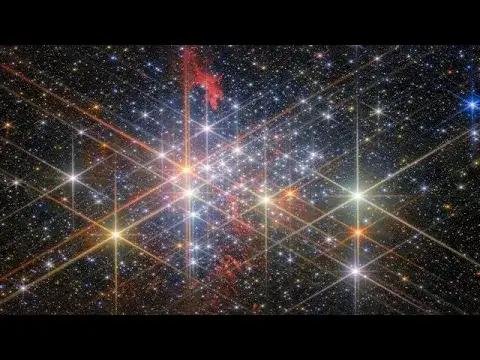
Infrared Insights from Webb: Piercing the Cosmic Shroud
The striking image of Westerlund 1 captured by the James Webb Space Telescope demonstrates the power of its technology. Unlike visible-light observatories such as Hubble that face difficulties observing through dense interstellar dust and gas, JWST’s Near Infrared Camera (NIRCam) can penetrate these obscuring clouds, revealing the cluster’s magnificent details.
This capability stems from NIRCam’s sensitivity to infrared light — wavelengths beyond visible red — enabling astronomers to study celestial structures previously concealed by cosmic dust. Such infrared observations unlock new realms in astrophysical discovery.
The Webb image reveals complex features within Westerlund 1, including:
- Swirling red gas enveloping the star group
- Bright stars highlighted by distinct diffraction spikes
- Horizontal lines resulting from light bouncing between telescope mirrors
Peering into Our Galaxy's Evolutionary Story
Westerlund 1 offers scientists a rare glimpse into an earlier era of the Milky Way when star formation was intense. This super star cluster resembles the galaxy’s youthful phase, helping researchers decipher the origins and development of massive stars and clusters.
Though only about 3.5 to 5 million years old, Westerlund 1 faces a dramatic future. In the next 40 million years—a fleeting moment in cosmic history—the cluster is anticipated to generate over 1,500 supernovae. These powerful explosions will reshape the cluster and enrich its environment with energy and heavy elements.
This upcoming stellar activity underscores the dynamic behavior of star clusters and their importance in shaping cosmic landscapes. As JWST continues to explore the universe's secrets, Westerlund 1 remains a captivating subject for advancing our cosmic understanding.
Observations from advanced tools like the James Webb Space Telescope continue to unveil spectacular cosmic phenomena such as Westerlund 1. This massive cluster acts as a luminous beacon, expanding our knowledge of how stars and galaxies evolve, and inspiring further astronomical exploration.
- Categories:
- Astronomy




0 comments
Sign in to Comment