

NASA’s James Webb Space Telescope continues to transform our perception of the cosmos by delivering unparalleled clarity on the formation and architecture of remote galaxies. Recent investigations by the Webb team have illuminated how disk galaxies, a group including the Milky Way, develop their distinct structures.
Disk galaxies are known for their flattened shapes, featuring a broad, thick outer disk and a slimmer, more concentrated inner disk. Webb’s capability to observe galaxies at various evolutionary phases, dating back as far as 11 billion years, is bringing fresh understanding of these intricate cosmic formations.
Decoding How Disk Galaxies Take Shape
Modern disk galaxies like the Milky Way possess two separate disk layers: an expansive thick disk filled with stars, and a nested thin disk. The thick disk in the Milky Way extends roughly 3,000 light-years, whereas the thin disk is about 1,000 light-years thick. Scientists have long sought to explain the emergence of these dual disks. Leveraging Webb’s detailed data, researchers are reconstructing the timeline and working mechanisms behind their formation.

Examining 111 edge-on disk galaxies—observed as they appeared around 2.8 billion years following the Big Bang—the team has been able to differentiate thick and thin disk components at previously unreachable distances. Takafumi Tsukui, the study’s principal author, highlights Webb’s advanced resolution, which allows separation and precise measurement of these disk layers in galaxies once thought to be uniform.
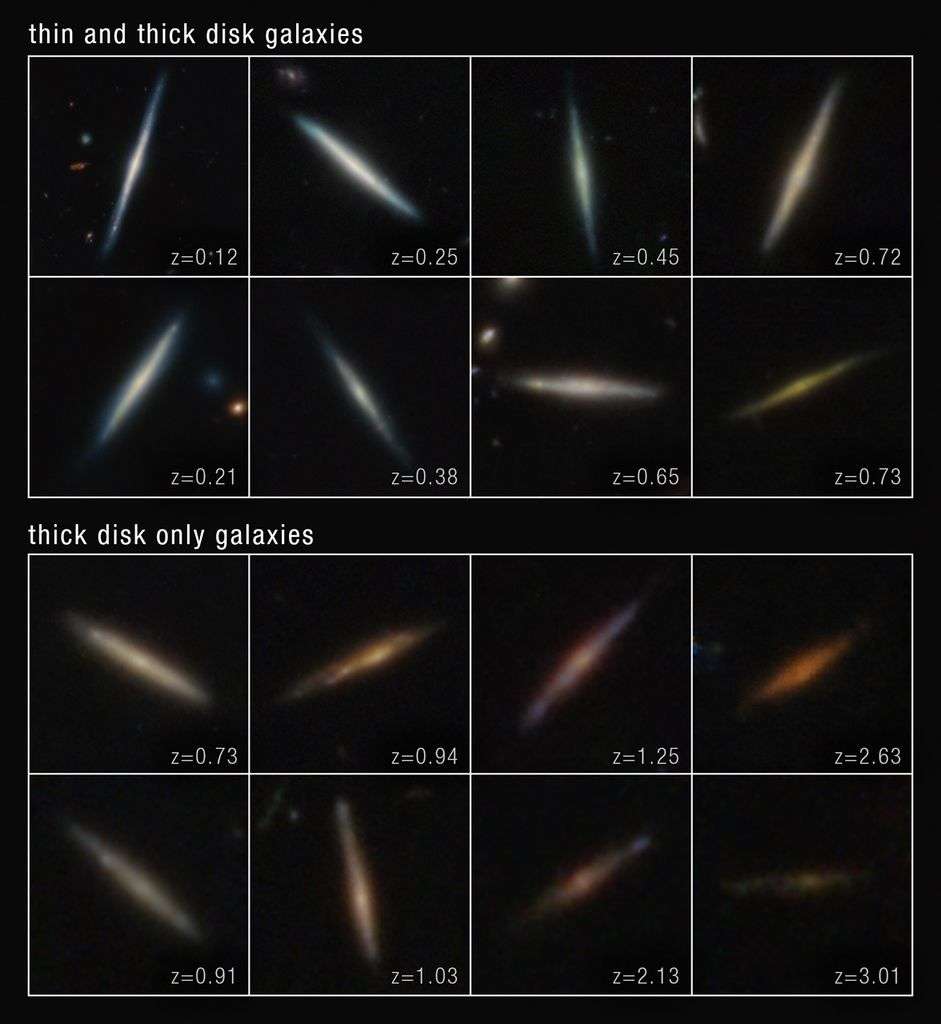
Gas Dynamics Drive the Disk Formation Process
A key revelation from this study is that disk galaxies initially develop a thick disk, with the thinner disk emerging subsequently. The timing for this two-disk formation varies with the galaxy’s mass: massive galaxies established their thin disks about 8 billion years ago, while lower-mass galaxies began this transition closer to 4 billion years ago.
The researchers linked this discrepancy to the motion of gas within these galaxies. By integrating data from the Atacama Large Millimeter/submillimeter Array (ALMA) and ground observatories, they corroborated the "turbulent gas disk" model. This concept proposes that early universe galaxies were filled with chaotic gas flows sparking intense star formation, which produced a thick stellar disk. Over time, star formation helped stabilize the gas, allowing the disks to settle and thin out.
Webb’s imaging reveals that the evolution from a singular thick disk to a dual-disk system is a gradual phenomenon. The thick disk grows continuously but at a slower rate than the thin disk as galaxies mature.
Webb’s Exceptional Observation Power
The James Webb Space Telescope is revolutionizing the study of remote galaxies thanks to its extraordinary sensitivity. This enables astronomers to probe smaller, fainter galaxies akin to the Milky Way during earlier cosmic times. Such capabilities were essential to detecting disk formation stages in galaxies up to 11 billion light-years away.
For the first time, scientists could clearly distinguish thin stellar disks at such great distances (high redshifts). The finding that thin disks were already present as far back as 8 billion years ago stands out as particularly unexpected. “To see thin stellar disks already in place 8 billion years ago, or even earlier, was surprising,” remarked Emily Wisnioski, a co-author of the publication.
- Categories:
- News








0 comments
Sign in to Comment