

Scientists have gathered compelling new evidence indicating that the rocky exoplanet TOI-561 b, which orbits exceptionally close to its star, possesses an atmosphere. Leveraging the powerful capabilities of the James Webb Space Telescope (JWST), astronomers successfully gauged the planet’s temperature. Reported in The Astrophysical Journal Letters, this breakthrough implies that such worlds may sustain atmospheres much longer than previously anticipated.
Previously, it was widely believed that planets of this type would lose their atmospheres rapidly due to intense stellar radiation stripping away gases. However, recent JWST findings challenge this assumption and suggest a need to revisit current models of atmospheric behavior under extreme conditions.
An Unexpected Discovery: Lower Density and Cooler Surface
Situated roughly 280 light-years from Earth, TOI-561 b belongs to a category known as ultra-short-period super-Earths, characterized by their close-in orbits and extremely high surface temperatures. This planet exhibits a surprisingly low density for a rocky body, raising intriguing questions about its internal composition.
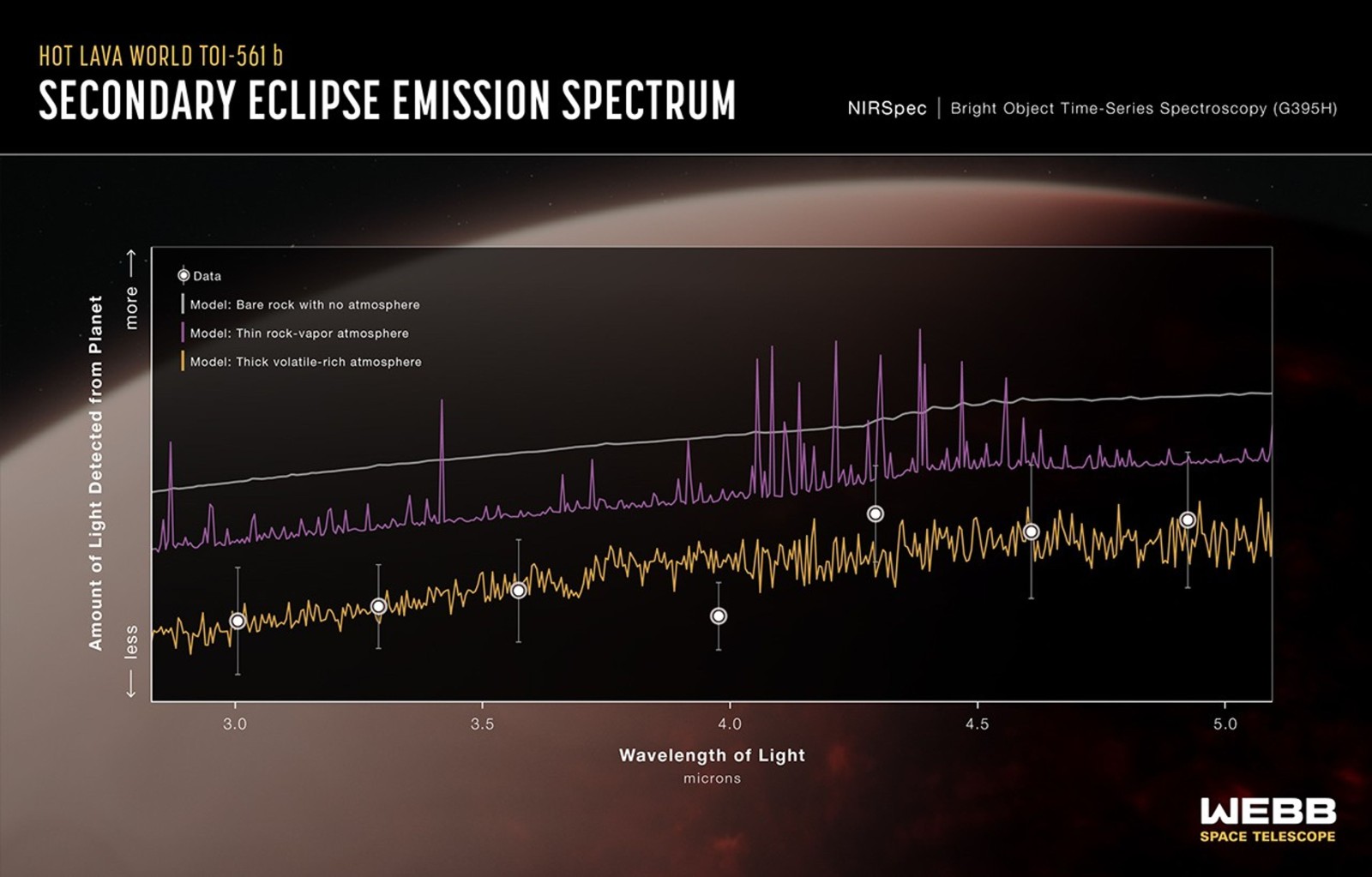
Typically, a planet this close to its star would boast surface temperatures near 4,900 °F (2,700 °C), enough to liquefy rock if no atmosphere is present. However, JWST observations reveal a significantly more moderate dayside temperature of about 3,100 °F (1,700 °C), pointing to the presence of atmospheric heat regulation.

NASA comments that this temperature disparity strongly suggests TOI-561 b has a substantial atmosphere moderating its heat, differentiating it from an airless, molten surface. Johanna Teske, lead author and researcher at Carnegie Earth and Planets Laboratory, described TOI-561 b as:
“TOI-561 b is distinct among ultra-short period planets in that it orbits a very old (twice as old as the Sun), iron-poor star in a region of the Milky Way known as the thick disk. It must have formed in a very different chemical environment from the planets in our own solar system.”
Atmospheric Mechanisms That Cool TOI-561 b’s Surface
According to Anjali Piette of the University of Birmingham, co-author of the study published on December 11, 2025, in The Astrophysical Journal Letters,
“We really need a thick volatile-rich atmosphere to explain all the observations”. She added, “Strong winds would cool the dayside by transporting heat over to the nightside,” resulting in more evenly distributed temperatures.
The team hypothesizes that the atmosphere and the molten surface might engage in a cycle where gases evaporate and then recondense, constantly replenishing the atmosphere. This recycling process could explain how TOI-561 b manages to retain its atmosphere despite intense stellar radiation.
Interactions between the exoplanet’s surface and atmosphere seem critical in maintaining this delicate balance. The researchers also mention that ongoing volcanic or tectonic phenomena could contribute to atmospheric regeneration, although further observations are needed to clarify these mechanisms. Future studies of TOI-561 b and related worlds are expected to deepen understanding of how atmospheres endure close to their host stars.
“What’s really exciting is that this new data set is opening up even more questions than it’s answering,” noted Teske.

- Categories:
- Space













0 comments
Sign in to Comment