

Researchers have identified an extraordinary exoplanetary system displaying an uncommon configuration among its planets. Presented in a new paper on the arXiv pre-print archive, this discovery challenges existing frameworks of how planets develop. Detected via NASA’s TESS mission, the findings enrich our comprehension of the varying masses and dimensions planets can have within a single stellar system. TOI-1422, a star hosting a distinctive pair of planets, offers novel insights into planetary evolution.
Unveiling TOI-1422’s Extraordinary Planetary Duo
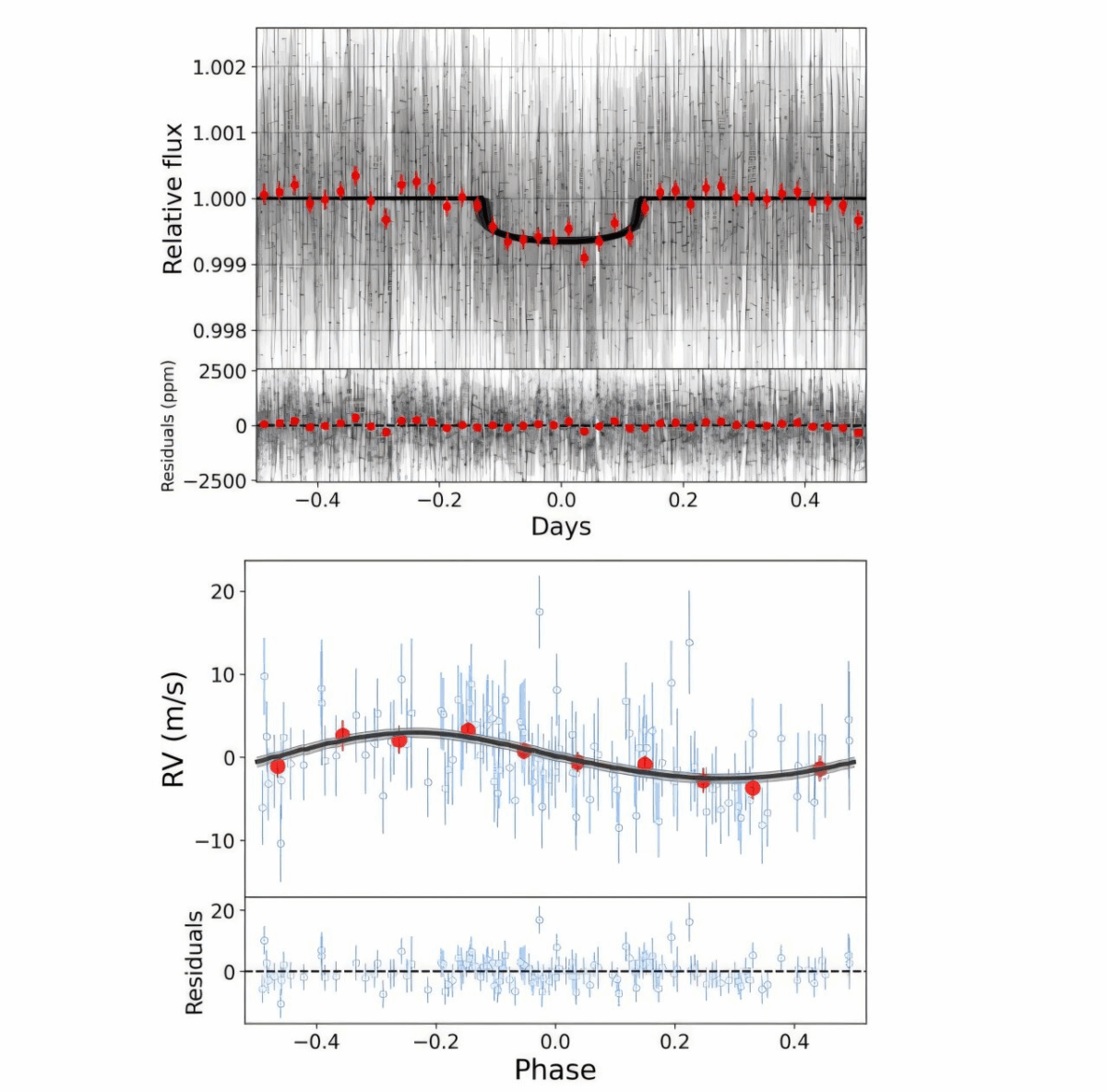
TOI-1422, situated relatively near Earth, contains two puzzling planets, known as TOI-1422 b and TOI-1422 c. Their significance lies in an unusual inversion of mass and size that is seldom documented. The study released on arXiv describes how new data sectors from TESS, paired with an enhanced radial velocity dataset and refined analysis, have confirmed the presence of TOI-1422 c, shedding light on the coexistence of differently sized planets in tight orbits.
Typically, planetary systems follow a pattern where planets farther from their star tend to be smaller and less massive than those orbiting closer. The TOI-1422 system, however, defies this trend. Its outer planet, TOI-1422 c, is both more massive yet smaller in radius than the inner planet, TOI-1422 b. This rare inverse relationship challenges prevailing assumptions in exoplanet research.

Examining the Contrasting Characteristics of TOI-1422 b and c
Although orbiting close together, TOI-1422 b and TOI-1422 c display stark disparities. The inner planet, TOI-1422 b, is a low-mass planet with a comparatively large radius, while TOI-1422 c, further out, possesses greater mass but a smaller radius. This unexpected combination raises questions about planetary formation models, where size and mass traditionally correlate with orbital distance. Insights into planet formation must now account for such anomalies.
“In contrast to the widely observed trend in multiplanet systems, where planet mass and radius tend to decrease with orbital period (or at least density remains constant or decreases), this system exhibits the opposite pattern: the outer planet, TOI-1422 c, is more massive yet smaller than the inner planet, TOI-1422 b. Such anti-ordered or ‘mass/density-inverted’ architectures are rarely observed,” the researchers explain in the paper.
This remarkable configuration indicates planetary formation processes may be more complex than previously recognized. The peculiar traits of TOI-1422 b and c raise new puzzles about how such planets originate, migrate, and evolve within multi-planet systems. Scientists are eager to investigate whether this kind of “mass/density inversion” is more widespread than once thought.
What Sets TOI-1422’s Planets Apart?
The TOI-1422 system stands out not just because of its unusual reversal of planet mass and size, but also as a valuable case for studying planetary system dynamics. Commonly, planets closer to their star gain mass more rapidly, creating a pattern of larger inner planets. Yet TOI-1422 c’s combination of higher mass and smaller size complicates that understanding.
The authors propose that this rare arrangement may be explained by “planetary migration,” where gravitational influences cause planets to shift positions over time. It’s possible that TOI-1422 c formed nearer to the star before moving outward, though verifying this scenario will require more observations. Meanwhile, TOI-1422 b’s attributes could arise from distinct formation conditions, providing a unique window into planetary diversity.
The Impact of Discovering TOI-1422 c
TOI-1422 c’s detection marks a key advancement in planetary system science. Beyond studies focused on habitability, this find helps illuminate the complex mechanisms behind planet growth and arrangement. Confirming TOI-1422 c’s presence may trigger fresh research avenues, enhancing our grasp of the variety intrinsic to exoplanet systems.
By analyzing TOI-1422 further, astronomers aim to update models of planetary development and movement. Should mass and size inversions like this prove more prevalent, they could reshape approaches to identifying planets that might support life. The coexistence of close yet contrasting planets points to intricate system architectures worthy of deeper investigation.
- Categories:
- Space










0 comments
Sign in to Comment